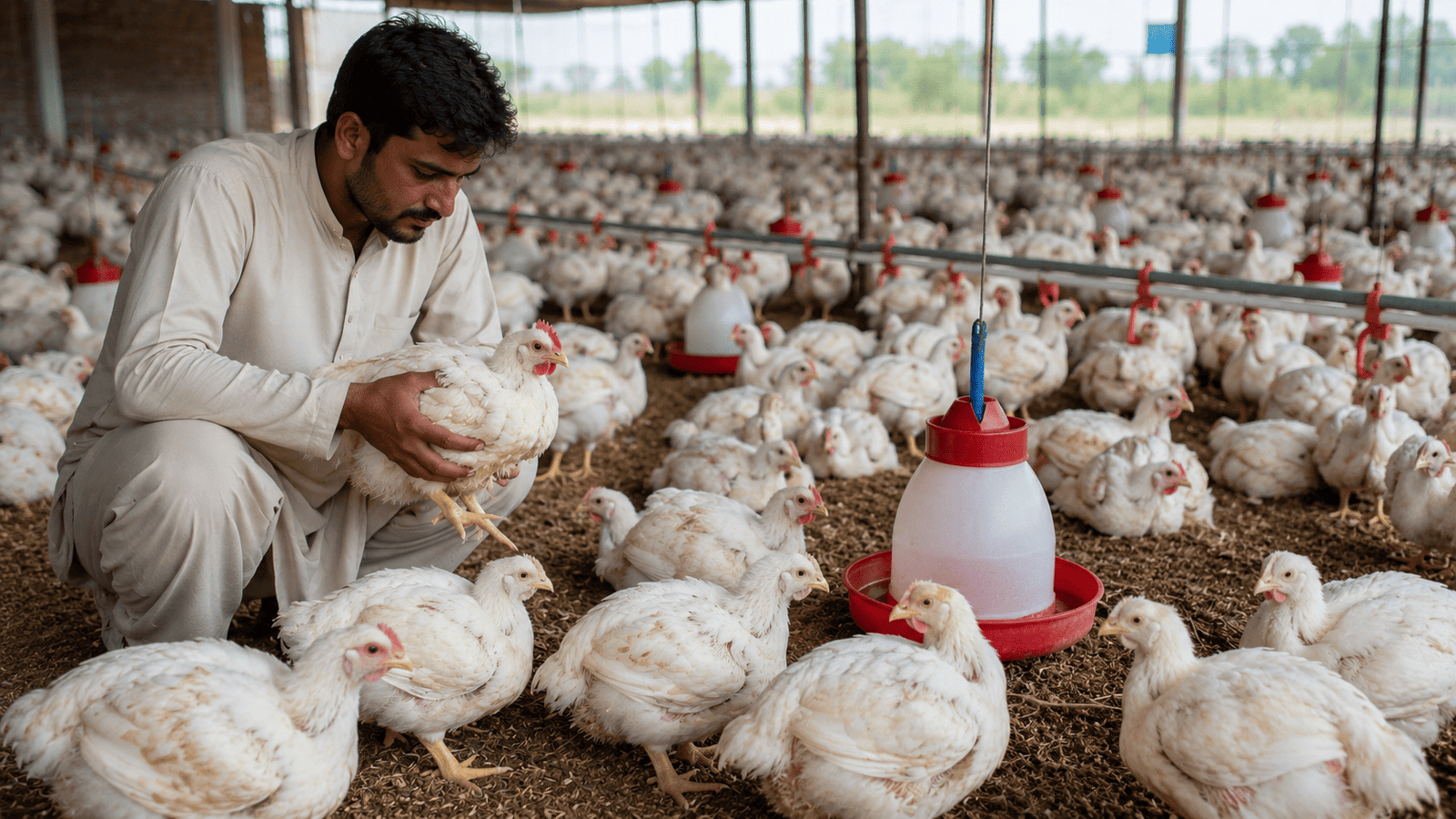
Broiler Chicken Farming Guide for Beginners: A Complete 2026 Guide
By Farmers Advisory Editorial Team ·
Published July 10, 2026 · Updated July 10, 2026 · 11 min read ·
Category: Poultry Farming
The first two weeks of brooding determine a broiler flock's lifetime performance.
Broiler farming rewards precision more than almost any other type of livestock farming — because
the entire production cycle lasts just 6-8 weeks, small mistakes in the first two weeks compound
quickly and leave little time to recover. This guide walks through the practical fundamentals of
broiler chicken farming in 2026: brooding temperature, stocking density, feeding, and
the mortality benchmarks that tell you whether your management is on track.
Key Takeaways
Brood chicks at 90-95°F (32-35°C) at chick level, reducing by roughly 5°F (2-3°C) per week until reaching ambient temperature around day 21.
Optimal commercial stocking density is 30-35 kg of live weight per square meter, equal to roughly 13-14 birds per m² for 2.5 kg market-weight birds.
Well-managed commercial flocks achieve cumulative mortality below 5% over a full cycle; investigate any daily spike above 0.5%.
At optimal stocking density, farms typically achieve a Feed Conversion Ratio of 1.65-1.75.
Environmentally controlled operations typically complete 5-7 production cycles per year.
Key Broiler Performance Benchmarks (2026)
Broiler Production Benchmarks (2025-2026 Industry Data)
Metric
Target/Benchmark
Brooding temperature (chick level)
90-95°F (32-35°C), reducing ~5°F/week
Initial brooding stocking density
30-50 chicks/m²
Final stocking density (2.5 kg market weight)
30-35 kg/m² (~13-14 birds/m²)
Cumulative mortality target
Below 5% over full cycle
Feed Conversion Ratio at optimal density
1.65-1.75
Litter depth
2-3 inches (5cm minimum)
Cycles per year (environmentally controlled)
5-7 cycles
💡 Quick Tip
Check brooding temperature at chick height, not sensor height, and do it twice daily during the first two weeks. Chicks that huddle together are signaling they're too cold; chicks spread far from the heat source are signaling they're too hot.
1. Starting with Quality Chicks
Flock performance starts at the hatchery, not the farm. Inspect day-old chicks for bright, clear
eyes, clean navels, firm legs, and uniform size before accepting any shipment.
Reject shipments with more than 2-3% visible culls or dehydration signs (sunken eyes, dry shanks)
Check crop fill at 8 and 24 hours after placement — at least 80% of chicks should have palpably full crops within 8 hours, confirming they're finding feed and water quickly
2. Brooding Temperature Management
The first two weeks of a broiler's life determine its lifetime performance more than any other
stage. Preheat the brooding area before chick placement to ensure litter is properly dried, reducing
bacterial growth and ammonia buildup.
Start at 90-95°F (32-35°C) at chick level — measure at chick height, not sensor height
Reduce temperature gradually by approximately 5°F (2-3°C) per week
Reach ambient temperature of roughly 70-75°F (21-24°C) by around day 21
Provide 23 hours of light for the first 48 hours so chicks locate feed and water quickly
⚠️ Common Mistake
Measuring brooding temperature at sensor or thermostat height instead of chick height. Temperature can vary significantly between these two points, and a reading that looks correct on the controller can still leave chicks too cold at floor level.
3. Stocking Density
Stocking density is one of the highest-leverage decisions in broiler farming, directly affecting
feed conversion, mortality, growth uniformity, and ventilation efficiency.
Initial brooding density: 30-50 chicks per square meter, expanding as birds grow
Final density: 30-35 kg live weight per m² is widely considered optimal, equating to roughly 13-14 birds/m² for 2.5 kg market weight birds
In hot climates, reduce to 30-32 kg/m² and pair with strong tunnel ventilation
Overcrowding reduces growth rates, increases leg problems, and raises the risk of aggressive behavior including cannibalism
4. Litter and Ventilation
Use absorbent litter material like wood shavings or straw, spread evenly to a depth of 2-3 inches (minimum 5cm)
Monitor and change litter regularly to prevent ammonia buildup and control odor
Ensure ventilation removes moisture and stale air without chilling young birds — growing too cool forces the flock to burn feed on body temperature maintenance instead of converting it to weight gain
Match ventilation capacity to your chosen stocking density; a density that looks fine on paper can fail if the house is poorly insulated or unevenly ventilated
5. Feeding Schedule
Broiler starter feed is typically higher in protein (18-22%) than layer feed, formulated specifically
to fuel rapid early growth. Feed and water access must be within arm's reach of every chick from day one,
since delayed feed access in the first 24-48 hours has lasting effects on overall flock performance.
6. Monitoring Mortality and Health
Track daily mortality and investigate any spike above 0.5% per day immediately
Well-managed flocks should stay below 5% cumulative mortality over a full production cycle
Mortality consistently above this threshold typically signals chick quality issues, brooding management problems, disease, or environmental conditions needing investigation
7. Common Commercial Breeds
Globally, Cobb, Ross, Arbor Acres, and Hubbard are the predominant commercial broiler breeds, each
bred for specific growth rate and feed efficiency characteristics. Regional breeds also exist in some
markets, bred for local climate adaptation alongside commercial performance traits.
Stocking Density Quick Reference
Stocking Density by Production Stage
Stage
Density
Initial brooding
30-50 chicks/m²
Final (2.5 kg market weight, standard climate)
30-35 kg/m² (~13-14 birds/m²)
Final (hot climate, tunnel ventilation)
30-32 kg/m²
Maximum under optimal conditions
Up to 34 kg/m²
Pros and Cons of High vs Low Stocking Density
✅ Lower Stocking Density
Better growth uniformity and lower leg problem risk
Easier ventilation and temperature management
Lower mortality risk in marginal housing conditions
❌ Higher Stocking Density
More birds per cycle, higher potential revenue per house
Requires stronger ventilation capacity to manage safely
Higher risk of aggressive behavior and disease spread if ventilation falls short
Frequently Asked Questions
What is the ideal brooding temperature for broiler chicks?
Brood chicks at 90-95°F (32-35°C) at chick level, gradually reducing by about 5°F (2-3°C) per
week until reaching ambient temperature of roughly 70-75°F (21-24°C) by around day 21.
What is the ideal stocking density for broiler chickens?
Most commercial floor systems target 30-35 kg of live weight per square meter, equal to roughly
13-14 birds per m² for chickens raised to a 2.5 kg market weight.
What mortality rate is normal in broiler farming?
Well-managed commercial flocks typically achieve cumulative mortality below 5% over a full
production cycle. Any daily spike above 0.5% should be investigated immediately.
How many broiler production cycles can I run per year?
Environmentally controlled commercial operations typically complete 5-7 production cycles
annually, depending on grow-out length and downtime between flocks for cleaning.
Which broiler breed is best for commercial farming?
Cobb, Ross, Arbor Acres, and Hubbard are the most widely used commercial broiler breeds globally,
each selected for specific growth rate and feed efficiency traits.
Conclusion
Successful broiler farming comes down to precision in a short window of time: getting brooding
temperature, stocking density, and early feed access right in the first two weeks sets the trajectory
for the entire 6-8 week cycle. Track your mortality rate and feed conversion ratio consistently against
industry benchmarks, and treat any deviation as an early signal to investigate rather than something to
address after the cycle ends.
Want more poultry farming tips delivered to your inbox every week?
Data sources: Folio3 AgTech commercial broiler farming best practices (April 2026); Weifang Splendid
Machinery 2026 broiler stocking density guide (May 2026); EW Nutrition broiler house preparation
guide; Forms on Fire broiler production guidelines (July 2025); and Jahan Kaveh complete broiler
farming guide. Figures represent commercial industry benchmarks and vary by climate, housing type,
and breed. Current as of July 10, 2026.
 Farmers Advisory