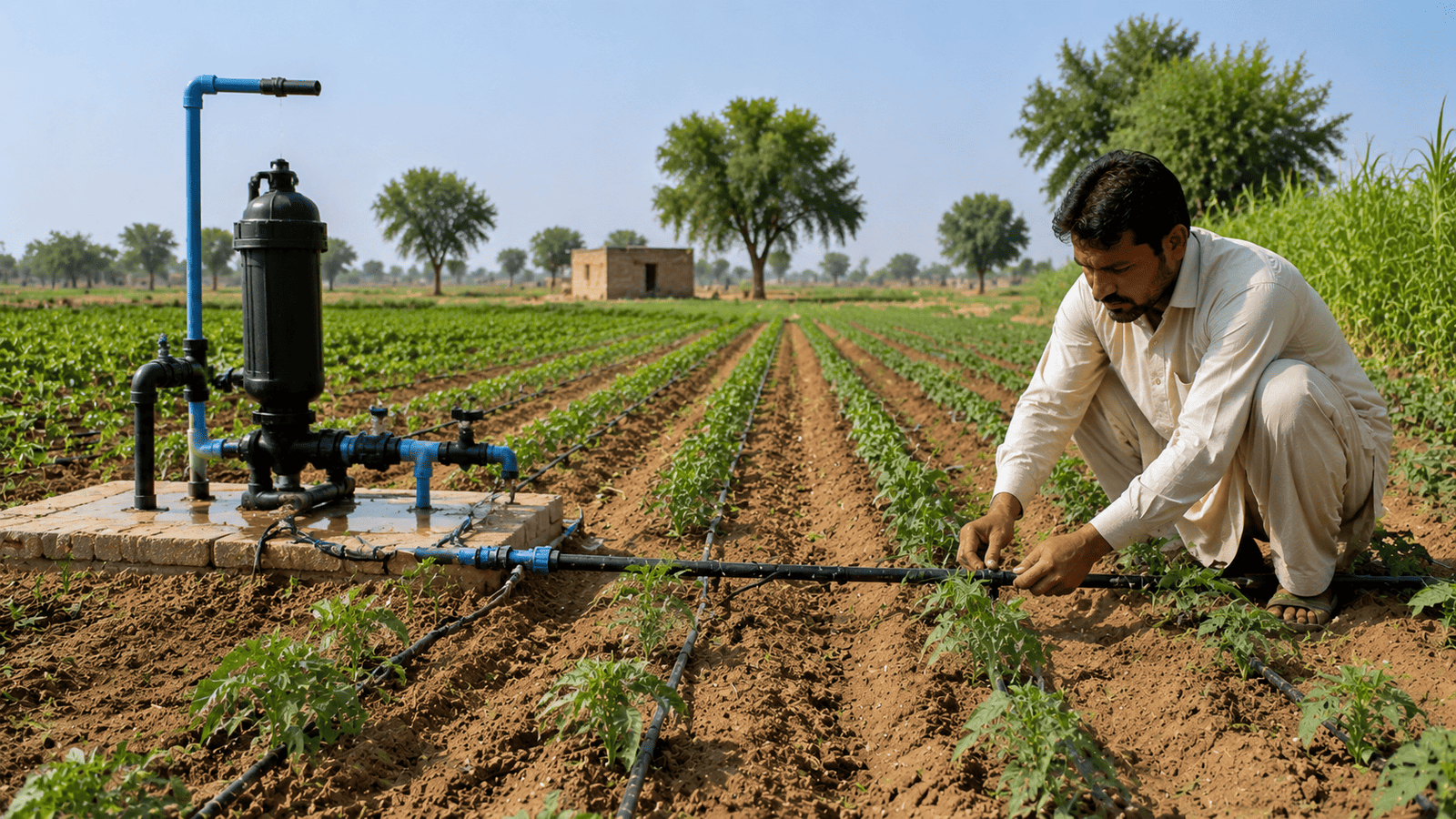
Working out irrigation water requirement comes down to answering one question: how much water does the crop need that rainfall and stored soil moisture won't supply on their own? The standard approach starts with reference evapotranspiration, adjusts it for the specific crop and growth stage using a crop coefficient, subtracts the rainfall the crop can actually use, and then accounts for how efficiently your irrigation system delivers water to the field. This guide walks through each step with a worked example using clearly stated assumptions.
Crop evapotranspiration, the water a crop uses under standard growing conditions, is calculated as:
Where ET₀ is reference evapotranspiration (a measure of atmospheric water demand for a standardized grass surface) and Kc is a crop coefficient that adjusts ET₀ for a specific crop at a specific growth stage. From there, net irrigation requirement subtracts effective rainfall from ETc, and gross irrigation requirement adjusts that figure for irrigation system efficiency. Each of these terms is explained in detail below.
Crop water requirement is the total amount of water a crop needs over its growing season to grow normally and produce a full yield, accounting for water lost through transpiration (via the plant) and evaporation (from the soil surface) — together called evapotranspiration. It is usually expressed as a depth of water, in millimeters or inches, over a given period such as a day, week, or full growing season.
Reference evapotranspiration (ET₀) estimates the evapotranspiration rate from a standardized, well-watered grass reference surface, based on climate data such as temperature, humidity, wind speed, and solar radiation. Agricultural agencies and weather networks in many regions publish daily or weekly ET₀ values calculated using the FAO Penman-Monteith equation, which is the internationally recognized standard method. ET₀ varies constantly with weather — it rises in hot, dry, windy, sunny conditions and falls in cool, humid, calm, overcast conditions.
The crop coefficient (Kc) adjusts reference ET to reflect how a specific crop uses water compared to the grass reference surface, and it changes across the growing season as the crop develops:
Published Kc values differ by crop and by region-specific research, so growers should use values from a recognized source such as FAO Irrigation and Drainage Paper 56 or a regional agricultural extension service rather than assuming one figure applies everywhere.
Effective rainfall is the portion of total rainfall that actually becomes available to the crop's root zone, as opposed to rainfall lost to runoff, deep percolation below the root zone, or evaporation before it infiltrates. A short, intense downpour on dry, crusted soil may produce far less effective rainfall than the same total amount falling as a gentle, extended shower. Several standard methods exist for estimating effective rainfall from total rainfall records, and the appropriate method depends on soil type, rainfall intensity, and local climate — there is no single fixed percentage that applies everywhere.
These two terms are often confused, but the distinction matters for sizing an irrigation system correctly.
Net irrigation requirement is the amount of water the crop actually needs from irrigation after accounting for what rainfall supplies. It assumes perfect delivery, with no water lost in transit or during application.
Gross irrigation requirement is the amount of water that actually needs to be pumped or diverted at the source to deliver the net requirement to the crop, accounting for losses in conveyance and application. Because no irrigation system is 100% efficient, gross requirement is always higher than net requirement. Efficiency varies by system — well-managed drip systems tend toward the higher end of the efficiency range, while surface irrigation methods tend toward the lower end.
Soil acts as a reservoir between irrigation events, and how much water it can hold — and how deep the crop's roots can reach into that reservoir — determines how much buffer exists before the next irrigation is needed. Coarse, sandy soils hold less available water per unit depth and drain faster, so they generally need more frequent, lighter irrigation. Finer-textured soils like loams and clays hold more available water and can typically go longer between irrigations, though they also drain and re-wet more slowly. Root depth changes through the season too — a young seedling with a shallow root system can only draw on moisture near the surface, while a mature crop with a deep root system can draw on water stored much lower in the soil profile.
Once net irrigation requirement per day (or per week) and the soil's available water within the root zone are known, irrigation frequency can be estimated by dividing available water by the crop's daily water use — giving a rough number of days between irrigations before the allowable depletion threshold is reached. Many irrigation managers use a management allowable depletion (MAD) threshold, commonly a percentage of total available soil water, as the trigger point for the next irrigation rather than waiting until the soil is fully dry. Actual frequency in practice should be adjusted using direct soil moisture monitoring rather than calculation alone, since real field conditions vary from any standardized model.
The figures below are illustrative assumptions for demonstrating the calculation steps, not universal values for any specific crop or location:
| Step | Assumption / Value | Result |
|---|---|---|
| Reference ET (ET₀) | 5 mm/day (assumed local weather-station value) | — |
| Crop coefficient (Kc) | 0.9 (assumed mid-season value for the crop) | — |
| Crop evapotranspiration (ETc) | ET₀ × Kc = 5 × 0.9 | 4.5 mm/day |
| Effective rainfall | 1.0 mm/day (assumed for the period) | — |
| Net irrigation requirement | ETc − Effective rainfall = 4.5 − 1.0 | 3.5 mm/day |
| Irrigation efficiency | 85% (assumed for a well-managed drip system) | — |
| Gross irrigation requirement | Net requirement ÷ Efficiency = 3.5 ÷ 0.85 | ≈4.1 mm/day |
In this illustrative scenario, the field would need roughly 4.1 mm of water applied per day at the source to meet the crop's actual water use, once irrigation system losses are accounted for. Real ET₀, Kc, rainfall, and efficiency values must come from local weather data, crop-specific coefficients, and actual system performance — not from this example.
Crop evapotranspiration (ETc) is calculated as ET₀ × Kc, where ET₀ is reference evapotranspiration based on local climate data and Kc is a crop-specific coefficient that changes through the growing season.
Net irrigation requirement is crop evapotranspiration minus effective rainfall, assuming perfect water delivery. Gross irrigation requirement divides that figure by irrigation system efficiency to account for conveyance and application losses.
No. It changes as the crop coefficient shifts through growth stages and as weather conditions, rainfall, and root depth change, so requirements should be recalculated periodically rather than treated as fixed.
Recognized sources include FAO Irrigation and Drainage Paper 56 and regional agricultural extension services, which publish Kc values by crop and growth stage; values can vary by region and variety.
No. Only effective rainfall — the portion that infiltrates and becomes available to the root zone — counts. Rainfall lost to runoff, deep percolation, or evaporation before infiltration does not reduce irrigation requirement.
Dividing the soil's available water in the root zone by the crop's daily net water use gives a rough interval between irrigations, but this should be checked against direct soil moisture monitoring rather than calculation alone.
Calculating irrigation water requirement is a matter of layering a few well-defined steps: start from reference evapotranspiration, adjust for the crop and its current growth stage, subtract what rainfall genuinely contributes, and then correct for how efficiently your specific irrigation system delivers water. None of these inputs are fixed — they shift with climate, season, soil, and equipment — so the goal is a working framework you can recalculate with current, local data rather than a single number to memorize.
Want more irrigated farming guidance delivered to your inbox every week?
Subscribe to Farmers AdvisoryData sources: FAO Irrigation and Drainage Paper 56, Crop Evapotranspiration (Guidelines for Computing Crop Water Requirements); USDA Natural Resources Conservation Service irrigation guides; university extension crop water use and irrigation scheduling publications. Figures represent methodology and illustrative values; actual ET₀, Kc, rainfall, and efficiency must be sourced locally. Current as of August 12, 2026.