 Farmers Advisory
Farmers Advisory
Farmers Advisory
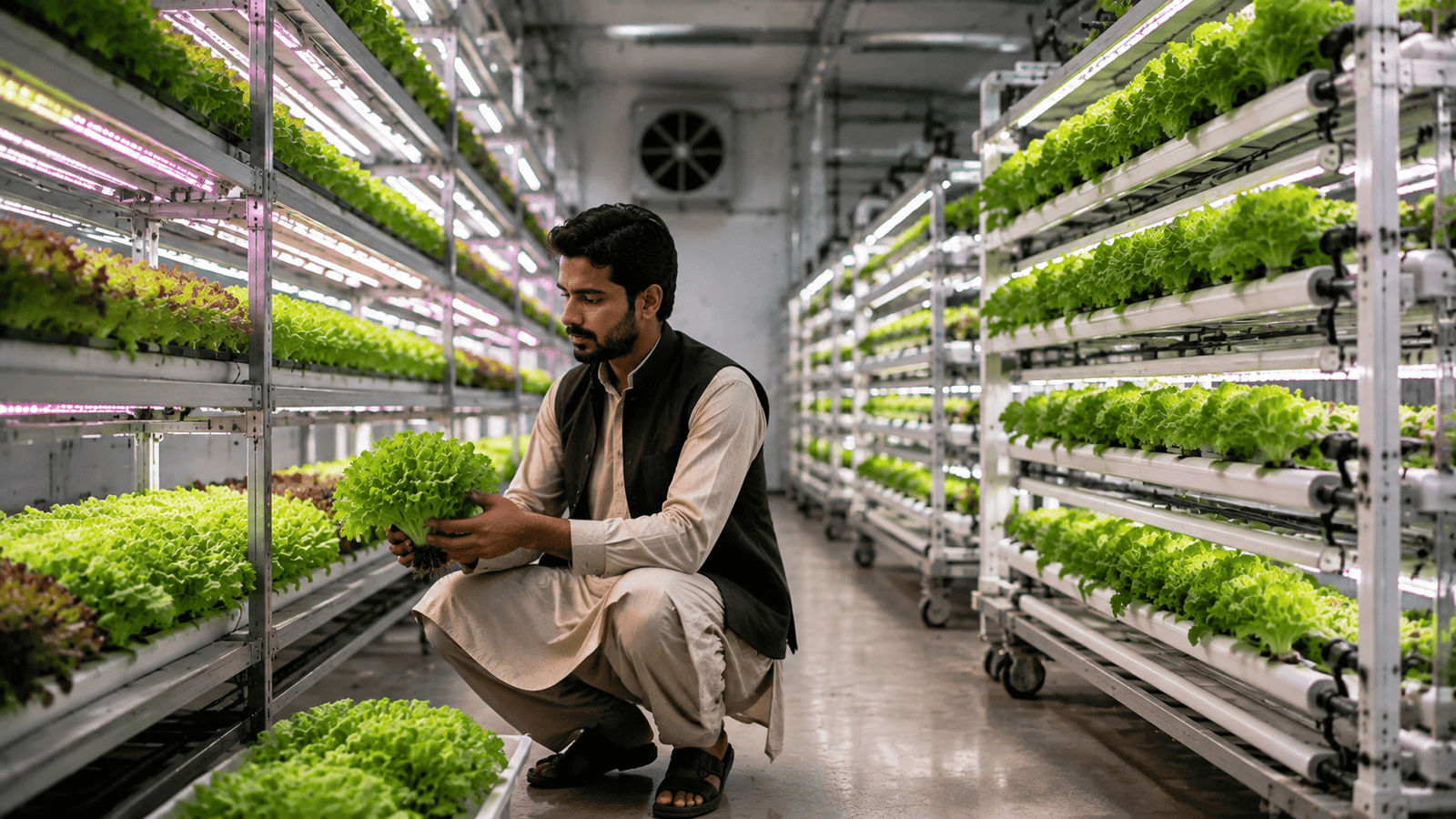
There's no single profit margin that applies to vertical farming as an industry — it depends on crop choice, local electricity rates, facility efficiency, labor cost, and how consistently a facility sells what it grows. Some operations run profitably; others, including some well-funded and well-publicized ones, have struggled or shut down. The honest answer to "how profitable is vertical farming" is that profitability is possible but not guaranteed, and it needs to be evaluated with real numbers for a specific facility rather than assumed from the industry's reputation either way.
Revenue in a vertical farming business comes from three variables multiplied together: how much you can sell your crop for, how much you can produce in a given period, and how consistently you actually sell what you grow. Selling price depends on the crop and sales channel — wholesale, food service, or direct-to-consumer — and on local market conditions that shift over time.
Production capacity depends on rack count, crop cycle length, and per-cycle yield, all of which vary by crop and system design. See our crop comparison guide for how growth cycle and market demand differ across common vertical farming crops — both feed directly into the revenue side of this calculation.
Costs that reduce gross revenue down to gross margin include electricity for lighting and HVAC, labor for seeding, monitoring, and harvest, nutrients and water treatment, packaging, and transportation. Electricity is typically one of the largest single line items, and its impact on margin depends heavily on local commercial electricity rates and how efficiently the facility's lighting and insulation are designed.
Crop losses — plants lost to disease, pests, equipment failure, or simple growing error — are an underappreciated cost. Even a well-run facility rarely achieves 100% usable yield from every cycle, and that loss rate directly reduces the revenue side of the equation without reducing the cost side at all.
Gross margin is revenue minus the direct costs of growing and harvesting a crop — electricity, labor, nutrients, packaging. Net profit goes further, subtracting fixed costs like rent or mortgage payments, equipment depreciation, insurance, administrative overhead, and any debt service on the original startup investment.
A facility can show a reasonable gross margin on paper while still operating at a net loss, if fixed costs and debt payments are large relative to production volume. This is a common trap for facilities that scaled their capital investment faster than their confirmed sales volume.
Break-even is the production and sales volume at which total revenue equals total costs — startup investment plus accumulated operating costs. It depends on your specific cost structure and selling price, and there's no fixed timeline that applies across facilities; some reach break-even in their first year of full operation, others take considerably longer, and some never reach it if the underlying cost structure doesn't support the crop and market they chose.
Return on investment (ROI) measures net profit against total capital invested over a given period. It's a useful metric for comparing a vertical farming investment against alternative uses of the same capital, but it only means something once the facility's actual production and cost figures are known — it can't be estimated reliably from generic industry figures.
Rather than relying on a published margin figure, build the calculation from your own numbers:
Running this calculation with genuinely conservative assumptions, rather than best-case numbers, gives a far more useful picture than any generic industry percentage could.
Larger facilities can sometimes improve margins by spreading fixed costs like management, software licensing, and some equipment across more production volume. But scaling also increases exposure to the risks above — a bigger facility has more revenue riding on the same electricity grid, the same buyer relationships, and the same equipment reliability. Scaling should generally follow proven unit economics at a smaller scale, not precede it.
It can be, but it isn't guaranteed. Profitability depends on crop choice, electricity costs, labor efficiency, and consistent sales, and varies significantly between individual facilities.
Electricity for lighting and climate control is typically the largest recurring cost category, though its exact share of total costs varies by facility and region.
There's no fixed timeline — it depends on startup investment size, crop cycle speed, and how quickly the facility reaches consistent sales at a sustainable price. Some reach break-even within a year of full operation; others take much longer.
Common factors include scaling facility size faster than confirmed buyer demand, underestimating electricity and labor costs, and carrying debt service that outpaced actual production revenue.
Scale isn't the deciding factor by itself. A small, well-run facility with a confirmed buyer base and efficient operations can be profitable, while a larger facility with weak sales or high fixed costs can lose money.
Vertical farming profitability is a facility-specific question, not an industry-wide fact. It depends on getting crop choice, cost management, and sales volume right at the same time — and it's worth modeling with conservative, honest numbers before committing significant capital, rather than assuming an outcome based on how the industry is discussed in the press.
Want the next article in this series delivered straight to your inbox?
Subscribe to Farmers AdvisoryData sources: USDA Economic Research Service, farm financial performance data; Cornell University Controlled Environment Agriculture program economics publications; U.S. Small Business Administration general financial planning guidance; USDA Agricultural Marketing Resource Center, controlled environment agriculture economics overview. Figures represent general planning categories, not fixed margins, and vary by facility. Current as of August 5, 2026.