 Farmers Advisory
Farmers Advisory
Farmers Advisory
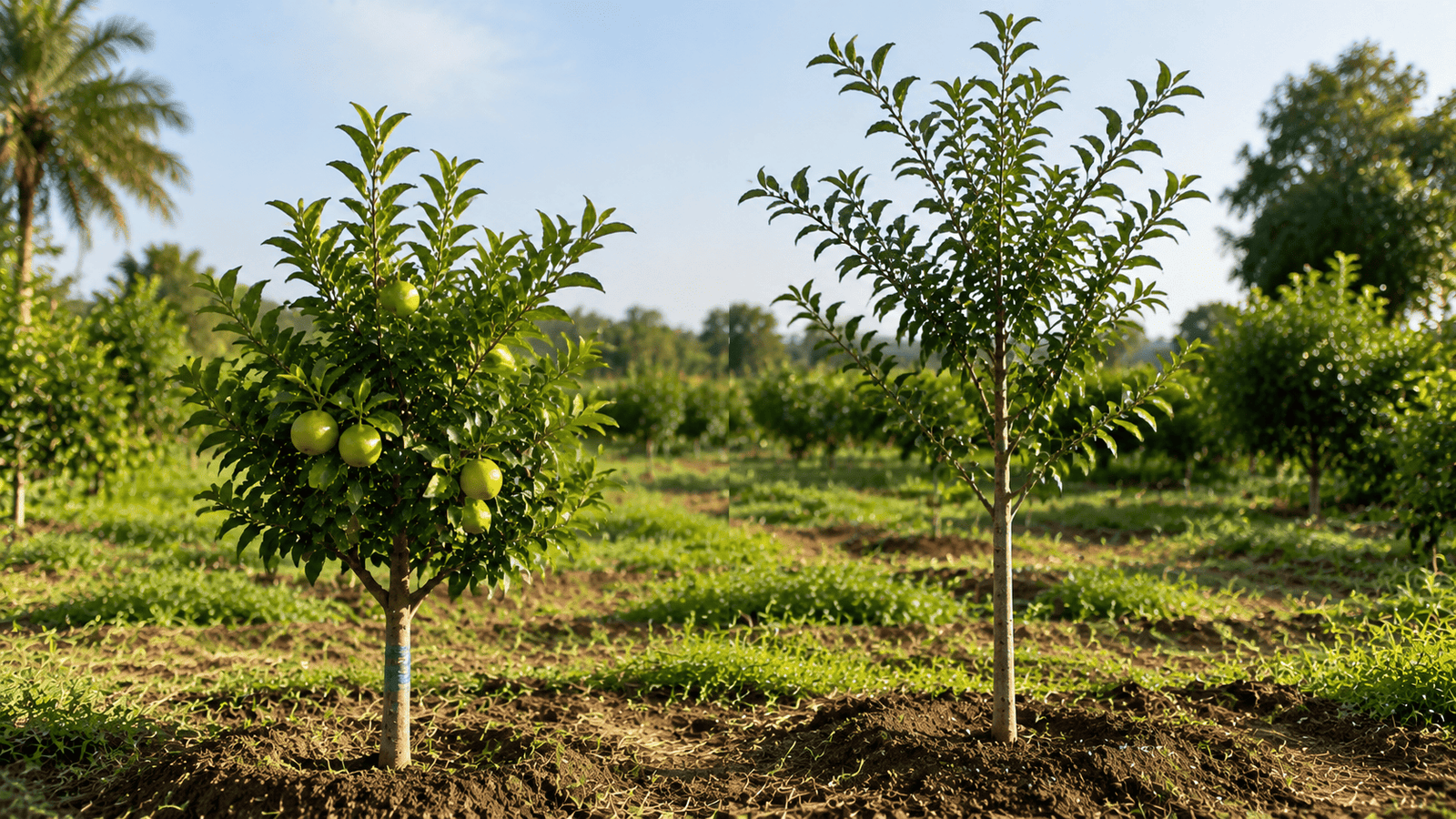
Search for the "best" fertilizer schedule for fruit trees and you'll find plenty of generic calendars promising a fixed formula for every tree. In practice, no single schedule is right for a young peach tree in sandy soil and a mature apple tree in clay, even if they're planted a few miles apart. This guide gives a practical framework for building a fertilizer program for fruit trees — grounded in soil testing and growth-stage timing — rather than a one-size-fits-all calendar to copy without adjustment.
| Step | Purpose |
|---|---|
| Soil test | Establishes baseline pH, texture, and existing nutrient levels before adding anything |
| Match to species and age | Young, non-bearing trees and mature bearing trees have different nutrient priorities |
| Time to growth stage | Pre-flowering, flowering, fruit development, and post-harvest each place different demands on the tree |
| Reassess with leaf tissue testing | Confirms whether the program is actually meeting the tree's needs, not just following a plan |
| Adjust for crop load and season | A heavy fruit set or an unusual season may call for a different response than the standard plan |
Fertilization supports the growth, flowering, and fruit development that soil alone often can't fully provide, especially as trees mature and demand more nutrients each year. But applying fertilizer without knowing what the soil already has is effectively guessing — some soils are naturally rich in a nutrient a generic schedule would still recommend adding, while others are deficient in something a standard program ignores entirely. A soil test before establishing a fertilizer program, repeated every few years, is the single most useful step toward an accurate, tree-appropriate schedule.
Nitrogen supports vegetative growth and is often the nutrient fruit trees need in the largest quantity, but excess nitrogen can suppress flowering and fruiting in favor of leafy growth, so more is not automatically better. Phosphorus supports root development and is particularly important while trees are young and establishing. Potassium plays a significant role in fruit size, quality, and the tree's overall stress tolerance, and demand for it often rises as fruit develops. Calcium and magnesium are needed in smaller quantities but still matter — calcium deficiency is linked to certain fruit quality disorders in some species, and magnesium deficiency commonly shows up as characteristic leaf yellowing patterns. Exact needs and ratios vary enough by species, soil, and region that a soil test, not a generic ratio, should guide actual application amounts.
Micronutrients are needed in far smaller quantities than macronutrients but can still limit yield and fruit quality when deficient. Zinc, iron, manganese, and boron are among the micronutrients most commonly linked to visible deficiency symptoms and reduced fruit set in various fruit tree species, though which micronutrients matter most varies by species, soil type, and region. Because micronutrient deficiencies often show up as specific leaf patterns that can be confused with other problems, testing is a more reliable diagnostic than guessing from appearance alone.
Young, non-bearing trees generally benefit from steady, moderate feeding aimed at building a strong root system and structural framework, rather than large or infrequent applications. Mature bearing trees have different priorities that shift across the season — supporting flowering, sustaining fruit development, and replenishing reserves after harvest — and typically need proportionally more nutrition overall than young trees, though exact amounts should be based on tree size, crop load, and soil or tissue test results rather than a flat increase by age alone.
Rather than a single application date, most fruit trees benefit from nutrition timed to growth stages. Little to no fertilization is typically needed during dormancy, when the tree isn't actively growing. A pre-flowering application supports the energy-intensive process of bloom. Nutrition during flowering and early fruit set supports fruit retention, while continued feeding through fruit development supports fruit size and quality. A post-harvest application, used in some fruit tree systems, helps the tree rebuild reserves before the next dormant period. The specific timing, number of applications, and amounts all depend on species, climate, and local growing season length, which is why a regionally specific schedule from an extension office is more useful than a generic calendar.
Organic fertilizers, such as compost and other organic amendments, release nutrients gradually as they break down and can improve soil structure and biological activity over time, but their nutrient content and release timing are less precise and harder to match exactly to a tree's immediate needs. Synthetic fertilizers offer more precise, faster-acting nutrient delivery but don't provide the same soil-structure benefits as organic matter. Many orchard programs use a combination of both, and neither approach removes the need for soil testing to guide actual application amounts.
Fertilizer is generally most effective when placed where the tree's active feeder roots can access it, which for most trees is around the drip line rather than tight against the trunk. Broadcasting granular fertilizer evenly over this zone, fertigation through an existing irrigation system, and foliar application for certain micronutrient corrections are all used depending on the nutrient, the tree, and the equipment available. Watering in granular fertilizer after application helps move nutrients into the root zone rather than leaving them to sit on the soil surface.
Nutrient deficiencies often show up as specific leaf discoloration patterns, stunted growth, or poor fruit set, but many of these symptoms can resemble each other or be caused by non-nutritional problems like poor drainage or root disease — which is why testing, rather than visual diagnosis alone, is the more reliable approach. Over-fertilization carries its own risks: excess nitrogen can suppress flowering and fruiting, excess of one nutrient can interfere with a tree's uptake of another, and over-application in general can damage roots or contribute to nutrient runoff without any benefit to the tree.
Frequent mistakes include applying the same schedule to every tree regardless of species or age, skipping soil testing and fertilizing on guesswork, assuming more fertilizer is always better, fertilizing heavily during dormancy when the tree can't use it, and ignoring micronutrients until a visible deficiency appears rather than testing proactively.
Correct — species, variety, tree age, soil, climate, and crop load all change what a given tree needs, so a schedule that works well for one tree can be wrong for another even on the same property.
Many growers test every few years as a baseline, with leaf tissue testing done more frequently during the growing season for bearing trees. A local extension office can recommend a testing frequency appropriate for your soil and crop.
Generally little to no fertilization is needed while a tree is dormant and not actively growing. Most nutrition programs concentrate applications around pre-flowering, flowering, and fruit development instead.
Yes. Over-fertilization, particularly excess nitrogen, can suppress flowering and fruiting, and can damage roots or interfere with the uptake of other nutrients rather than simply being wasted.
Often, yes. Deficiencies in micronutrients like zinc, iron, manganese, or boron can limit yield and fruit quality even when major nutrients are adequate, though needs vary by species and soil.
The best fertilizer schedule for a fruit tree is the one built around that tree's species, age, soil, and actual test results — not a generic calendar applied uniformly across an orchard. Start with soil testing, time nutrition to growth stages rather than the calendar alone, don't overlook micronutrients, and treat "more fertilizer" as a real cost rather than free insurance. A program built this way adapts as trees age and conditions change, which a fixed schedule never can.
Want more fruit farming guidance delivered to your inbox every week?
Subscribe to Farmers AdvisoryGeneral guidance in this article draws on publicly available horticultural resources from university agricultural extension services. Exact nutrient rates, timing, and deficiency symptoms vary significantly by species, variety, soil, and region — consult a soil testing lab or local extension office for a program specific to your trees and conditions before applying fertilizer. Current as of August 2026.