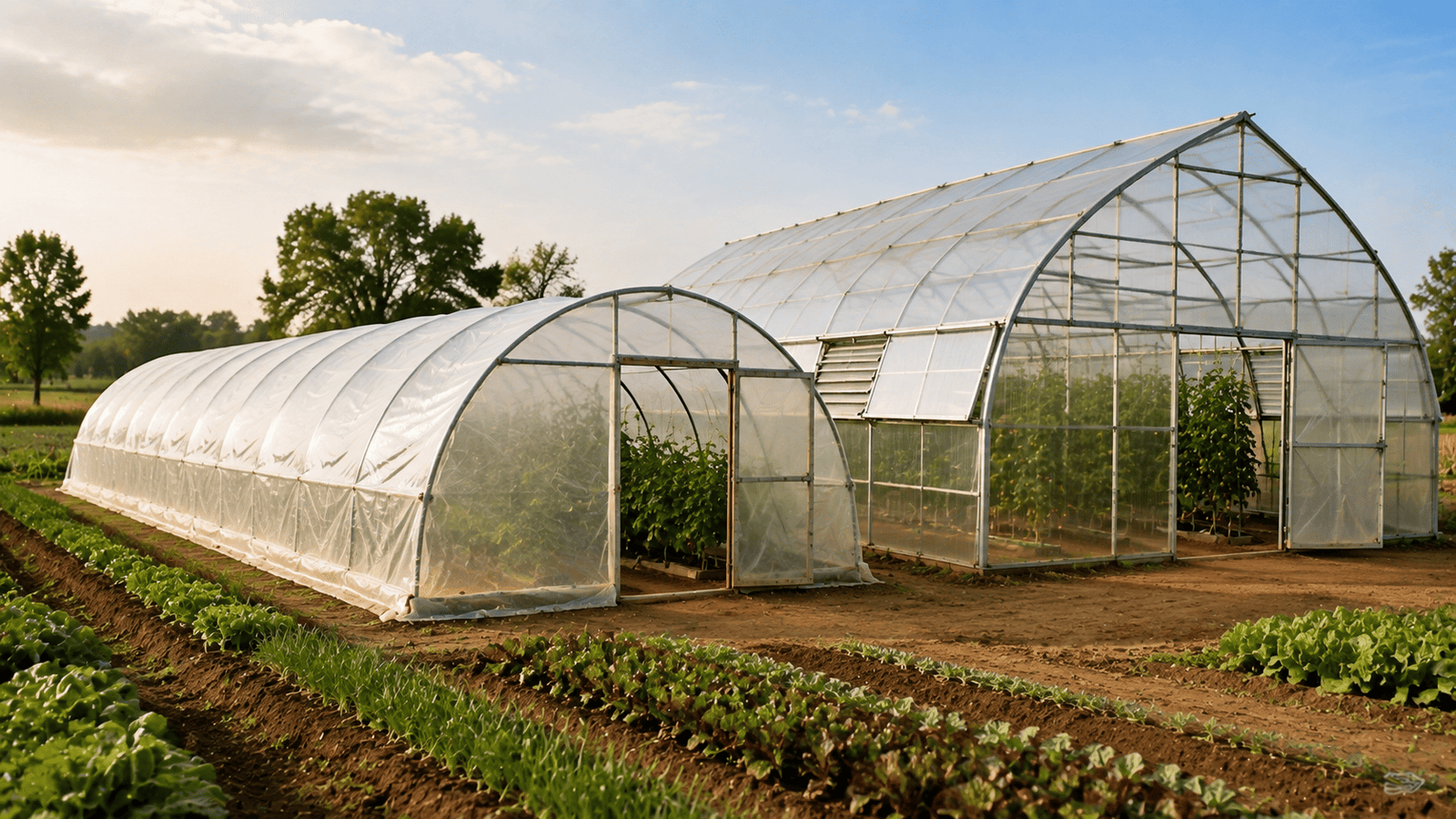
Types of Greenhouses and Which One to Choose (2026)
By Farmers Advisory Editorial Team ·
Published August 5, 2026 · Updated August 5, 2026 · 11 min read ·
Category: Greenhouse Farming
The right greenhouse type balances upfront cost against how much climate control, snow/wind resistance, and scalability your operation actually needs.
Picking a greenhouse type before understanding what each one trades off is one of the most
expensive early mistakes a new grower can make — a structure that's cheap to put up but can't handle
local wind or snow load, or one so heavily automated it outpaces the market you're selling into,
both waste money in different directions. This guide compares the main types of
greenhouses — hoop houses, gothic arch, gable roof, multi-span, and high-tech controlled
structures — across cost, strength, climate suitability, and scalability, so you can match the
structure to your actual conditions and goals rather than picking whatever's most common nearby.
Key Takeaways
Hoop houses are the lowest-cost, fastest-to-build option but offer the least strength and climate control.
Gothic arch structures shed snow more effectively than rounded hoop houses, making them a better fit for snow-prone climates.
Multi-span and high-tech structures scale efficiently for commercial production but require significantly more capital and management skill.
No single greenhouse type is best for everyone — the right choice depends on climate, budget, crop, and how much automation you can manage.
Local wind, snow, and rain loads should shape structural decisions, not just cost per square foot.
Greenhouse Type Comparison Table
Greenhouse Types Compared
Type
Relative Cost
Structural Strength
Best Fit
Hoop house / Quonset
Low
Low–Moderate
Beginners, season extension, mild climates
Gothic arch
Low–Moderate
Moderate–High
Snow-prone climates, small-to-mid commercial
Gable roof / even-span
Moderate
High
Mid-size commercial production
Lean-to
Low
Depends on host wall
Small space, attached to an existing structure
Multi-span / tunnel
Moderate–High
High
Larger commercial operations needing scale
High-tech controlled
High
High
Intensive commercial production, year-round climates control
💡 Quick Tip
Before comparing greenhouse types on cost alone, check local building codes and typical wind/snow
loads for your area. A structure that's cheapest to buy can become the most expensive if it needs
reinforcement or replacement after the first bad storm season.
1. Quonset / Hoop House
The simple, rounded-roof hoop house is the most common entry point into greenhouse farming due to
its low cost and quick construction.
Typically built from bent metal tubing covered with polyethylene film
Fast to construct and relatively easy to relocate or expand
Rounded shape sheds rain reasonably well but performs less predictably under heavy snow than
steeper-roofed designs
Usually relies on natural ventilation (roll-up sides, end vents) rather than mechanical climate
control, which limits precision but keeps running costs low
2. Gothic Arch Greenhouse
The gothic arch is a peaked variation on the hoop house shape, with a steeper roof angle.
The steeper peak sheds snow more effectively than a rounded hoop house roof, an important factor
in colder or snow-prone regions
Generally offers more headroom at the peak, useful for taller crops like trellised tomatoes
Costs somewhat more than a basic hoop house but less than gable or multi-span designs
Can be built with the same covering and ventilation approaches as a hoop house
3. Gable Roof and Even-Span Greenhouses
Gable roof (also called even-span) greenhouses use a peaked roof similar to a traditional building,
offering a stronger, more rigid structure.
Straight walls and a peaked roof provide more usable interior headroom and easier equipment
installation than curved designs
Generally more structurally robust, supporting heavier covering materials like polycarbonate or
glass
Better suited to permanent installations with mechanical ventilation and climate control systems
Higher construction cost than hoop or gothic arch structures of the same footprint
4. Lean-To Greenhouse
A lean-to greenhouse attaches to an existing wall or building, using that structure as one side.
Lower material cost since one wall is already provided by the host building
Convenient access to existing electricity and water lines from the attached structure
Size is inherently limited by the length of the host wall
Orientation is fixed by the host building, which can limit sunlight optimization compared to a
freestanding structure
5. Multi-Span / Tunnel Greenhouses
Multi-span structures connect several greenhouse "bays" under a shared gutter system, creating one
large continuous growing area.
Efficient use of materials and space at scale — shared walls between bays reduce cost per unit
area compared to several separate structures
Well suited to commercial operations that need large, uniform growing areas
Ventilation and climate uniformity become more complex to manage as the structure grows larger,
often requiring mechanical systems rather than natural ventilation alone
Higher upfront capital requirement than single-span designs of comparable total area
6. High-Tech Controlled Greenhouses
High-tech greenhouses integrate automated climate control, often including supplemental lighting,
CO2 enrichment, and computer-controlled ventilation, heating, and cooling.
Offers the most precise and consistent growing environment, supporting year-round production of
demanding crops regardless of outdoor climate
Requires the largest capital investment and the most technical management skill of any greenhouse
type
Energy costs for lighting and climate control can be substantial, particularly in climates far
from a crop's natural preferences
Generally reserved for intensive commercial production where crop value and scale justify the
investment
⚠️ Common Mistake
Choosing a high-automation structure before validating that the local market and your own management
capacity can support it. A sophisticated greenhouse run without the matching technical skill and
market often underperforms a simpler structure run well.
7. How to Choose
✅ Lean Toward Simpler Structures If...
You're new to greenhouse farming and want to learn before committing significant capital
Your climate is relatively mild and doesn't demand heavy climate control
You're growing crops that tolerate more variable conditions, like leafy greens
❌ Lean Toward Advanced Structures If...
You're producing high-value, climate-sensitive crops like specialty tomatoes year-round
Your local climate is extreme enough that basic ventilation can't hold viable conditions
You have the capital and technical capacity to manage automated systems properly
A basic hoop house (Quonset-style structure with polyethylene film covering) is generally the
lowest-cost option to build, though actual cost still depends on size, materials, and local prices.
What greenhouse type is best for snowy climates?
Gothic arch structures, with their steeper peaked roof, shed snow more effectively than rounded
hoop houses, making them a common choice in snow-prone regions.
What's the difference between a hoop house and a greenhouse?
A hoop house is a type of greenhouse — specifically a simple, low-cost, rounded-roof structure
usually covered with polyethylene film and relying on natural ventilation, as opposed to more rigid
or highly automated greenhouse designs.
Do I need a high-tech greenhouse to grow commercially?
No. Many commercial operations run successfully with simpler structures like gothic arch or gable
roof greenhouses. High-tech, fully automated structures are generally reserved for intensive,
high-value, year-round production where the investment is justified by the crop and market.
Can a hoop house be upgraded to a more advanced structure later?
Some elements, like adding mechanical ventilation or shade systems, can be added to an existing
hoop house. However, structural changes like moving to a gable roof or multi-span design generally
require building a new structure rather than upgrading the existing frame.
How do I know what size greenhouse I need?
Size should follow from your crop plan, expected yield goals, and available budget and labor,
rather than being decided first. Starting smaller and expanding as you validate your crop and market
is a common, lower-risk approach.
Conclusion
There's no universally "best" greenhouse type — only the type that best matches your climate, budget,
crop, and management capacity. A hoop house gets a beginner growing quickly and cheaply; a gothic arch
holds up better under snow load; a gable roof or multi-span structure supports serious commercial scale;
and a high-tech controlled greenhouse unlocks year-round precision for growers who can manage and afford
it. Match the structure to where you actually are, not where you eventually hope to be, and upgrade as
the operation proves itself.
Want more greenhouse farming guidance delivered to your inbox every week?
General structural-comparison framework informed by publicly available horticultural extension
guidance on greenhouse design and protected agriculture structures. Cost comparisons are relative, not
absolute figures, since actual pricing varies by region, materials, and labor — confirm current local
pricing and building code requirements before construction. Current as of August 5, 2026.
 Farmers Advisory