 Farmers Advisory
Farmers Advisory
Farmers Advisory
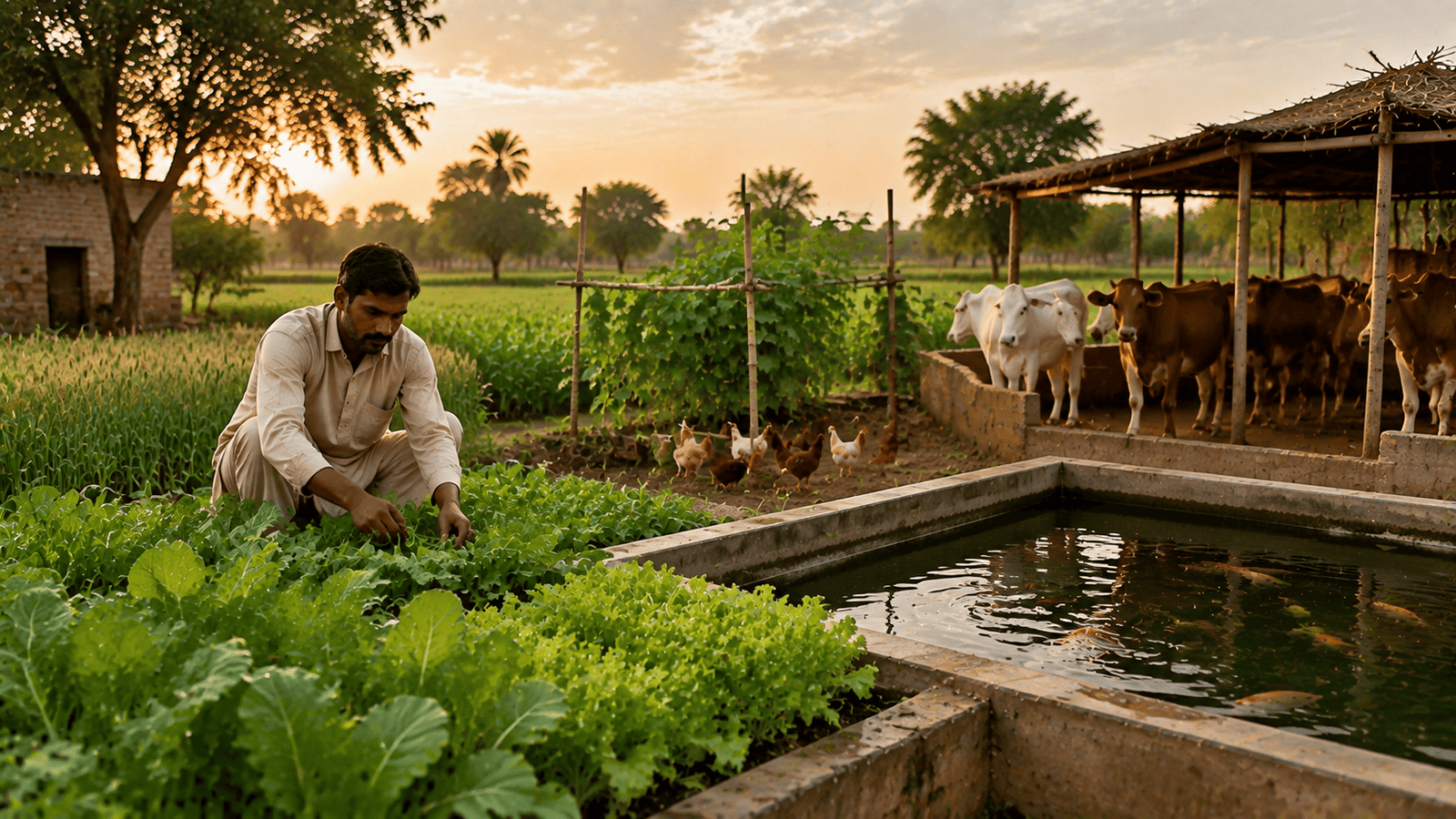
Integrated farming can increase farm income by adding revenue streams and reducing certain input costs through recycled residue and manure — but it does this by changing the shape of a farm's revenue and cost structure, not by any fixed multiplier. Whether total income actually rises depends on crop and livestock choice, scale, market prices, and how well the components are managed. This guide walks through the revenue streams integration can add, the cost categories it affects, and the break-even and ROI formulas a farmer can use to evaluate a specific plan realistically.
An integrated farm typically has more than one product to sell: grain or vegetables from the crop side, and milk, meat, eggs, or fish from the animal or aquaculture side. Each stream has its own price cycle and market, so a downturn in one doesn't necessarily coincide with a downturn in another. This diversification supports more stable income over time even in seasons when total income isn't higher than a specialized farm's best year.
These reductions typically build gradually across seasons as composting and feeding routines mature, rather than showing up fully in the first year.
| Category | Examples | Fixed or Variable |
|---|---|---|
| Fixed costs | Land, housing, pond construction, fencing, major equipment | Fixed |
| Variable costs | Purchased feed, seed, veterinary care, labor tied to output | Variable |
| Operating costs | Fuel, utilities, routine maintenance, transport to market | Mostly variable |
| Opportunity costs | Farmer's own labor time, land that could be used differently | Often overlooked, but real |
These formulas apply the same way to an integrated farm as to any business — the difference is that an integrated farm should run them per component as well as for the whole operation, since combining revenue can hide a component that's actually losing money.
No. Income depends on crop and livestock choice, scale, market prices, labor, and management. Integration diversifies income sources but doesn't guarantee a higher total.
Calculate break-even output separately for each component using Break-Even Output = Fixed Costs ÷ (Price per Unit − Variable Cost per Unit), then review the whole-farm picture afterward.
Recycling crop residue into feed and manure into fertilizer typically lowers purchased feed and fertilizer costs over time, though the size of the saving depends on how well matched the components are.
Both — tracking only the combined total can hide a component that's losing money while another component's profit masks the loss.
Yes, often — processing raw output into products like cheese or preserves can raise revenue per unit, though it adds labor, equipment, and food-safety requirements of its own.
Integrated farming can genuinely raise farm income through diversified revenue and lower purchased input costs, but the mechanism is additive and gradual, not automatic or guaranteed. Track revenue and costs per component as well as for the whole farm, use break-even and ROI formulas with your own farm's real figures, and expect savings from recycling to build up over several seasons rather than the first. A realistic income plan starts with the same land-and-resource assessment covered in our guide to designing an integrated farming system.
Want more integrated farming guides delivered to your inbox every week?
Subscribe to Farmers AdvisoryGeneral background: FAO Climate-Smart Agriculture Sourcebook, Module B5 on integrated production systems and farm economics; FAO Plant Production and Protection Division guidance on integrated crop-livestock systems. Income, cost, and ROI figures vary enormously by farm, region, and market — the formulas here are a planning framework, not a source of universal figures. Current as of August 6, 2026.