 Farmers Advisory
Farmers Advisory
Farmers Advisory
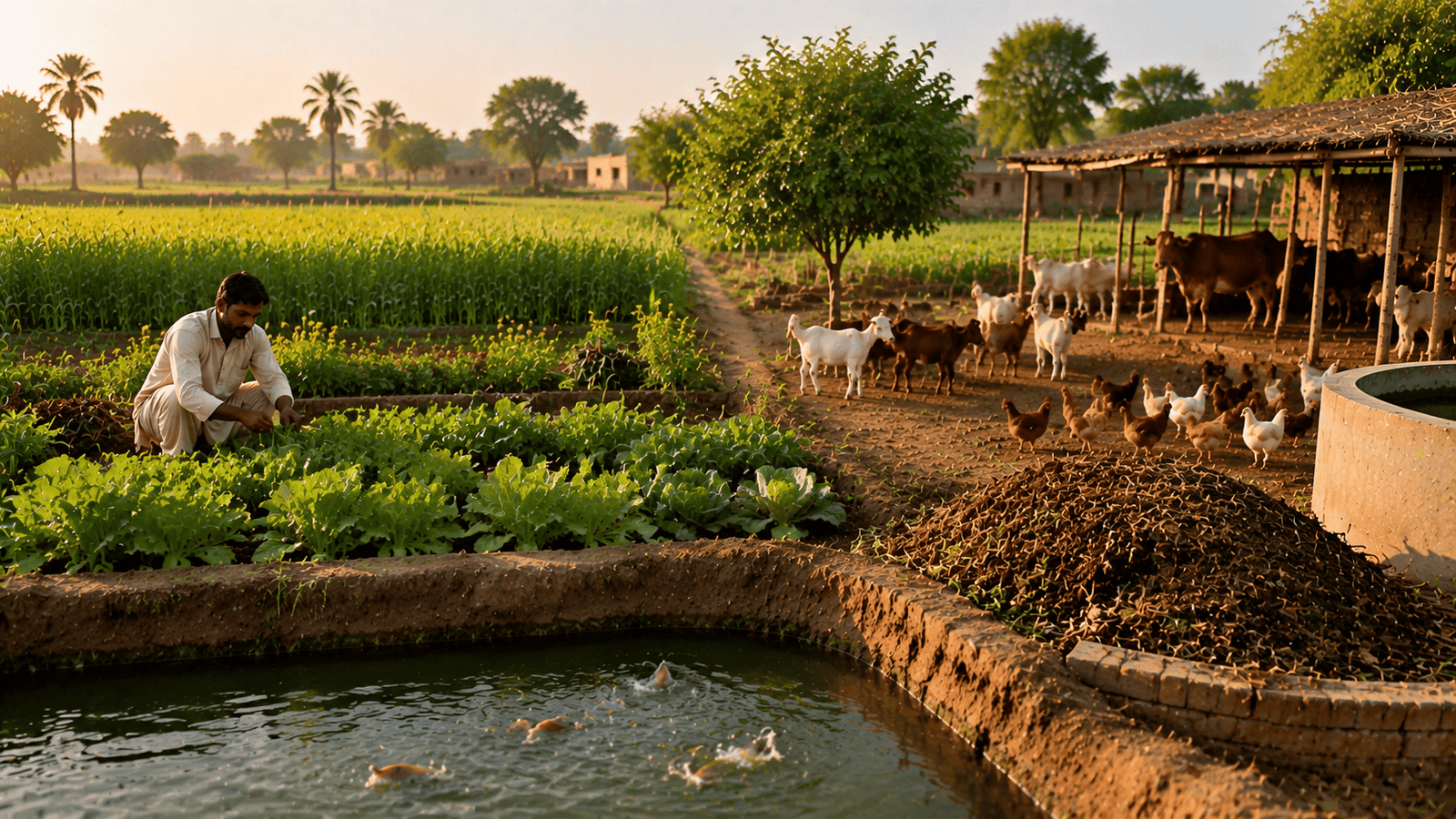
Integrated farming and monoculture farming represent two different answers to the same question: how should a farm use its land? Monoculture concentrates on one crop grown at scale, optimizing for simplicity and economies of scale. Integrated farming combines multiple enterprises, optimizing for diversification and resource recycling. Neither is universally better — each fits different goals, resources, and risk tolerances. This comparison walks through the practical differences across land use, risk, labor, sustainability, and profitability.
Monoculture uses land for a single purpose, which simplifies planning, machinery use, and harvest logistics, particularly at large scale. Integrated farming layers multiple uses onto the same land — crop, livestock, sometimes fish — which can increase total output per unit of land but requires more careful spatial planning to avoid components interfering with each other.
Monoculture typically depends more heavily on purchased fertilizer to maintain soil fertility over successive seasons of the same crop, and can be more prone to soil nutrient depletion or structural decline without added organic matter. Integrated systems that cycle manure and residue back into the soil can build organic matter and reduce (though rarely eliminate) purchased fertilizer needs, provided nutrient cycling is managed properly rather than assumed.
Monoculture at scale often benefits from mechanization that reduces labor per unit of output, though it may require significant capital investment in specialized equipment. Integrated farming, with more distinct components, typically needs more varied labor and skills — feeding, manure handling, health monitoring across species — that's harder to fully mechanize at small to medium scale.
Monoculture concentrates income in one product, which can be highly productive and profitable at scale when the market for that product is strong, but leaves the farm fully exposed to that market. Integrated farming spreads income across products, generally trading some peak productivity in any single enterprise for more stability across the whole farm. For a deeper look at the income mechanics specific to integration, see how integrated farming increases farm income.
| Factor | Integrated Farming | Monoculture Farming |
|---|---|---|
| Farm diversity | Multiple crops/species | Single crop or species |
| Management complexity | Higher — multiple components to coordinate | Lower per unit of land |
| Market risk | Spread across products | Concentrated in one product |
| Mechanization potential | Limited by component variety | High, especially at scale |
| Nutrient cycling | Internal (manure, residue) if managed well | Mostly external (purchased inputs) |
| Scalability | More difficult beyond moderate scale | Scales more straightforwardly |
| Income structure | Multiple smaller streams | One larger stream, more market-exposed |
It can be, when nutrient cycling and waste management are handled well, but poorly managed integration can also degrade soil or water — sustainability depends on management, not the system label alone.
Not always, but its mechanization and standardization advantages often help it scale efficiently for commodity markets. Profitability still depends on market prices, input costs, and management quality.
Integrated systems generally spread market and disease risk across multiple products, while monoculture concentrates risk in a single crop or animal — though shared vulnerabilities can reduce this advantage.
Yes, many farms do, typically by adding one compatible component at a time rather than converting the whole operation at once. See our guide on designing an integrated farming system for the planning steps.
Monoculture generally has a simpler management profile per unit of land, since there's one crop calendar and skill set to learn rather than several coordinated components.
Integrated farming and monoculture aren't competing for the same prize — they optimize for different outcomes. Monoculture rewards scale, standardization, and mechanization; integration rewards diversification, resource cycling, and resilience against single-point failures. The better fit for any given farm depends on its scale, market access, labor, and the farmer's own risk tolerance, not on either system being inherently superior. Farmers weighing a shift toward integration can start with our guide to integrated farming system examples to see which model best matches their own resources.
Want more integrated farming guides delivered to your inbox every week?
Subscribe to Farmers AdvisoryGeneral background: FAO Plant Production and Protection Division guidance on integrated crop-livestock systems; FAO Climate-Smart Agriculture Sourcebook, Module B5. Comparative performance of integrated versus monoculture systems varies substantially by scale, region, crop, and market — treat this comparison as a general framework rather than a ranking that applies to every farm. Current as of August 6, 2026.