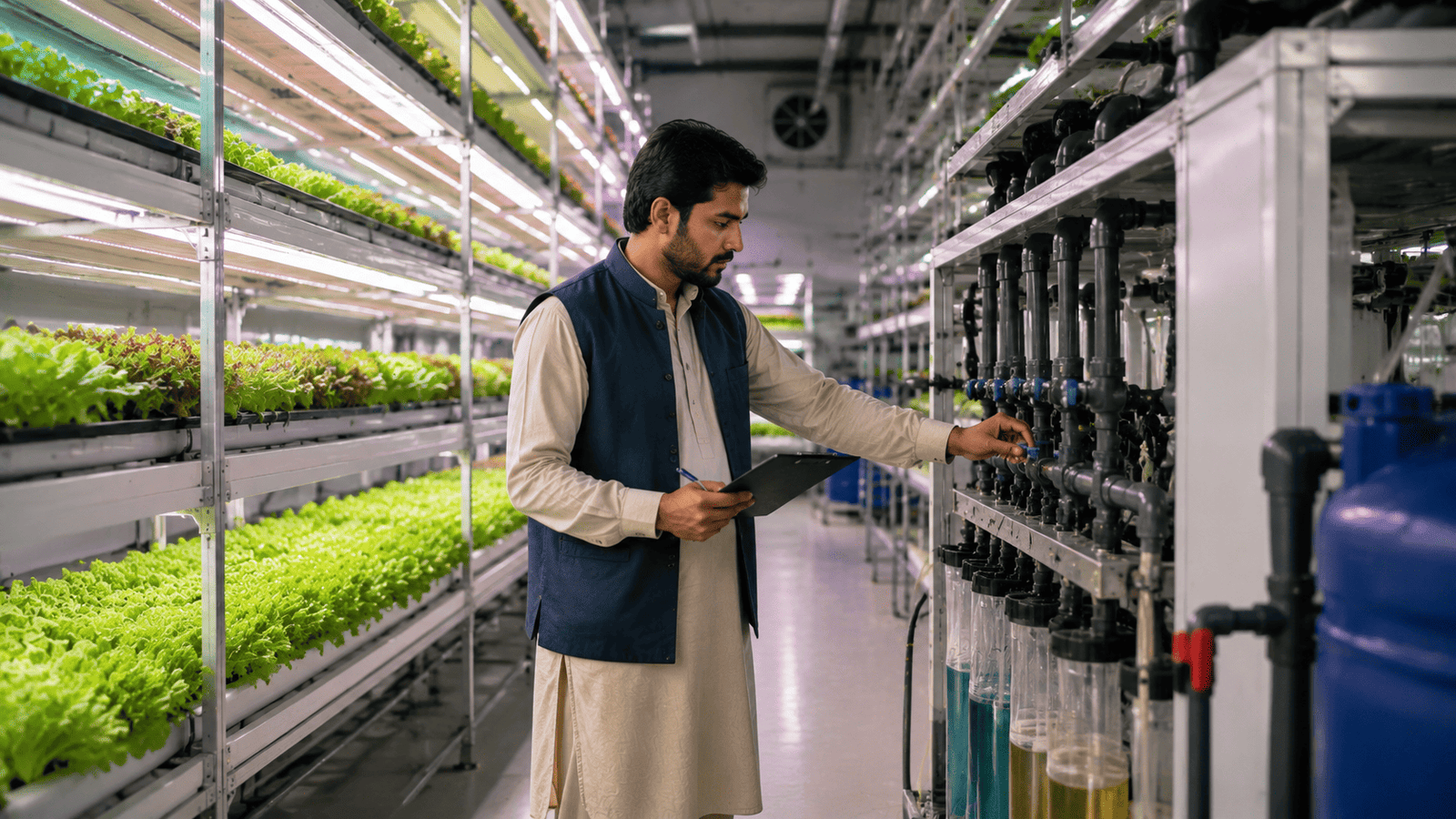
LED Lighting Requirements for Vertical Farms: PPFD, DLI, and Spectrum Explained (2026)
By Farmers Advisory Editorial Team ·
Published August 5, 2026 · Updated August 5, 2026 · 11 min read ·
Category: Vertical Farming
Lighting decisions in a vertical farm come down to three numbers — PPFD, photoperiod, and DLI — and getting any one wrong shows up in yield within days.
Lighting is the single largest energy cost in most vertical farms, and it's also the variable most
directly responsible for how plants grow — get it wrong and no amount of nutrient dosing or climate
control will fully compensate. This guide breaks down LED lighting requirements for vertical
farms in plain terms: what PPFD and DLI actually measure, how spectrum and photoperiod affect
crops differently by growth stage, and how to avoid the fixture-placement mistakes that waste
electricity without improving yield.
Key Takeaways
PPFD measures light intensity at a given moment; DLI measures total light delivered over a full day — both matter, and neither alone tells the full story.
Target PPFD and DLI values vary significantly by crop, cultivar, and growth stage — there is no single universal lighting setting for a vertical farm.
Seedlings generally need lower light intensity than mature plants; ramping up too fast can stress young tissue.
More light isn't always better — overlighting past a crop's saturation point wastes electricity without adding growth and can cause leaf damage.
Fixture placement and canopy distance affect uniformity as much as raw output; uneven light across a rack produces uneven crop quality.
Lighting Terms at a Glance
Core Vertical Farming Lighting Terms
Term
What It Measures
Why It Matters
PAR
The wavelength range plants use for photosynthesis (roughly 400-700nm)
Defines which light is biologically useful, not just visible
PPFD
Light intensity at a point, at a moment in time
Tells you how strong the light is at canopy level right now
DLI
Total PAR light delivered over a full day
Tells you whether a crop is getting enough total light across the whole photoperiod
Photoperiod
Number of hours of light per day
Affects flowering, growth rate, and total DLI achieved
Spectrum
The mix of wavelengths a fixture emits
Affects photosynthesis efficiency and plant morphology
1. Why Lighting Matters More Than Any Other Input
In an outdoor field, sunlight is free and largely uncontrollable. In a vertical farm, light is
entirely engineered — every photon a plant receives is a deliberate design and cost decision. That
makes lighting simultaneously the biggest lever for crop performance and the biggest recurring expense
in most facilities.
Photosynthesis converts light energy into the sugars that drive plant growth, so light directly gates growth rate
Lighting typically represents the largest share of a vertical farm's electricity bill
Because light is fully controllable, it's also one of the easiest inputs to get wrong through guesswork rather than measurement
2. PPFD: Measuring Light Intensity
Photosynthetic Photon Flux Density, or PPFD, measures how many photosynthetically active photons hit
a given area per second. In practice, it tells growers how intense the light is at canopy level at any
given moment — the equivalent of checking a single snapshot of light strength.
PPFD is measured with a quantum sensor placed at canopy height, not at the fixture
Different crops and growth stages tolerate and benefit from different PPFD ranges — a single blanket target across an entire facility is rarely accurate
PPFD alone doesn't tell you the full lighting picture, since it's a single-moment reading rather than a measure of total daily exposure
3. DLI: Measuring Total Daily Light
Daily Light Integral, or DLI, is the total amount of photosynthetically active light a crop receives
over a full 24-hour photoperiod. Where PPFD is a snapshot, DLI is the running total.
DLI is calculated from PPFD and photoperiod length together, so the same DLI can be reached with high intensity over fewer hours or lower intensity over more hours
Different crops have different DLI targets, and those targets also shift across growth stages
Tracking DLI, not just PPFD, is what actually predicts whether a crop is getting adequate total light for the day
💡 Quick Tip
If yield seems inconsistent despite stable-looking PPFD readings, check photoperiod consistency too — a shortened lighting schedule lowers DLI even if intensity hasn't changed.
4. Light Spectrum and Photosynthesis
Not all wavelengths of light drive photosynthesis equally, and spectrum also influences plant shape
and development beyond just growth rate.
Red and blue wavelengths are generally the most efficiently used for photosynthesis
Spectrum composition affects plant morphology — leaf shape, stem length, and compactness can all shift depending on the light mix a crop receives
Full-spectrum and tunable fixtures let growers adjust the light mix by crop or growth stage rather than committing to a single fixed spectrum
Spectrum needs vary by crop and objective (leafy biomass versus fruiting versus compact seedlings), so there is no single "best" spectrum for every situation
5. Photoperiod and Lighting Schedules
Photoperiod is the number of hours of light a crop receives per day, typically set on automated timers or controllers
Longer photoperiods increase total DLI at a given intensity but also increase electricity use and can affect flowering response in some crops
Some crops respond to specific photoperiod lengths for flowering or bolting, so schedule choice isn't purely about maximizing total light
Consistent scheduling matters — irregular photoperiods can stress crops even if average daily light stays similar
6. LED Fixture Selection and Efficiency
Fixture efficiency — how much usable light output a fixture delivers per watt of electricity
consumed — directly affects both crop performance and the facility's energy budget.
Compare fixtures on efficacy (micromoles of PAR light per joule of electricity), not just raw wattage
Higher-efficiency fixtures cost more upfront but typically reduce long-term electricity spend, particularly in facilities running lights many hours per day
Fixture heat output affects HVAC load, so lighting and climate control decisions are linked, not separate
Dimmable and zone-controllable fixtures allow lighting adjustments by crop or growth stage without replacing hardware
7. Fixture Placement and Canopy Distance
⚠️ Common Mistake
Mounting all fixtures at a single fixed height regardless of rack level or crop stage. Canopy distance affects both intensity and uniformity, and a distance that works for one rack tier or crop stage often doesn't work for another.
Light intensity falls off with distance from the fixture, so canopy distance needs to be set deliberately, not left to whatever the rack design allows by default
Uneven fixture spacing or mounting height creates uneven PPFD across a canopy, leading to inconsistent crop quality within the same rack
Adjustable-height fixtures or racks let growers maintain consistent canopy distance as plants grow taller through a crop cycle
8. Lighting by Growth Stage
Light requirements shift as a plant develops, and applying mature-plant lighting settings to
seedlings — or vice versa — is a common source of stress and uneven growth.
Seedlings and young transplants generally tolerate lower PPFD than mature plants and can be damaged by intensity levels appropriate for later growth stages
Light requirements typically increase as plants develop more leaf area and photosynthetic capacity
Ramping intensity gradually across growth stages, rather than jumping straight to mature-plant settings, reduces the risk of light stress
Exact PPFD and DLI targets by stage vary by crop and cultivar, so growers should treat published ranges as a starting point to validate against their own crop's response
9. Insufficient Light, Overlighting, and Uniformity
Insufficient light: shows up as leggy growth, pale coloration, and slower development, since the plant isn't generating enough photosynthetic energy to grow at its normal rate
Overlighting: can cause leaf bleaching, tip burn, or reduced quality once intensity exceeds what a crop can productively use — additional light beyond that point is largely wasted electricity
Uniformity: uneven light distribution across a rack produces uneven growth even when the average PPFD reading looks acceptable, so spot-checking multiple points across the canopy matters more than a single central reading
10. Lighting Automation and Measuring Light
Automated lighting controllers can adjust intensity and photoperiod by zone, crop, or growth stage without manual reconfiguration
Quantum sensors placed at canopy height provide the most accurate PPFD readings — fixture-rated output alone doesn't account for mounting height, canopy shading, or fixture aging
Regularly re-measuring light levels matters, since LED output can gradually decline over years of operation, drifting a facility away from its intended targets
Logging PPFD and calculated DLI over time helps correlate lighting conditions with yield and quality outcomes for future adjustments
Frequently Asked Questions
What is the difference between PPFD and DLI?
PPFD measures light intensity at a single moment, while DLI measures the total amount of light
delivered over a full 24-hour photoperiod. Both matter, and DLI is calculated from PPFD combined with photoperiod length.
What PPFD level should a vertical farm target?
Target PPFD varies by crop, cultivar, and growth stage, so there is no single universal value —
growers should reference crop-specific ranges and validate results against their own crop's response.
Can too much light hurt vertical farm crops?
Yes. Overlighting past a crop's saturation point wastes electricity without improving growth and
can cause leaf bleaching or tip burn in some crops.
Do seedlings need the same light intensity as mature plants?
No. Seedlings generally tolerate lower PPFD than mature plants, and ramping intensity gradually
across growth stages reduces the risk of light stress.
How often should LED grow lights be recalibrated or checked?
Light output should be re-measured periodically, since LED intensity can gradually decline over
years of use, drifting the facility away from its intended PPFD and DLI targets.
Does light spectrum affect plant shape, not just growth rate?
Yes. Spectrum composition influences plant morphology, including leaf shape, stem length, and
compactness, in addition to overall photosynthetic efficiency.
Conclusion
Lighting in a vertical farm isn't a set-it-and-forget-it decision — it's an ongoing measurement and
adjustment process built around PPFD, DLI, spectrum, and photoperiod working together, not any single
number in isolation. Growers who measure light at canopy height, adjust intensity by growth stage, and
track uniformity across racks consistently get more predictable results than those relying on fixture
wattage alone. Since lighting is usually the largest energy cost in the facility, getting these details
right pays off in both crop quality and the electricity bill.
Want more vertical farming insights delivered to your inbox every week?
Data sources: Cornell Controlled Environment Agriculture program lighting resources; USDA Agricultural
Research Service controlled-environment agriculture publications; university extension guidance on
PPFD, DLI, and supplemental lighting for indoor crop production. Figures and ranges represent general
guidance and vary by crop, cultivar, growth stage, and system design. Current as of August 5, 2026.
 Farmers Advisory