 Farmers Advisory
Farmers Advisory
Farmers Advisory
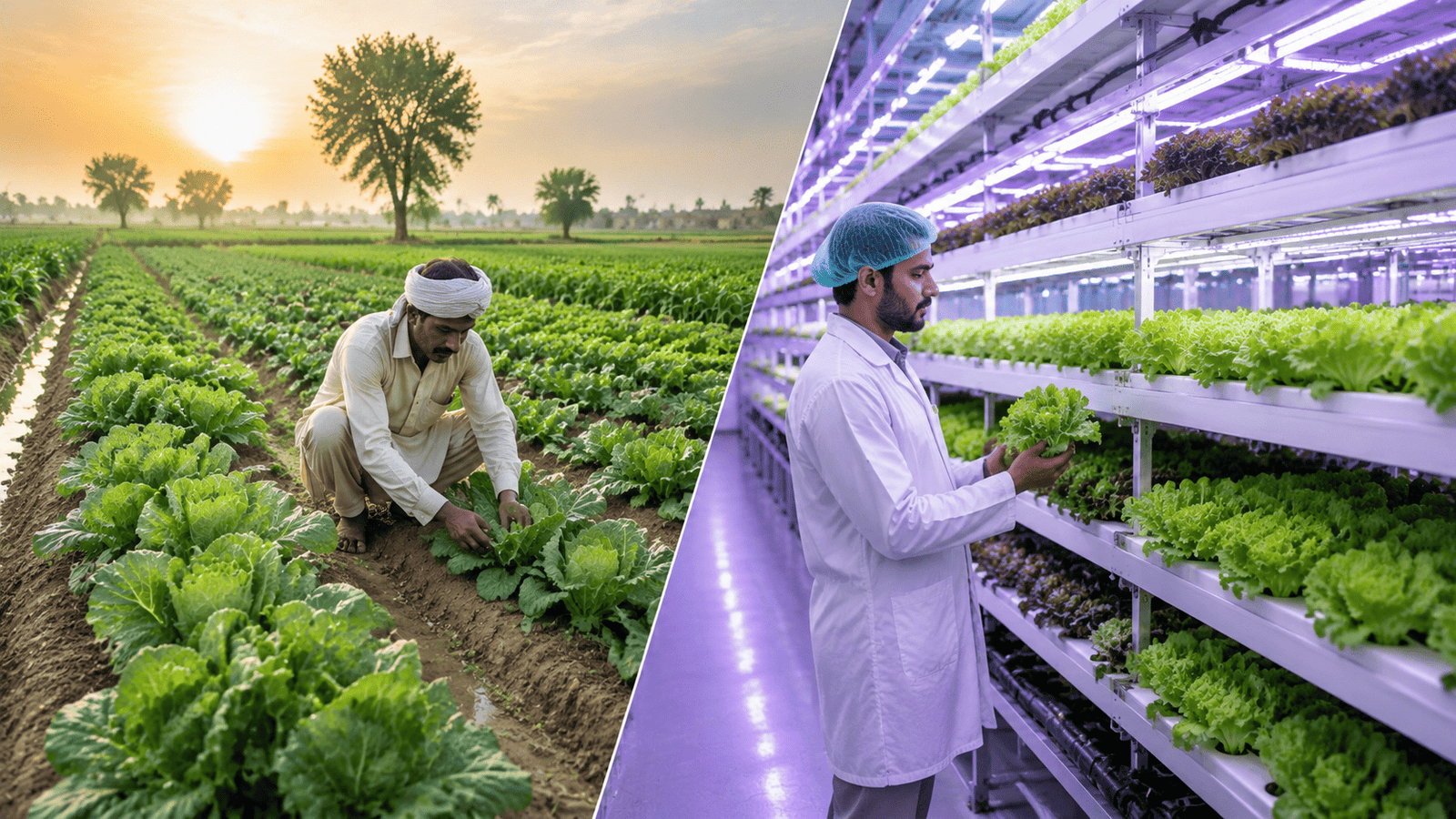
Vertical farming grows crops in stacked layers instead of spread across open fields, using artificial lighting and closely managed root-zone systems rather than sunlight and soil. It lets a single building produce many multiples of the yield a field of the same footprint would give, because the growing surface is measured in layers rather than acres. That efficiency comes from replacing an open, variable outdoor environment with a sealed, engineered one — which is also where most of the cost and complexity in vertical farming comes from.
Vertical farming is the practice of growing crops in vertically stacked layers, usually inside a climate-controlled building, warehouse, shipping container, or purpose-built facility. Instead of one planting layer spread across a field, a vertical farm might stack six, ten, or more growing layers within the same footprint. Each layer gets its own light source, since sunlight can't reach through the layers above it, and its own irrigation and nutrient delivery.
The term covers a range of setups — from a few shelves of leafy greens in a converted retail space to multi-story automated facilities producing thousands of pounds of produce a week. What ties them together is the stacking principle: production scales with height and layer count rather than land area.
Stacking layers is a direct response to the cost and scarcity of land, particularly near cities where demand for fresh produce is highest but farmland is either unavailable or prohibitively expensive. A facility with ten growing layers can produce roughly ten times the crop volume of a single layer occupying the same floor space, assuming similar yields per layer.
Vertical farming also decouples production from outdoor climate and season. A facility in a cold climate can run the same crop cycle in January as in July, because the growing environment is built rather than inherited from the weather outside.
Almost all commercial vertical farming happens indoors, inside warehouses, converted industrial buildings, or purpose-built modules, because indoor conditions are what make precise light and climate control possible in the first place. A small number of outdoor vertical systems exist — vertically stacked strawberry gutters or trellised crops in open-air structures — but these still rely on natural sunlight and don't offer the same layer-count flexibility as a fully enclosed facility.
When people refer to "vertical farming" as a distinct category from greenhouse growing, they generally mean indoor, artificially lit systems. That distinction matters for cost planning, since indoor systems carry a much higher electricity load from lighting and climate control than sunlight-fed greenhouses.
Soil is impractical in a stacked system — it's heavy, inconsistent, and hard to manage uniformly across many layers. Vertical farms instead rely on one of three general root-zone methods.
Roots sit in or are regularly flooded with a nutrient-rich water solution, either in a shallow flowing film (nutrient film technique), a deeper standing reservoir (deep water culture), or a drip-fed medium. Hydroponics is the most widely used method in commercial vertical farms because it's relatively simple to automate and monitor at scale.
Roots hang in open air and are periodically misted with a fine nutrient solution spray. Aeroponic systems can use less water than hydroponics and expose roots to more oxygen, but the misting equipment is more failure-prone — a clogged nozzle or pump outage can dry out roots within hours.
Plants grow in an inert medium such as coconut coir, rockwool, or perlite, which holds moisture and anchors the root system while nutrient solution is delivered by drip irrigation. This method is common for crops with larger root structures or for growers who want a buffer against short irrigation interruptions.
| Method | Water Use | Setup Complexity | Failure Sensitivity | Common Crops |
|---|---|---|---|---|
| Hydroponics | Moderate | Low–Moderate | Moderate | Lettuce, leafy greens, herbs |
| Aeroponics | Low | High | High | Leafy greens, propagation, research crops |
| Substrate-based | Moderate–High | Low | Low–Moderate | Herbs, strawberries, larger-root crops |
Regardless of growing method, most vertical farms are built around the same set of interdependent systems.
None of these systems function well in isolation. A lighting schedule that runs hotter than expected will push humidity and temperature past the HVAC system's comfortable range; a nutrient dosing error will show up in EC readings before it's visible in the plants. Vertical farming is, in large part, the discipline of keeping these systems in balance with each other.
Most vertical farms follow a broadly similar production sequence, even though the specific equipment varies by facility.
Crop cycle length varies enormously by crop — microgreens can be ready in under two weeks, while head lettuce typically takes several weeks from seed to harvest. Faster cycles mean more harvests per year from the same rack space, which is part of why leafy greens dominate commercial vertical farming.
Energy use deserves particular attention: LED lighting and HVAC together typically represent the largest share of a vertical farm's operating costs, and the exact figure depends heavily on local electricity rates, facility insulation, and lighting efficiency — there isn't a single universal number that applies across facilities.
Commercial vertical farming today is concentrated in a fairly narrow set of applications: leafy greens and salad mixes for grocery and food-service supply, culinary herbs, microgreens, and some berry crops like strawberries. Research facilities and universities also use vertical systems for controlled-environment crop studies, and some urban and educational projects use small vertical setups for community food production rather than commercial sale.
Staple crops like wheat, corn, rice, and most root vegetables are essentially absent from vertical farming today. Their low per-unit market value, larger space requirements, and longer growth cycles don't match well against the high fixed costs of a stacked, artificially lit growing environment.
No. Hydroponics is a growing method — delivering nutrients through water instead of soil — that many vertical farms use. Vertical farming refers to the stacked-layer structure itself, and could technically use hydroponics, aeroponics, or substrate-based growing.
Rarely. Most use hydroponic, aeroponic, or substrate-based systems because soil is heavy and harder to manage consistently across multiple stacked layers.
Sunlight can only reach the top layer of a stacked system. Every layer below needs its own light source, which is why LED grow lights are standard in vertical farming.
Compact, fast-cycling, high-value crops such as lettuce, leafy greens, herbs, and microgreens are the most common, since they generate multiple harvests per year and don't need large root volume or extended growing periods.
It generally has higher startup and energy costs, but can produce far more per square foot of space. Whether it's more cost-effective depends on the crop, local electricity prices, and facility scale rather than being true or false universally.
Not with current technology and economics. It's well suited to a limited range of high-value, fast-cycling crops, but staple grains and most field crops remain far more efficiently grown outdoors.
Vertical farming works by substituting engineered systems — lighting, climate control, nutrient delivery, and sensors — for what an open field gets for free from the sun, rain, and soil. That trade lets a facility multiply its production per square foot, at the cost of a much higher electricity and equipment bill. It's a genuinely useful approach for a specific slice of agriculture — fast-cycling, high-value, space-efficient crops — rather than a universal replacement for how most food is grown.
Want the next article in this series delivered straight to your inbox?
Subscribe to Farmers AdvisoryData sources: USDA Agricultural Marketing Resource Center, controlled environment agriculture overview; Cornell University Controlled Environment Agriculture program publications; University of Arizona Controlled Environment Agriculture Center resources; North Carolina State University Extension, hydroponic and vertical growing systems guidance. Figures and practices represent general guidance and vary by crop, system design, and facility. Current as of August 5, 2026.