Setting Up Integrated Farming on a Small Landholding: A Beginner's Guide
By Farmers Advisory Editorial Team ·
Published August 6, 2026 · Updated August 6, 2026 · 13 min read ·
Category: Integrated Farming
A small landholding doesn't need every component at once — a compact, well-planned pairing beats an ambitious layout the farmer can't yet manage.
Setting up integrated farming on a small landholding is less about fitting in as many components
as possible and more about choosing a pairing the land, water, and labor available can genuinely
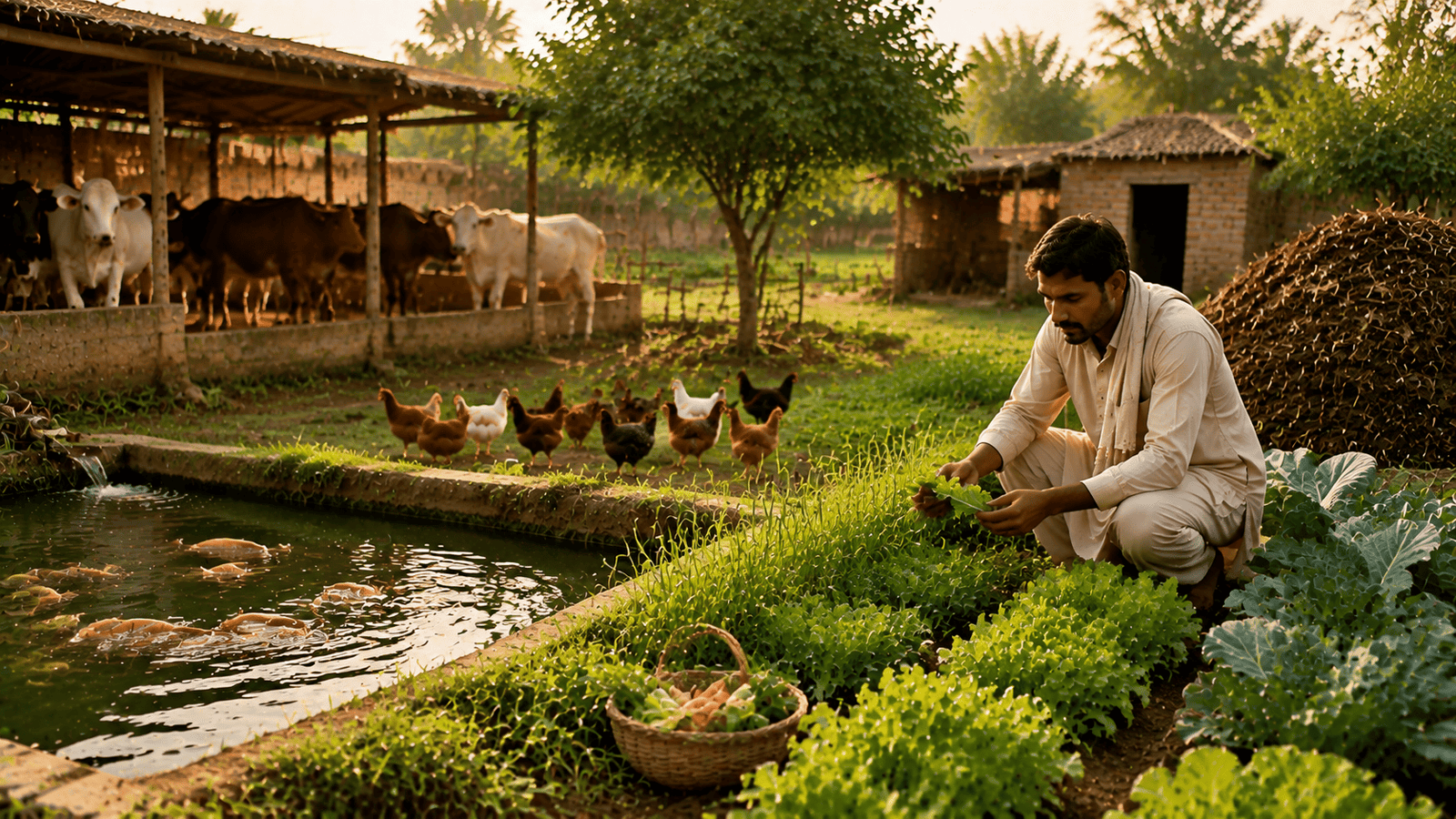
support. A quarter-acre plot with a few chickens and a compost bin is a legitimate integrated system;
it doesn't need a pond and a herd of cattle to count. This guide walks a beginner through assessing
the land, choosing enterprises, laying out the space, planning manure and feed flows, budgeting startup
and running costs, and scaling up once the first pairing is working.
Key Takeaways
Start with one or two compatible enterprises sized to your actual land, water, and labor — not the most ambitious model you've seen elsewhere.
Map where manure, residue, and other by-products will physically go before building any housing or beds.
Separate one-time startup costs (fencing, housing, a pond if applicable) from ongoing running costs (feed, seed, labor) when budgeting.
Keep simple records from day one so you can judge what's actually working before adding a third component.
Scale gradually — add a new component only after the current pairing is stable and well understood.
1. Assess Your Available Land and Resources
Land: total usable area, sun exposure, slope, and drainage
Water: how reliable the supply is across the year, since this determines whether a pond-based component is realistic
Soil: current condition, ideally checked with a simple soil test
Existing livestock or plantings: anything already on the plot that a new component should work around rather than replace
Climate: rainfall pattern and temperature range, which shape what will actually grow or thrive
2. Choose Compatible Enterprises
For a small landholding, the lowest-risk starting pairings are usually a vegetable or grain plot with
a small poultry flock, or a plot with a couple of goats, since both require modest space and manageable
daily labor. A pond-based system adds real value where water is reliable, but it also adds the most
management complexity — it's often better added later rather than as a first step. See our guide to
integrated farming system examples
for a fuller comparison of pairings by resource need.
⚠️ Common Mistake
Choosing three or four components at once because each one looked appealing individually. On a small
landholding with limited labor, this usually means every component gets less attention than it needs.
Start with one pairing, get it working reliably, then add.
3. Plan the Farm Layout
Position animal housing close to both the compost or manure storage area and the beds that will receive finished compost
Keep grazing or free-range areas fenced away from vegetable beds to prevent crop damage
If water is limited, cluster water-dependent components (a small pond, irrigated beds) near the water source rather than spreading them across the plot
4. Plan Manure, Composting, and Feed
Small-Landholding Manure and Feed Flow
Source
Destination
Key Step
Poultry droppings
Compost pile, then vegetable beds
Compost fully before applying to growing crops
Kitchen and garden scraps
Poultry or goat feed
Check scraps are appropriate for the species before feeding
Crop residue (stalks, trimmings)
Livestock feed or compost
Chop fibrous residue for easier feeding or faster composting
💡 Quick Tip
Even on a small plot, keep manure and compost storage away from any well, rainwater tank, or drinking
water source, and never apply uncomposted manure directly to a crop close to harvest.
5. Irrigation and Infrastructure
Simple drip or hand-watering systems suit most small vegetable plots without requiring major infrastructure investment
Basic, secure housing — even simple and inexpensive — matters more for animal health and predator protection than for appearance
Fencing is often the single most valuable early investment on a mixed small plot, since it prevents the most common early conflict between grazing animals and crops
6. Labor, Startup Costs, and Operating Costs
Startup costs: fencing, basic housing, initial seed or breeding stock — one-time investments before any income appears
Operating costs: ongoing feed (where residue and scraps don't fully cover it), seed for successive plantings, minor veterinary needs
Labor: daily feeding and monitoring, periodic composting and bed preparation — realistically estimate the hours available before committing to a second component
7. Income Opportunities and Record Keeping
Eggs, surplus vegetables, or young animals are common small-scale income sources that require little processing infrastructure
Keep a simple written or notebook record of what's planted, fed, and harvested — this becomes the basis for deciding what to expand or drop next season
8. Risk Management and Scaling
Identify the plot's biggest single risk — water shortage, a specific pest, predator loss — and have at least a basic fallback plan for it
Scale by adding one new component at a time, after the existing pairing has run through at least one full season successfully
Reassess herd size, planting area, or stocking levels each season based on actual records rather than the original plan
Frequently Asked Questions
What's a good first pairing for a small landholding?
A vegetable or grain plot combined with a small poultry flock is generally the most manageable
starting point — low cost, modest labor, and straightforward manure-to-compost flow.
Do I need a pond to call my small farm "integrated"?
No. Integration simply means components are connected through resource flow — a garden and a
few chickens sharing manure and scraps already qualifies.
How much land do I need to start?
There's no fixed minimum — many small integrated setups run on a fraction of an acre. What
matters more is matching enterprise choice and scale to the space, water, and labor actually available.
How do I decide when to add a second component?
Wait until the first pairing has run through at least one full season successfully, and use that
season's records to judge whether you have the labor and resources to take on more.
What's the biggest early mistake on a small integrated farm?
Taking on too many components at once. It's generally better to establish one pairing well before
adding another, rather than spreading limited labor across several undermanaged enterprises.
Conclusion
A small landholding doesn't need an elaborate system to benefit from integration — a single
well-matched pairing, properly resourced and given a full season to prove itself, delivers more than an
ambitious layout the farmer can't yet manage. Assess what the plot actually offers, choose one
compatible pairing, plan the manure and feed flow deliberately, and keep simple records to guide the
next step. For the fuller planning process behind larger or more complex setups, see
how to design an integrated farming system.
Want more integrated farming guides delivered to your inbox every week?
General background: FAO Climate-Smart Agriculture Sourcebook, Module B5 on integrated production
systems and smallholder practice; FAO Plant Production and Protection Division guidance on integrated
crop-livestock systems. Suitable enterprise choices, costs, and layouts vary by climate, region, and
household resources — use this guide as a starting framework and adapt it to local conditions. Current
as of August 6, 2026.
 Farmers Advisory