 Farmers Advisory
Farmers Advisory
Farmers Advisory
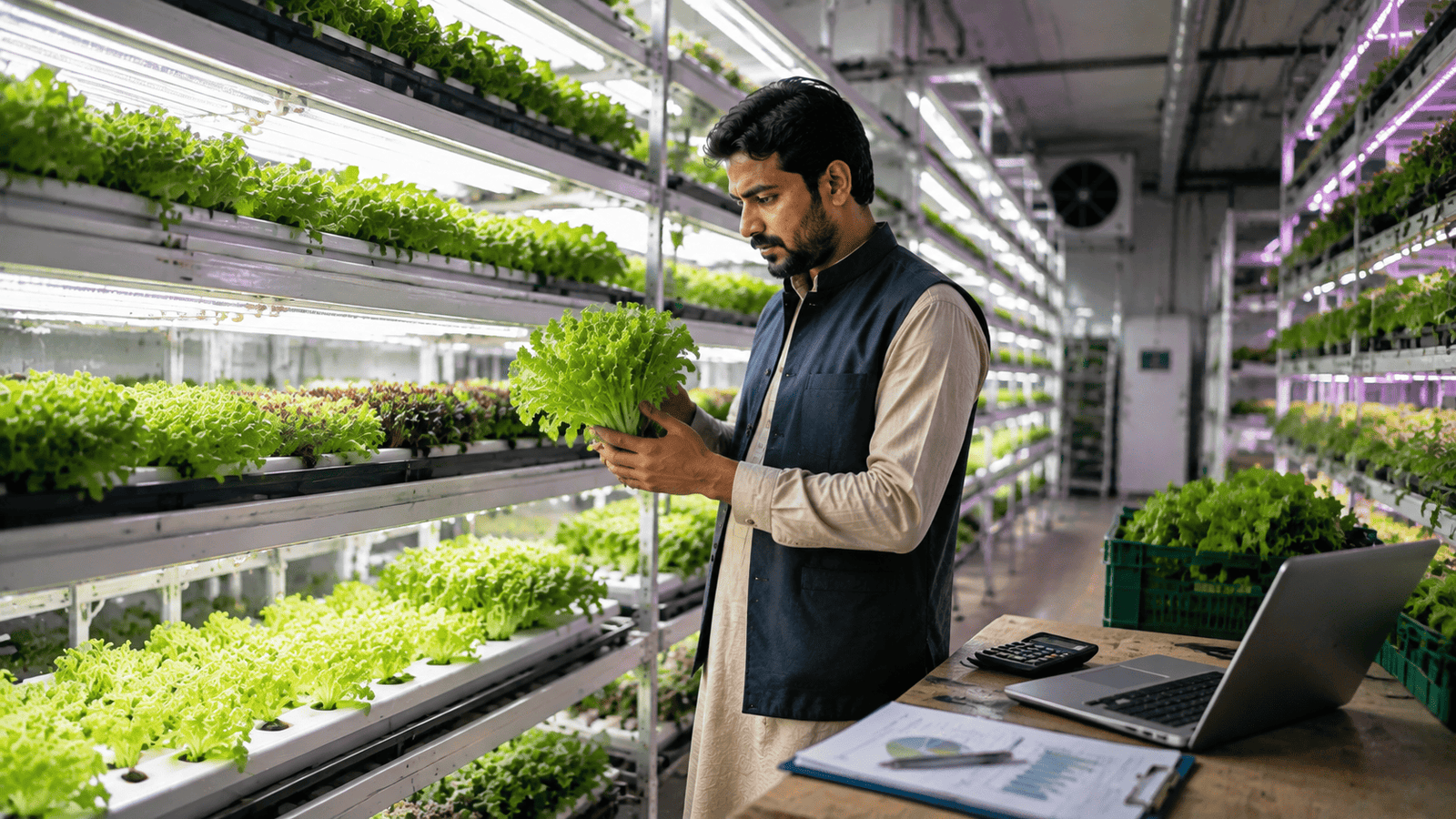
Vertical farming and traditional field farming spend money in almost opposite places. Traditional farming's biggest cost is usually land, with relatively modest ongoing inputs once that land is productive. Vertical farming flips that: land and building footprint are small, but the equipment needed to replace sunlight, weather, and soil — lighting, HVAC, racks, sensors — carries a much higher price tag, both to build and to run every month afterward. Neither approach is inherently cheaper; which one costs less depends heavily on the crop, the location, and the scale involved.
Traditional farming's largest upfront cost is typically land acquisition or lease, followed by buildings, larger field equipment like tractors and irrigation infrastructure, and initial soil preparation. Land cost varies enormously by region and can represent a very large share of total startup investment, particularly near urban areas where farmland is scarce.
Vertical farming needs far less land — often a warehouse or industrial unit rather than acres of field — but the buildout cost per square foot is much higher. Racks, LED fixtures, HVAC systems, water treatment, and sensor infrastructure all have to be purchased and installed before the facility can produce anything. A smaller footprint doesn't mean a smaller capital bill; it shifts the spending from land into equipment.
Traditional farming's recurring costs include seeds, fertilizer, pest management, fuel for machinery, irrigation water, and labor for planting, maintenance, and harvest — costs that fluctuate with weather, pest pressure, and seasonal labor availability.
Vertical farming's recurring costs center on electricity for lighting and climate control, nutrient solution, water treatment, and labor for seeding, monitoring, and harvest. Electricity is usually the single largest operating cost category in a vertical farm, and its size depends heavily on local commercial electricity rates, lighting efficiency, and how well the building retains its climate-controlled environment.
This is where vertical farming's core advantage shows up most clearly: a facility with multiple growing layers can produce many times the crop volume of a single-layer planting on the same floor space, because production scales with layer count rather than acreage. Traditional field farming produces one planting layer per unit of land, regardless of how tall the crop grows.
That space efficiency doesn't automatically translate into lower total cost, though — it just means the cost is concentrated differently. A vertical farm spends more per unit of production on energy and equipment to achieve that density; a traditional farm spends more on the land needed to reach the same total volume.
Vertical farming's recirculating hydroponic or aeroponic systems typically use significantly less water per unit of crop than field irrigation, since little water is lost to evaporation, runoff, or deep soil percolation. This is one of the more consistent advantages vertical farming holds over traditional field production, particularly in water-scarce regions.
Production risk runs in a different direction for each. Traditional farming is exposed to weather events, drought, and outdoor pest pressure across an entire growing season. Vertical farming is exposed to equipment failure, power outages, and mechanical breakdowns — a single system failure can affect an entire facility's crop at once, in a way that a localized field problem typically doesn't.
| Factor | Traditional Farming | Vertical Farming |
|---|---|---|
| Dominant capital cost | Land and field equipment | Racks, lighting, HVAC, controls |
| Dominant operating cost | Seed, fertilizer, fuel, seasonal labor | Electricity, nutrients, year-round labor |
| Space efficiency | One growing layer per unit of land | Multiple growing layers per unit of floor space |
| Water use per unit of crop | Higher (evaporation, runoff) | Generally lower (recirculating systems) |
| Primary production risk | Weather, drought, outdoor pests | Equipment failure, power outages |
| Crop flexibility | Wide range, including staples and grains | Best suited to compact, fast-cycling crops |
Because the two approaches concentrate cost so differently, a fair comparison always needs to specify:
There's no universal answer to "which is cheaper" — it's a calculation specific to a given crop, site, and scale, not a fixed industry-wide fact.
Not automatically. Vertical farming has lower land costs but higher equipment and electricity costs; traditional farming has lower equipment costs but higher land and seasonal input costs. Which is cheaper depends on crop, location, and scale.
Generally yes, per unit of crop produced, because recirculating hydroponic and aeroponic systems lose far less water to evaporation and runoff than field irrigation.
Because vertical farms replace sunlight with LED lighting and manage their own climate with HVAC, both of which draw significant power continuously, unlike a field that receives sunlight and airflow for free.
Generally no. Grains and root vegetables have low per-unit value and long growth cycles that don't offset vertical farming's higher equipment and energy costs, so traditional field farming remains far more cost-effective for those crops.
No. Traditional farming carries its own risks — weather, drought, and outdoor pest pressure — that vertical farming largely avoids by growing indoors, in exchange for exposure to equipment and power-related risks instead.
Comparing vertical and traditional farming costs fairly means looking at where the money actually goes in each system, rather than assuming one is universally cheaper. Vertical farming trades land cost for equipment and energy cost, and gains major advantages in space and water efficiency in return. Traditional farming keeps operating costs lower for a wider range of crops, but ties production to land availability, season, and weather. The right choice — for a grower, investor, or business planner — depends on the specific crop, site, and scale in question.
Want the next article in this series delivered straight to your inbox?
Subscribe to Farmers AdvisoryData sources: USDA Economic Research Service, farm cost and returns data; Cornell University Controlled Environment Agriculture program cost publications; University of Arizona Controlled Environment Agriculture Center resources; USDA Agricultural Marketing Resource Center, controlled environment agriculture economics overview. Figures represent general cost categories and vary by region, crop, and facility scale. Current as of August 5, 2026.