 Farmers Advisory
Farmers Advisory
Farmers Advisory
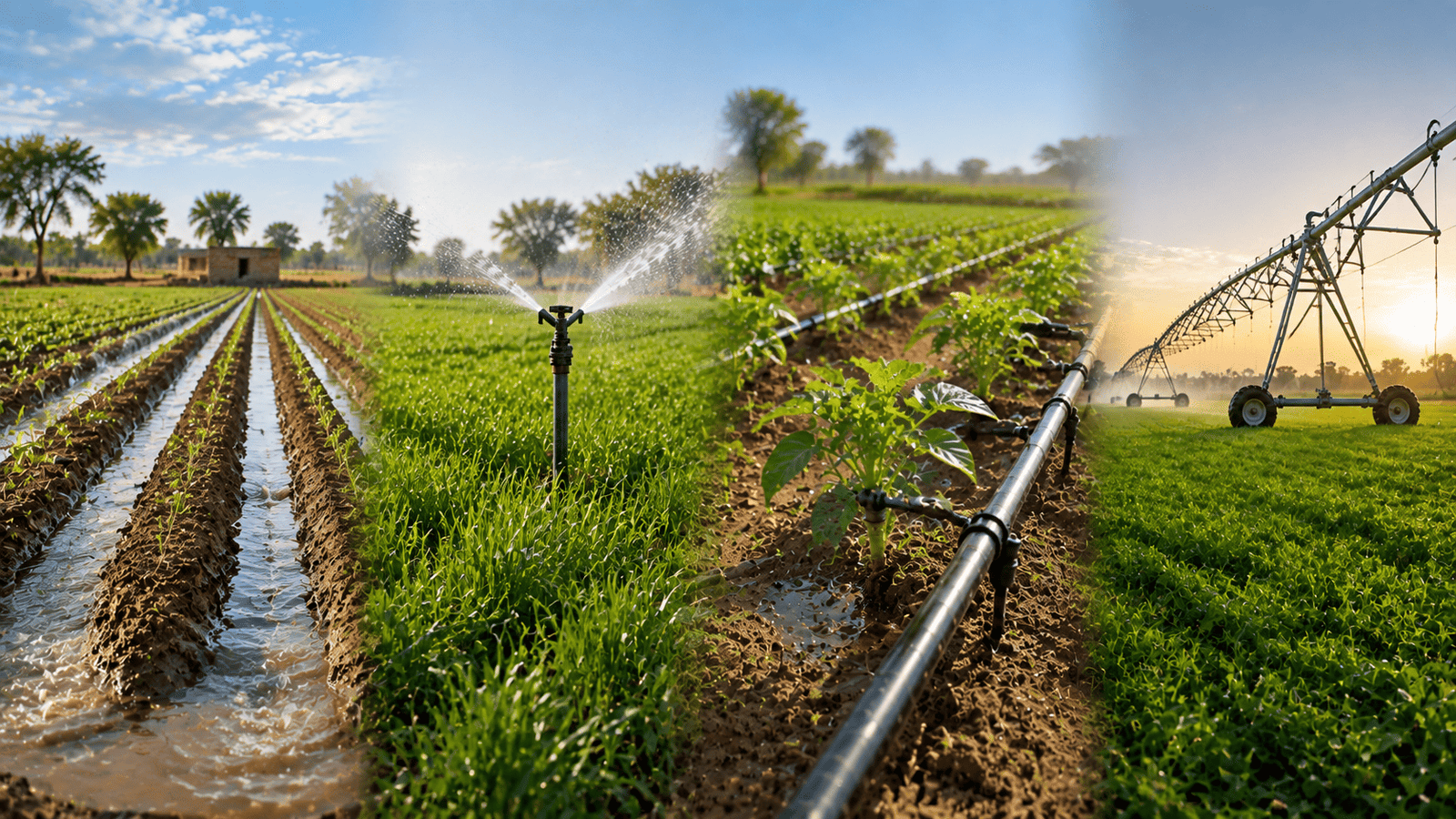
The real target of water conservation in irrigation is the water that never reaches the crop — lost to evaporation off a wet field surface, runoff draining downhill before it infiltrates, or percolation past the root zone into groundwater the crop can't reach. Reducing those losses, rather than simply cutting the total volume applied, is what genuinely conserves water without stressing the crop. This guide covers the scheduling, monitoring, and system practices that make the biggest difference.
Effective irrigation water use can be thought of as a simple balance: water applied minus water lost to evaporation, runoff, deep percolation, and system leakage equals water actually available to the crop. Conservation practices target each of these loss pathways specifically, rather than treating "use less water" as the goal on its own — an approach that risks under-watering the crop instead of cutting genuine waste.
Scheduling irrigation around actual crop water demand, rather than a fixed calendar routine, avoids both over-irrigation (which wastes water and can leach nutrients) and under-irrigation (which stresses the crop and can force a larger correction later). Weather-based scheduling uses local evapotranspiration and rainfall data to estimate how much water the crop has used since the last irrigation, which is covered in detail in our guide to calculating irrigation water requirement. Irrigating during cooler parts of the day, such as early morning, also reduces evaporation losses compared with midday irrigation under full sun and higher wind.
Direct soil moisture monitoring — using tensiometers, capacitance probes, or even simple manual soil checks — confirms whether calculated irrigation requirements match actual field conditions. Reliance on calculation alone can miss local variation caused by soil texture differences across a field, compaction, or drainage issues. Monitoring at multiple depths also shows whether water is reaching the full root zone or pooling near the surface, which points to different fixes.
The irrigation method itself has a major bearing on water-use efficiency: drip and micro-irrigation systems generally lose less to evaporation and runoff than surface or sprinkler methods, as covered in our drip vs sprinkler comparison. Within any system, proper nozzle or emitter selection and correct operating pressure matter just as much — over-pressurized sprinklers atomize water into fine mist that evaporates before reaching the ground, while under-pressurized systems distribute water unevenly. Filtration prevents emitter clogging that leads to uneven application, and routine leak detection catches losses that can otherwise go unnoticed for a full season.
A layer of organic or synthetic mulch on the soil surface reduces direct evaporation by shielding the soil from sun and wind, and it also moderates soil temperature swings that can otherwise increase water stress. Building soil organic matter over time through compost, cover cropping, or reduced tillage improves the soil's water-holding capacity, meaning it can store more available water per irrigation event and require less frequent watering.
Weeds compete directly with the crop for available soil water, so keeping fields reasonably weed-free reduces water demand that isn't contributing to yield. Selecting crop varieties suited to the local climate and water availability — rather than pushing a high-water-demand variety in a water-limited setting — is itself a conservation practice, since it reduces the total irrigation requirement from the outset rather than trying to conserve water after planting a poor fit for the site.
Capturing and storing rainwater — through farm ponds, tanks, or field bunding that slows runoff and encourages infiltration — supplements irrigation water and reduces draw from wells or other primary sources. Even modest rainwater harvesting can meaningfully offset irrigation demand during shoulder seasons when rainfall is inconsistent but present.
Deficit irrigation deliberately applies less water than full crop water requirement during growth stages where the crop is less sensitive to water stress, accepting a small, predictable yield trade-off in exchange for water savings. It can work well for certain crops at certain stages — for example, reducing water during a non-critical vegetative stage for some fruit crops — but it requires specific agronomic knowledge of which crop and which growth stage tolerates the reduction. Applied at the wrong stage, such as flowering or grain fill, deficit irrigation can cause a much larger yield loss than the water saved is worth.
Automated valves, timers, and remote-monitored systems reduce the chance of forgotten or mistimed irrigation events, and many integrate directly with soil moisture sensors or weather stations to adjust scheduling automatically. These tools don't replace the underlying practices above, but they make consistent scheduling and leak detection easier to maintain day to day. Our guide to smart irrigation technology covers these tools and their trade-offs in more depth.
The most effective approach combines accurate scheduling based on crop water demand, direct soil moisture monitoring, a well-maintained and appropriately chosen irrigation system, and practices like mulching that reduce evaporation — rather than any single technique alone.
Drip irrigation generally has lower evaporation and runoff losses, but a poorly maintained or clogged drip system can underperform a well-managed sprinkler system, so system upkeep matters as much as the method chosen.
Deficit irrigation deliberately applies less than full crop water requirement during growth stages when the crop tolerates water stress well. It can save water without major yield loss, but only when matched to the right crop and growth stage — applied carelessly, it can significantly reduce yield.
Yes. Mulch reduces direct evaporation from the soil surface and helps retain soil moisture longer between irrigations, which can reduce how often irrigation is needed.
Routine visual inspection of pipes, valves, and emitters, along with comparing expected versus actual flow rates or water meter readings, can reveal leaks that might otherwise go unnoticed for a full season.
Conserving irrigation water comes down to precision more than restriction — applying the right amount at the right time, catching losses from leaks or poor system design, and using soil health and mulching to stretch every irrigation event further. None of these practices ask a farmer to under-water the crop; they ask for water to be directed more accurately toward the crop's actual needs, which is what separates genuine conservation from simply cutting water and hoping yield holds.
Want more irrigated farming guidance delivered to your inbox every week?
Subscribe to Farmers AdvisoryData sources: FAO Irrigation and Drainage Papers on irrigation efficiency and scheduling; USDA Natural Resources Conservation Service water-conservation guidance; university extension publications on soil moisture monitoring and mulching for water conservation. Figures represent general guidance; actual water savings vary by crop, climate, soil, and system. Current as of August 6, 2026.