 Farmers Advisory
Farmers Advisory
Farmers Advisory
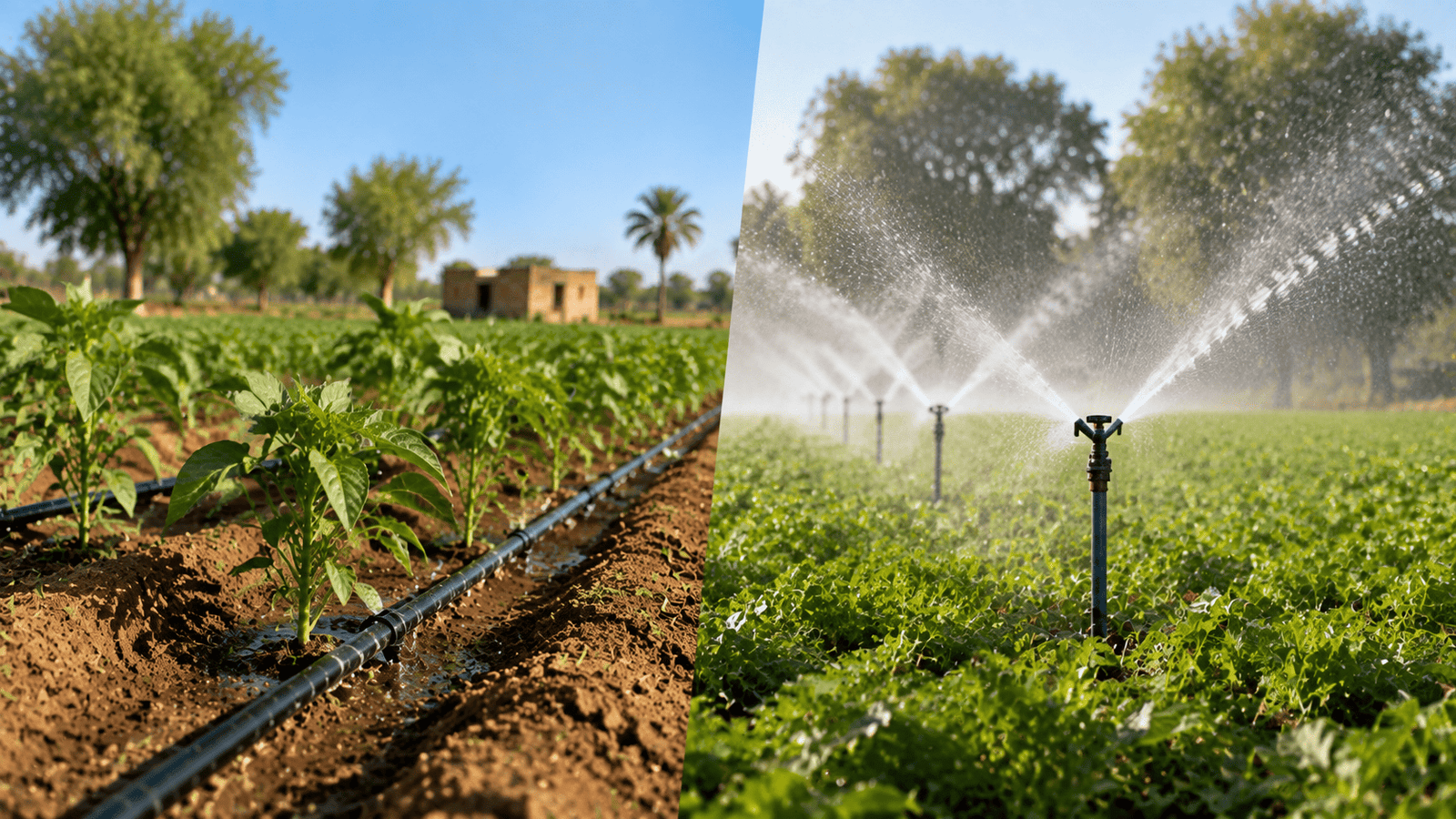
The choice between drip irrigation vs sprinkler irrigation comes up constantly when farmers plan a new field or upgrade an old system, and the honest answer is that it depends on what's being grown, on what terrain, and with what budget. Drip irrigation generally wins on water-use efficiency and root-zone targeting; sprinkler irrigation generally wins on upfront simplicity and suitability for close-planted crops. This comparison walks through both systems side by side so you can weigh the trade-offs against your own field conditions.
| Factor | Drip Irrigation | Sprinkler Irrigation |
|---|---|---|
| Water application | Direct to root zone via tubing and emitters | Overhead spray mimicking rainfall |
| Water-use efficiency | Generally high | Moderate to high |
| Evaporation losses | Low | Higher, especially in heat |
| Wind sensitivity | Minimal | High — wind causes drift and uneven coverage |
| Crop suitability | Row crops, orchards, vineyards, vegetables | Cereals, forage, pasture, closely spaced crops |
| Soil suitability | Most textures; strong fit for sandy soil | Most textures; can crust heavy clay |
| Fertigation | Well suited, precise nutrient placement | Possible but less precise |
| Filtration needs | High — emitters clog easily | Lower, though nozzles can clog too |
| Initial cost | Moderate to high | Moderate |
| Energy use | Lower pressure requirements | Higher pressure requirements |
| Automation | Common, pairs well with soil sensors | Common, especially center-pivot systems |
| Disease pressure | Lower — foliage stays dry | Higher — wet foliage can favor fungal disease |
| Field size and terrain | Flexible, including sloped or irregular land | Best on uniform, moderately sized to large fields |
Drip irrigation moves water at low pressure through a network of mainlines, submains, and laterals fitted with emitters that release water in slow, measured drops or a thin trickle at each plant. Because the water enters the soil close to the roots, very little is lost to evaporation or runs off the surface.
Sprinkler irrigation pressurizes water through pipes to sprinkler heads that spray it into the air, where it falls onto the crop and soil surface much like rain. Coverage depends on nozzle type, spacing, and operating pressure, and a poorly designed layout can leave dry spots between sprinkler heads.
Drip irrigation typically loses less water to evaporation and wind drift than sprinkler irrigation because the water never travels through open air before reaching the soil. Sprinkler systems lose more water to evaporation in hot, dry, or windy conditions, and wind can also blow spray off target entirely. That said, actual efficiency numbers for both systems vary widely with equipment quality, pressure management, and how well the system is scheduled — a neglected drip system can underperform a well-managed sprinkler system.
Drip irrigation suits crops planted in defined rows with enough spacing to justify a dedicated line per row — vegetables, orchards, vineyards, and many row crops. Sprinkler irrigation suits closely spaced or broadcast-planted crops like wheat, barley, and forage, where individual drip lines per plant would be impractical. On soil, drip irrigation is a strong fit for sandy soils that drain quickly since it can apply water in small, frequent doses; sprinkler irrigation works across most soils but can cause surface crusting on some heavy clays if applied too fast for the infiltration rate.
Initial cost for both systems depends heavily on field size, water source, and pipe network length, so a fixed number would be misleading. In general terms, sprinkler systems can be less expensive to install per acre for close-planted field crops, while drip systems cost more upfront per acre for row-crop layouts but often cost less in labor once installed, since manual field walking for irrigation management is reduced. Sprinkler systems typically operate at higher pressure and therefore consume more pumping energy than drip systems, which run at low pressure.
Drip emitters have small openings that clog easily with sediment, algae, or mineral deposits, so drip systems require dependable filtration and periodic line flushing to keep performing well. Sprinkler systems are somewhat more tolerant of untreated water, though nozzles can still clog and moving parts on rotating heads need periodic servicing. Both systems need routine leak checks — small drip leaks are often harder to spot than a leaking sprinkler head, since drip failures may only show up as a wilting plant rather than visible surface water.
Both systems support fertigation — injecting fertilizer into the irrigation water — but drip irrigation generally allows more precise nutrient placement directly at the root zone, reducing fertilizer waste. Automation is common on both: drip systems pair well with soil moisture sensors and timed valves, while sprinkler systems, especially center-pivot units, are often automated with weather- based scheduling and remote monitoring. Our guide to smart irrigation technology covers these tools in more depth.
Drip irrigation tends to make more sense when growing high-value row crops, orchards, or vineyards on land where water is limited, expensive, or of variable quality, and where the crop spacing justifies the added tubing and emitters. Sprinkler irrigation tends to make more sense for close-planted cereals, forage, or pasture, for germinating crops that need surface moisture, or where field size and terrain favor a mechanized, mobile system like center-pivot. Many farms run both systems on different blocks rather than treating the decision as all-or-nothing. For a broader look at how these fit alongside surface and other irrigation methods, see types of irrigation systems for farms.
Drip irrigation is generally more water-efficient because it targets the root zone directly, but a poorly maintained or clogged drip system can underperform a well-managed sprinkler system, so design and upkeep matter as much as the method.
It depends on the crop and field layout. Sprinkler systems can be cheaper per acre for closely spaced field crops, while drip systems often cost more upfront for row-crop layouts but can lower ongoing labor.
It's uncommon. Cereal crops are typically planted too densely to justify a dedicated drip line per row, so sprinkler or surface irrigation methods are more practical for these crops.
Yes, in some cases. Overhead sprinkler irrigation wets the foliage, which can create favorable conditions for certain fungal diseases, whereas drip irrigation keeps foliage dry since water is applied at soil level.
Yes. Drip emitters have small openings that clog easily with sediment, algae, or mineral deposits, so reliable filtration is essential for a drip system to keep working as designed.
Yes. Many farms use sprinkler irrigation for cereal or forage fields and drip irrigation for vegetable, orchard, or vineyard blocks, matching each system to the crop it serves.
Drip and sprinkler irrigation solve the same underlying problem — getting water to a crop reliably — in different ways, and each carries a distinct set of trade-offs. Drip irrigation generally offers tighter water-use efficiency and lower disease pressure for row crops and orchards; sprinkler irrigation offers broader coverage and simpler filtration demands for close-planted field crops. The right answer depends on what you're growing, your water source, and how much you're able to invest upfront, not on either system being categorically better.
Want more irrigated farming guidance delivered to your inbox every week?
Subscribe to Farmers AdvisoryData sources: FAO Irrigation and Drainage Papers comparing drip and sprinkler system performance; USDA Natural Resources Conservation Service irrigation guides; university extension drip and sprinkler irrigation fact sheets. Figures represent general guidance; actual efficiency, cost, and performance vary by farm, region, water quality, and equipment. Current as of August 6, 2026.