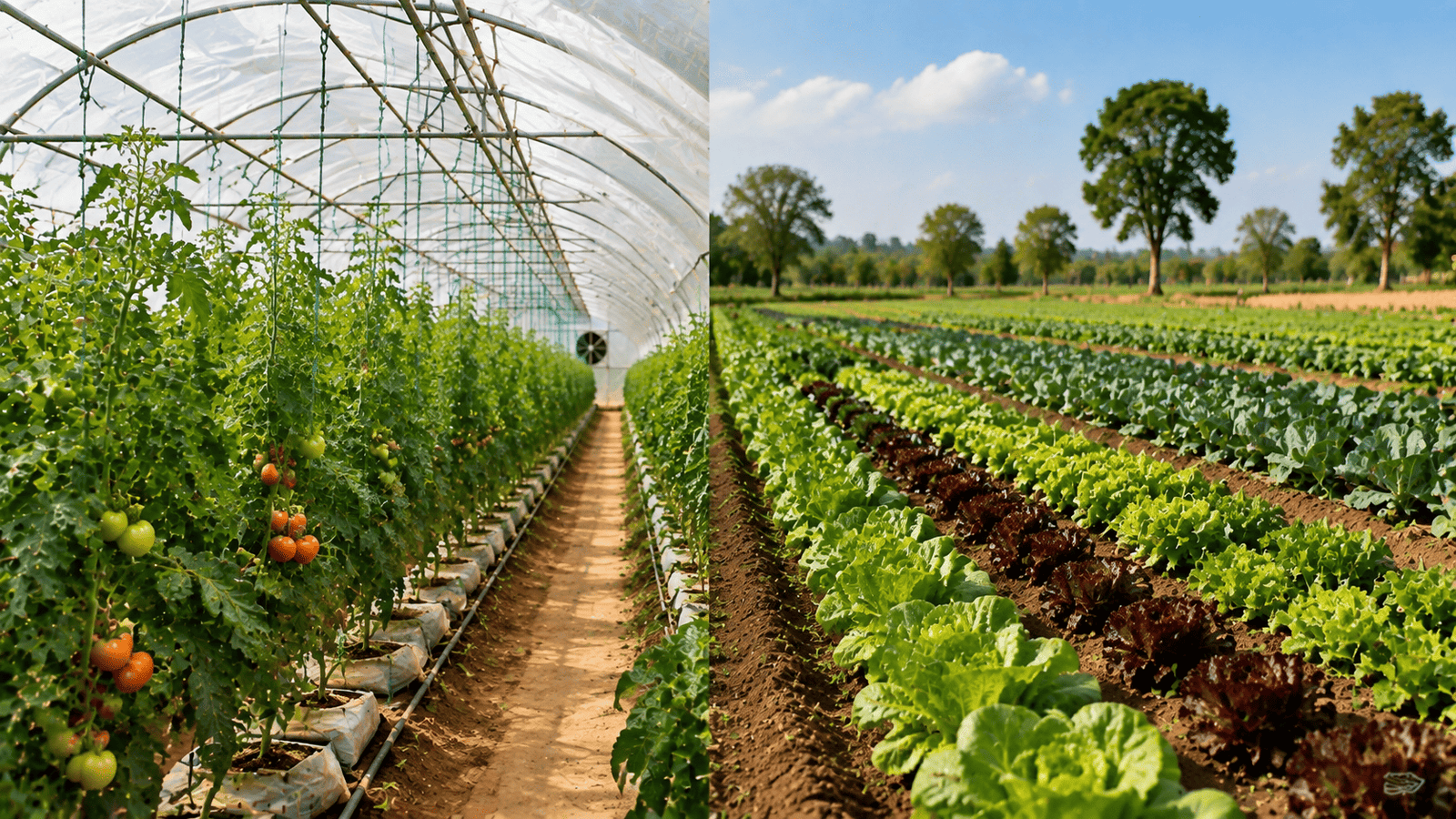
Best Crops to Grow in a Greenhouse: A Comparison Guide (2026)
By Farmers Advisory Editorial Team ·
Published August 5, 2026 · Updated August 5, 2026 · 10 min read ·
Category: Greenhouse Farming
The best greenhouse crop isn't a fixed list — it's whatever matches your structure's climate control, your local market, and your own experience level.
"What should I grow in my greenhouse?" doesn't have one right answer — it has one right answer
for your setup. A crop that thrives in a heated, automated glasshouse can struggle in an
unheated hoop house, and a crop with strong wholesale demand in one region may have none in another.
This guide compares the most common greenhouse crops — tomatoes, cucumbers, peppers,
leafy greens, herbs, and more — across temperature needs, light, growth cycle, yield potential, and
difficulty, so you can match the crop to your actual greenhouse and market rather than a generic
"best crops" list.
Key Takeaways
Fruiting vegetables like tomatoes, cucumbers, and peppers generally need warmer temperatures, more light, and more labor than leafy greens or herbs.
Leafy greens and herbs have shorter growth cycles and lower difficulty, making them a common starting point for new greenhouse growers.
Crop suitability depends on your greenhouse's heating, cooling, and ventilation capacity — not just the crop's general preferences.
Commercial viability depends as much on local market demand and selling price as on how well a crop grows in your structure.
There's no single "best" greenhouse crop — the right choice balances climate fit, difficulty, and what your local market will actually buy.
Greenhouse Crop Comparison Table
Common Greenhouse Crops Compared
Crop
Temperature Preference
Light Need
Growth Cycle
Beginner Difficulty
Tomatoes
Warm, stable
High
Long (multiple months)
Moderate–High
Cucumbers
Warm
High
Moderate
Moderate
Bell peppers / chilies
Warm
High
Long
Moderate–High
Lettuce
Cool–moderate
Moderate
Short
Low
Spinach
Cool
Moderate
Short
Low
Herbs (basil, mint, cilantro)
Varies by herb
Moderate–High
Short–Moderate
Low–Moderate
Strawberries
Cool–moderate
High
Moderate, perennial cycles possible
Moderate
Table reflects general
crop tendencies, not fixed values. Actual temperature and light requirements shift with variety,
growth stage, and local climate — confirm specifics with a local extension service or seed supplier
before planning a commercial crop.
💡 Quick Tip
Match crop difficulty to your own experience before matching it to market price. A high-value crop
that dies from a climate mismatch or a missed disease outbreak earns nothing — a well-grown lower-value
crop still earns something.
1. Fruiting Vegetables
Tomatoes, cucumbers, peppers, and eggplant are the backbone of most commercial greenhouse operations
because they combine strong market demand with yields that benefit noticeably from protected, climate-
controlled conditions.
Tomatoes: the most widely grown commercial greenhouse crop worldwide; reward
consistent temperature and humidity management but are also more sensitive to climate swings and
disease pressure than many alternatives
Cucumbers: fast-growing and productive under good conditions, with a shorter
cycle than tomatoes, but sensitive to temperature drops and humidity extremes
Peppers and chilies: tolerate a somewhat wider range of conditions than tomatoes
in many cases, with a longer time to first harvest
All fruiting vegetables generally need consistent pollination support in enclosed structures,
whether through natural insect access, introduced pollinators, or manual methods
2. Leafy Greens
Lettuce, spinach, and other leafy greens are a common entry point for new greenhouse growers and a
staple of many soilless and hydroponic greenhouse systems.
Shorter growth cycles mean faster feedback on what's working and more crop cycles per year
Generally tolerate cooler temperatures and lower light than fruiting vegetables, which can reduce
heating and lighting costs in some climates
Well suited to vertical or multi-tier growing systems that increase yield per square foot of
greenhouse floor space
Lower per-unit price than fruiting vegetables in most markets, so profitability usually depends on
volume and consistent turnover rather than premium pricing
3. Herbs
Basil, mint, cilantro, parsley, and similar herbs can be strong greenhouse crops where local demand
supports them, particularly for restaurant and specialty grocery markets.
Requirements vary meaningfully by herb — basil is warmth-loving and light-hungry, while mint and
cilantro tolerate cooler conditions
Often sold at a meaningful premium per unit weight compared to bulk vegetables, though total
volume per plant is lower
Many herbs are well suited to smaller-scale or supplemental greenhouse production alongside a
primary crop
4. Strawberries and Other Fruit
Strawberries are the most common greenhouse fruit crop, valued for extending the harvest season
beyond what open-field production allows in many climates.
Benefit from protected conditions that reduce fruit rot and pest pressure common in open-field growing
Can be grown in raised troughs or vertical systems to improve labor efficiency for harvesting
Season-extension value can be significant where greenhouse-grown strawberries fill a market gap
between local field seasons
5. What Determines Crop Fit
Before settling on a crop, weigh it against your specific structure and situation rather than a
generic "best crops" ranking:
Your greenhouse's climate control: an unheated structure limits which crops can
be grown through cold seasons; see our
temperature and humidity control guide for how much control your design actually provides
Local climate: outdoor conditions determine how much heating, cooling, or shading
your greenhouse needs to reach a crop's ideal range
Light levels: covering material, greenhouse orientation, and local day length all
affect how much usable light reaches the crop
Labor availability: fruiting vegetables generally require more pruning, training,
and harvest labor than leafy greens
Disease risk: humid, enclosed environments can favor certain fungal and bacterial
diseases depending on the crop and ventilation quality
Market demand: a crop with no local buyer isn't a viable commercial choice
regardless of how well it grows
⚠️ Common Mistake
Choosing a crop based on price per unit alone, without checking whether the local market can actually
absorb the volume a greenhouse can produce. A profitable-looking crop with no buyer for the harvest
produces nothing.
6. Beginner-Friendly vs Commercial-Scale Choices
✅ Good Starting Crops
Lettuce and other leafy greens — short cycle, forgiving, low startup risk
Herbs like basil and mint — fast turnover, useful for testing a market before scaling
Bush-type peppers — moderate difficulty with strong demand in many markets
❌ Higher-Commitment Crops
Tomatoes — high value but demanding on climate consistency and disease management
Cucumbers at commercial scale — fast-moving crop that punishes inconsistent care
Strawberries — rewarding but requires more specialized bed or trough systems
There's no single answer — profitability depends on local selling price, yield, market demand,
and your production costs, not the crop alone. Tomatoes are the most widely grown commercial
greenhouse crop globally, but that doesn't guarantee profitability in every market.
What is the easiest crop to grow in a greenhouse for beginners?
Leafy greens like lettuce and herbs such as basil or mint are generally considered more forgiving
for beginners due to their shorter growth cycles and wider tolerance for temperature and light
variation compared to fruiting vegetables.
Can I grow tomatoes in an unheated greenhouse?
It depends on your local climate. Tomatoes generally need consistently warm conditions, so an
unheated greenhouse in a cold climate may only support them during the warmer part of the year.
Do all greenhouse crops need the same temperature and humidity?
No. Requirements vary significantly by crop and even by variety and growth stage. Fruiting
vegetables generally need warmer conditions than leafy greens, and humidity tolerance also differs
by crop.
Can I grow multiple crops in the same greenhouse?
Yes, many greenhouse operations grow several crops, either in separate zones with different
climate settings or in succession through the year. This can also help spread market and weather
risk across more than one crop.
Do greenhouse crops need pollinators?
Fruiting vegetables like tomatoes, cucumbers, and peppers generally need pollination support in
enclosed structures, since natural insect access is limited. This is often addressed through
introduced pollinators, vibration/manual pollination, or vents that allow insect access.
Conclusion
The best crop for your greenhouse is the one that matches three things at once: what your structure
can actually control climate-wise, what you're equipped to manage in terms of labor and skill, and what
your local market will pay for. Fruiting vegetables offer higher value but demand more from both grower
and greenhouse; leafy greens and herbs offer a gentler entry point with faster feedback. Start with an
honest assessment of your setup and market, not a generic ranking, and the crop choice tends to follow
naturally.
Want more greenhouse farming guidance delivered to your inbox every week?
General crop-characteristic framework informed by publicly available horticultural extension guidance
on protected agriculture and greenhouse crop production. Specific temperature, light, and yield figures
are intentionally omitted because they vary by variety, growth stage, and local climate — verify with a
local agricultural extension service or seed supplier before commercial planning. Current as of August
5, 2026.
 Farmers Advisory