 Farmers Advisory
Farmers Advisory
Farmers Advisory
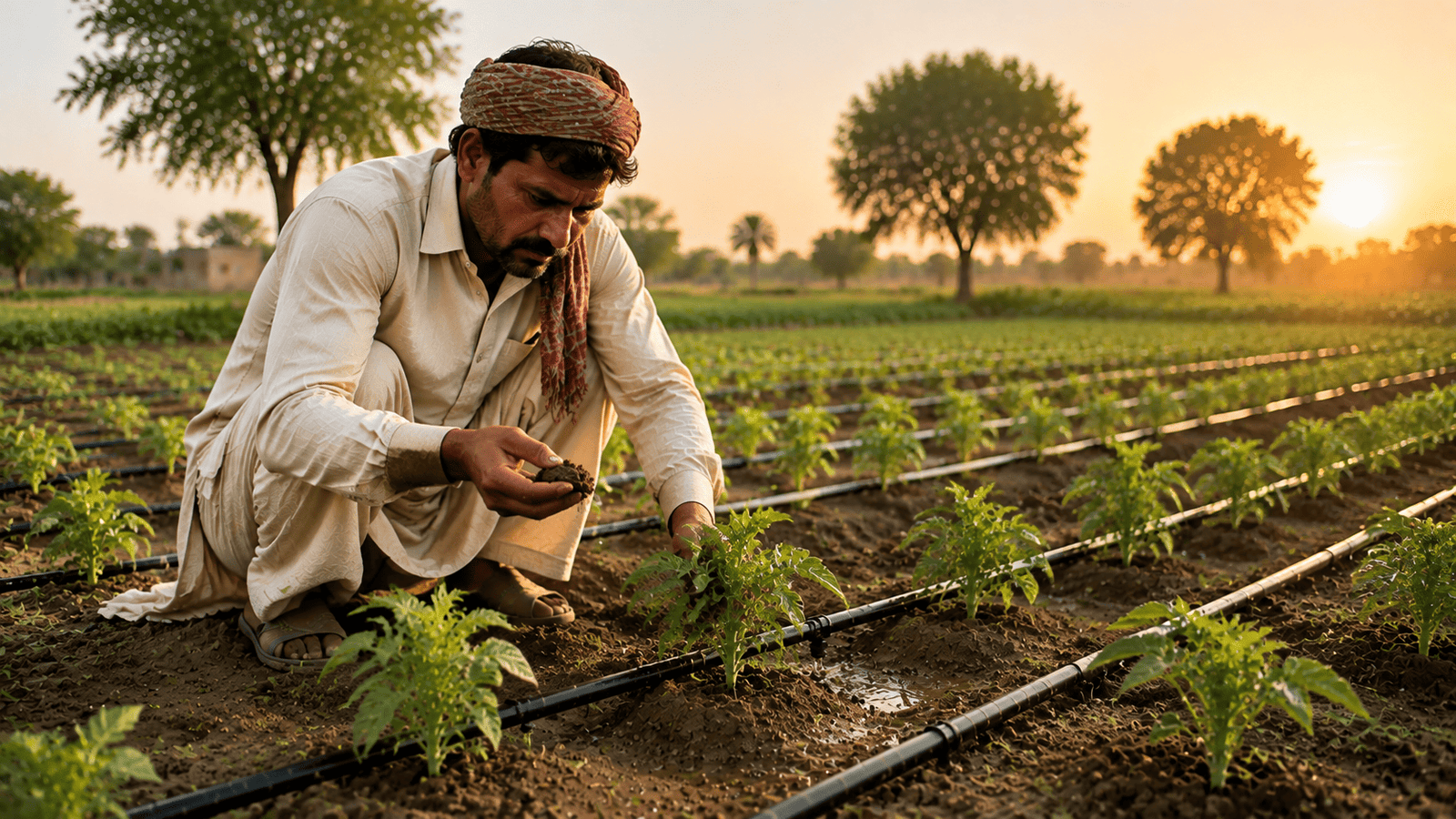
Designing a drip irrigation system for a small farm comes down to matching each component — pump, filter, mainline, laterals, and emitters — to the field's actual water source, crop layout, and terrain. Skip a step, like filtration or pressure regulation, and even a well-planned layout can underperform. This guide walks through the full design process in order, from assessing the farm to scheduling the finished system, with a worked example for a small vegetable plot.
Every drip irrigation system, regardless of farm size, follows the same general sequence of components:
The specific pipe sizes, pump capacity, and number of zones needed at each stage depend entirely on the farm's own conditions — there is no single specification that fits every small farm. The sections below walk through how to determine those specifics for your own field.
Before selecting any equipment, map out the essentials: field dimensions and shape, elevation changes across the field, the crops being grown and their row and plant spacing, and the location and capacity of the available water source. Elevation matters because it affects pressure — water flowing downhill gains pressure, while water flowing uphill loses it, which affects how the system needs to be zoned and regulated.
The water source — well, borehole, canal, tank, or municipal supply — determines available flow rate and whether a pump is even needed, since some elevated or pressurized sources may not require one. Where a pump is needed, its required flow rate and pressure depend on total emitter demand across the zone being irrigated at once, pipe friction losses over the mainline's length, and any elevation gain between the source and the field. Undersizing a pump leads to weak pressure and uneven distribution across the field; oversizing wastes energy and can stress smaller-diameter laterals.
Filtration protects the small openings in drip emitters from sediment, algae, and organic debris that would otherwise clog them. The appropriate filter type depends on the water source — sand or media filters suit water with organic matter and algae, while screen or disc filters suit water with sediment. Skipping filtration, or under-sizing it relative to the water source's contamination level, is one of the most common reasons drip systems underperform after installation.
Drip emitters are designed to operate within a specific pressure range, and pressure regulators keep the system within that range regardless of pump output or elevation changes across the field. Without regulation, emitters near the pump may discharge more water than emitters farther away or at a different elevation, leading to uneven watering across the field.
The mainline carries water from the pump and filtration setup to the field, and submains branch off the mainline to serve specific sections or zones. Pipe diameter for both needs to be sized to the flow rate required, since undersized pipe increases friction loss and reduces pressure at the far end of the line. The correct diameter depends on total flow demand and pipe length, which is why a universal pipe size recommendation without those specifics would be misleading.
Laterals are the smaller-diameter tubes that run along each crop row, fitted with emitters spaced to match plant spacing. Emitter discharge rate and spacing depend on the crop's water requirement, root spread, and soil type — sandier soils generally benefit from closer emitter spacing since water spreads less laterally through sand than through finer-textured soil. Matching emitter flow rate to soil infiltration rate also matters: emitters that discharge faster than the soil can absorb cause surface pooling and runoff even within a drip system.
Dividing a farm into irrigation zones, each controlled by its own valve, allows a single pump and filtration setup to serve more total area than it could irrigate all at once, since zones run in sequence rather than simultaneously. This is especially useful on small farms where pump capacity is limited relative to total field size. A fertigation injector can be added after the filter (or per zone, depending on design) to apply fertilizer through the irrigation water, and flush points at the ends of laterals allow sediment to be flushed out periodically during maintenance.
The layout below illustrates how the components fit together for a small, hypothetical vegetable plot. Actual pipe sizes, pump specifications, and emitter rates for any real farm must be calculated from that farm's own flow, pressure, and layout data.
| Component | Illustrative Assumption |
|---|---|
| Water source | Shallow well with an electric pump |
| Zones | 2 zones, run sequentially to stay within pump capacity |
| Filtration | Screen filter sized for well water with light sediment |
| Mainline | Sized to carry the combined flow of one zone at a time |
| Laterals | One lateral per crop row, spaced to match row spacing |
| Emitters | Spaced to match in-row plant spacing, matched to soil infiltration rate |
| Fertigation | Simple venturi injector installed after the filter |
Once installed, irrigation scheduling should follow the crop's actual water requirement, covered in our guide on calculating irrigation water requirement, rather than a fixed routine. Regular maintenance — filter cleaning, flushing laterals, and checking for clogged or leaking emitters — keeps the system performing at its designed efficiency. Systems that are otherwise well designed can still underperform without this ongoing upkeep.
The typical flow is water source, then pump, then filter, then pressure regulation, then mainline, then submain, then laterals, then emitters delivering water to the root zone.
Yes. Drip emitters have small openings that clog easily with sediment, algae, or organic debris, and skipping filtration is one of the most common causes of drip system failure regardless of farm size.
Pipe diameter and pump capacity depend on total flow demand, pipe length, and elevation change across your specific field — there's no universal size that fits every small farm, so these need to be calculated or specified by an irrigation supplier based on your layout.
Yes. A simple fertilizer injector, such as a venturi injector, can be installed after the filter to apply fertilizer through the irrigation water directly to the root zone.
Zoning lets a single pump serve more total field area by irrigating sections in sequence rather than all at once, which is especially useful when pump capacity is limited relative to the whole farm's needs.
A well-designed drip system for a small farm follows the same logical sequence every time — source, pump, filter, regulation, mainline, laterals, emitters — but the specifics at each stage have to be sized to that farm's own water source, crop layout, and terrain. Getting filtration and pressure regulation right early on prevents most of the common failures that show up later, and treating the design as something to review and adjust after installation, rather than a one-time fixed plan, keeps the system performing as intended.
Want more irrigated farming guidance delivered to your inbox every week?
Subscribe to Farmers AdvisoryData sources: FAO Irrigation and Drainage Papers on localized (drip) irrigation design; USDA Natural Resources Conservation Service drip irrigation guidance; university extension small-farm drip irrigation design publications. Figures represent design methodology and illustrative assumptions; actual component sizing must reflect farm-specific conditions. Current as of August 6, 2026.