By Farmers Advisory Editorial Team ·
Published August 6, 2026 · Updated August 6, 2026 · 11 min read ·
Category: Integrated Farming
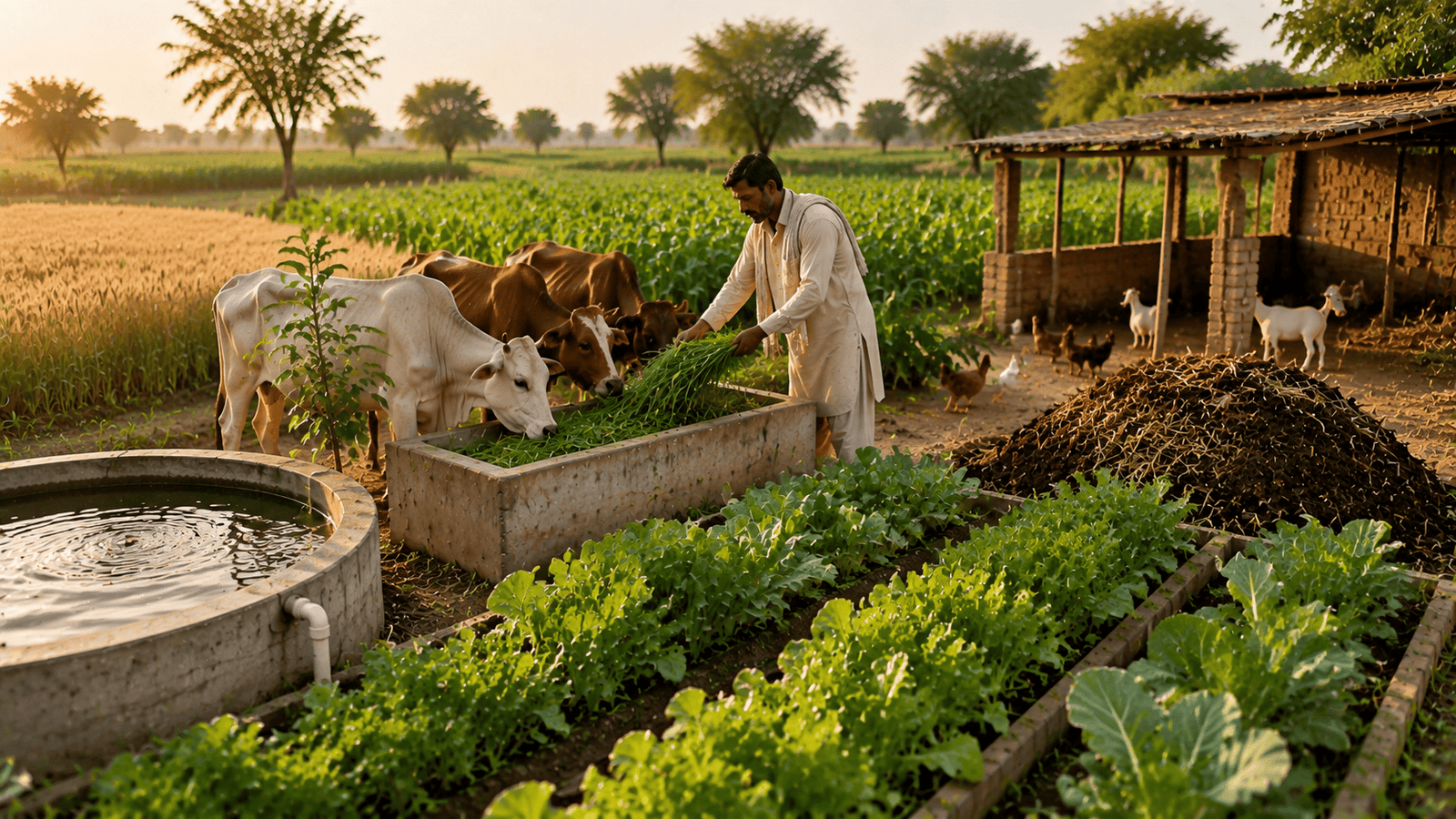
On a small holding, integration is less about scale and more about making a limited amount of land, water, and labor work harder.
For a small farmer working a limited plot, integrated farming's real appeal isn't a promise of
automatic higher profit — it's the chance to get more use out of land, water, and labor that would
otherwise support only one enterprise. A few chickens fed on kitchen and garden scraps, a small
livestock pen supplying manure for vegetable beds, or a backyard pond stocked with fish can each add a
modest income stream without requiring more land. This guide covers the genuine benefits small farmers
can expect, and the limitations that determine whether those benefits actually materialize.
Key Takeaways
Integration lets small farmers extract more value from the same land and water rather than requiring more of either.
Multiple income streams (crop, livestock, eggs, fish) reduce the impact of any single bad season or price drop.
Recycling crop residue and manure on-farm can lower purchased feed and fertilizer costs over time, though rarely eliminates them entirely.
Integration adds management complexity and labor — it is not automatically less work than a single-enterprise farm.
Whether integration pays off depends heavily on local markets, disease management, and the farmer's own capacity to coordinate multiple components.
1. Income Diversification
A small farm running a single crop is fully exposed to that crop's price and yield in any given
season. Adding a second or third enterprise — eggs, milk, fish, or a second crop — spreads that
exposure across multiple products, so a poor result in one doesn't determine the entire season's income.
This doesn't guarantee higher total income, but it does reduce the odds of a total loss.
2. Resource Recycling and Reduced Waste
Kitchen and garden scraps that would otherwise be discarded can become poultry or livestock feed
Crop residue that would be burned or left to rot can be composted or fed to animals instead
Manure that would otherwise need disposal becomes a fertilizer input, reducing purchased fertilizer volume over time
These savings compound gradually rather than appearing immediately — the first season often shows
modest gains while composting and feeding routines are still being established.
3. Better Use of Land and Water
On a small plot, layering enterprises — vegetables under a trellis with poultry housed at the edge,
or a small pond alongside a garden bed — can generate more total output per unit of land than a single
crop alone. Water used for one purpose, such as pond water rich in nutrients, can sometimes irrigate
adjacent beds rather than being drawn twice from a limited source.
4. Household Food Production and Food Security
A mixed small farm can supply a wider range of household food needs directly — vegetables, eggs, milk, or fish — reducing dependence on purchased food
This diversification also buffers household nutrition against a single crop failure in a way a monocrop garden doesn't
5. Risk Diversification and Resilience
💡 Quick Tip
Resilience comes from genuine independence between components, not just their number. If a disease
that affects poultry could also spread to fish through shared water, or if a drought affects both
crops and livestock feed at once, the components aren't diversifying risk as much as they appear to.
Choose combinations where failure in one component doesn't easily cascade into another.
6. Market Flexibility
Multiple products give a small farmer more than one market to sell into, and more flexibility in
timing sales — holding eggs or milk for a better local price while a grain crop is still in the field,
for instance. This flexibility is genuinely useful but depends on there being local demand for each
product; producing five things nobody nearby wants to buy doesn't create market flexibility.
7. Limitations Small Farmers Should Weigh
⚠️ Important
Integrated farming is not automatically more profitable than a well-run single-enterprise farm.
Whether it pays off depends on management skill, local markets, and how well the components are
actually coordinated — not on the mere fact of combining them.
Management complexity: more components mean more decisions, more knowledge required, and more things that can go wrong simultaneously
Labor: daily feeding, manure handling, and monitoring take real time that a single-enterprise farm doesn't require
Disease risk: closer proximity between species can spread disease faster without careful biosecurity
Initial investment: housing, fencing, or pond construction require upfront capital before any benefit appears
Technical knowledge: feeding, composting, and animal health each require some learning, particularly for a farmer new to livestock or aquaculture
Market access: a diversified product mix only helps if there's somewhere nearby to sell each product
Coordination: timing crop, livestock, and other components so each one's needs and outputs line up takes ongoing attention
Benefits vs. Limitations at a Glance
✅ Genuine Benefits
Multiple income streams reduce single-point failure risk
Recycled residue and manure can lower input costs over time
More total output possible from the same small land area
❌ Real Limitations
More daily labor and management complexity
Upfront investment before benefits appear
Coordination and disease-risk management take real skill
Frequently Asked Questions
Is integrated farming easier than single-enterprise farming for a small farmer?
Not necessarily. It generally requires more daily labor and broader management skills, since
more components need feeding, monitoring, and coordination.
Does integrated farming always increase income for small farmers?
No. Income depends on management, local markets, and how well components are coordinated —
integration diversifies risk but doesn't guarantee higher total income.
What's the easiest way for a small farmer to start integrating?
Starting with a small, manageable pairing — such as a garden plot and a handful of poultry fed
on kitchen scraps — lets a farmer learn the coordination skills before scaling up to more components.
Can integrated farming reduce food costs for a farming household?
Yes, often — producing a wider range of food directly (vegetables, eggs, milk, fish) can reduce
how much a household needs to purchase, though this depends on what's actually produced and consumed.
Does combining more components always mean more risk diversification?
Not automatically. If components share a common vulnerability — such as disease that can spread
between species sharing water — the risk isn't as diversified as the number of components suggests.
Conclusion
For a small farmer, integrated farming's value lies in stretching limited land, water, and labor
across more than one productive use, not in any promise that combining enterprises automatically raises
income. The benefits — diversified income, recycled resources, better land use, improved food
security — are real when management, market access, and disease control are handled well, and absent or
even negative when they aren't. Starting small, with one added component at a time, is the most reliable
way to find out which combination actually works on a given plot. For a broader look at proven
combinations, see our guide to
integrated farming system examples.
Want more integrated farming guides delivered to your inbox every week?
General background: FAO Climate-Smart Agriculture Sourcebook, Module B5 on integrated production
systems and smallholder resilience; FAO Plant Production and Protection Division guidance on
integrated crop-livestock systems. Outcomes for individual farms vary with management, local markets,
climate, and scale — treat the guidance here as a general framework rather than a guaranteed result.
Current as of August 6, 2026.
 Farmers Advisory