 Farmers Advisory
Farmers Advisory
Farmers Advisory
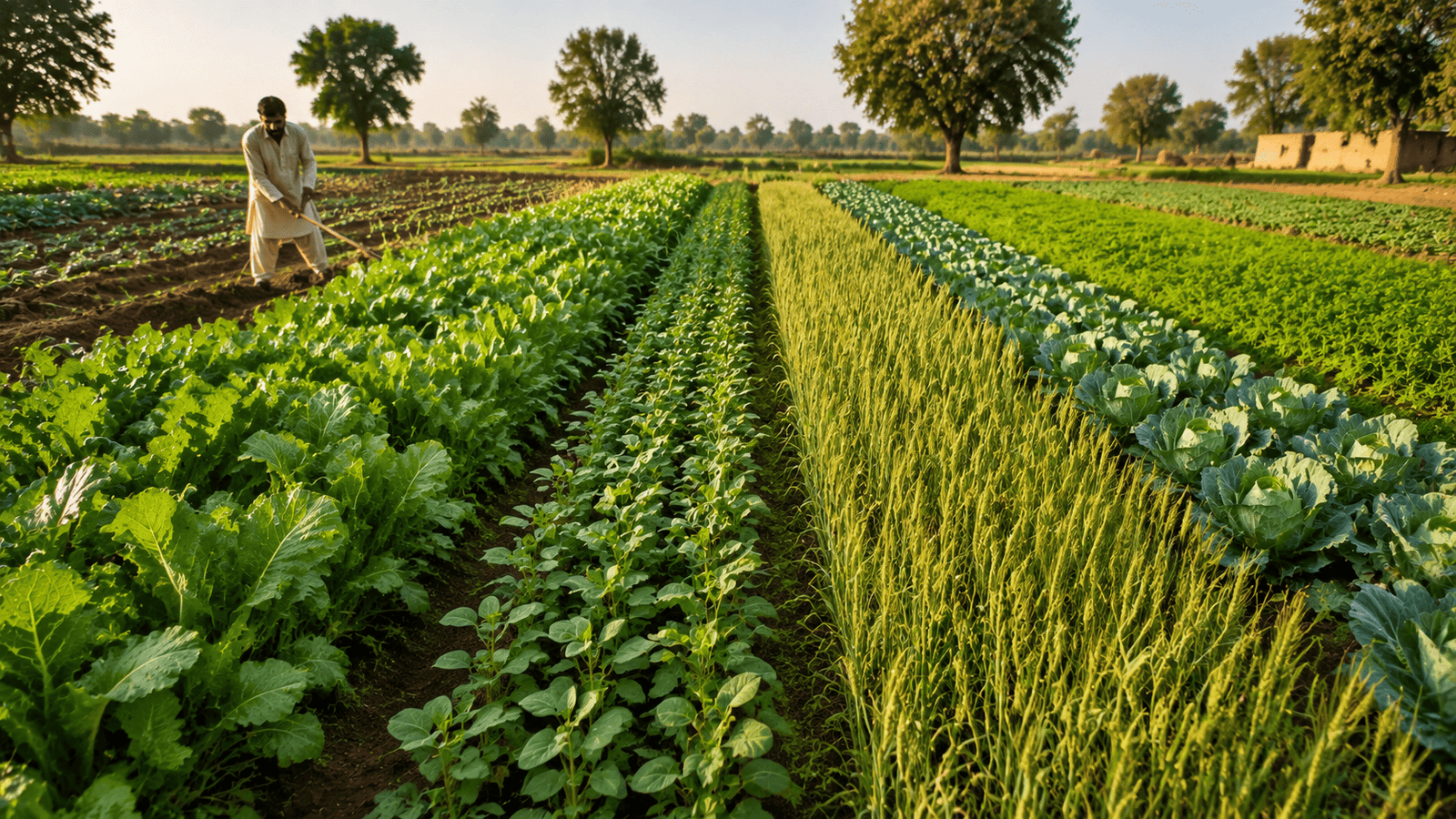
Crop rotation is the practice of growing different crops in a planned sequence on the same field across seasons, rather than planting the same crop repeatedly. In organic systems it isn't optional background practice — it's one of the primary tools replacing synthetic fertilizer and pesticide use, since it rebuilds soil fertility and interrupts pest and disease cycles at the same time. This guide covers how crop rotation in organic farming actually works, how to group crops by family, how long a rotation should run, and gives sample plans for small and large operations.
Without synthetic fertilizers to reliably top up nutrients and without synthetic pesticides to knock back an outbreak, organic systems need built-in mechanisms that prevent problems before they start. Rotation delivers three benefits simultaneously: it varies the nutrient demand placed on the soil so no single nutrient gets depleted season after season, it interrupts the life cycle of pests and pathogens that depend on a specific host crop, and it changes weed pressure by varying planting dates, root depths, and canopy structure year to year.
A field planted to the same crop repeatedly, even with compost added every season, will typically see rising pest and disease pressure over time, since organisms specific to that crop have an uninterrupted host to build up on. Rotation breaks that continuity.
Rotation planning starts with crop families, since pests and diseases are frequently family-specific rather than crop-specific.
| Family | Example Crops | General Nutrient Demand |
|---|---|---|
| Legumes (Fabaceae) | Beans, peas, clover, vetch | Low nitrogen need; fixes nitrogen for following crops |
| Brassicas | Cabbage, broccoli, kale, mustard | Heavy feeders, particularly nitrogen |
| Nightshades (Solanaceae) | Tomatoes, peppers, potatoes, eggplant | Moderate to heavy feeders; shared disease susceptibility |
| Cucurbits | Squash, cucumber, melon, pumpkin | Moderate feeders |
| Alliums | Onion, garlic, leek | Moderate feeders; some pest and disease overlap with other alliums only |
| Grasses/cereals | Corn, wheat, oats, barley | Heavy feeders, particularly nitrogen |
The core rule: avoid planting a crop from the same family in the same field in consecutive seasons, and ideally separate related families by at least one full season between plantings.
Legumes host bacteria in their root nodules that convert atmospheric nitrogen into a plant-available form, effectively adding fertility to the soil rather than just consuming it. Placing a legume crop or legume cover crop immediately before a heavy nitrogen feeder — brassicas or corn, for example — takes advantage of that nitrogen while it's most available.
Cover crops occupy fallow periods that would otherwise leave soil bare, which matters because bare soil is vulnerable to erosion, weed colonization, and organic matter loss.
Many soil-borne pathogens and pest larvae overwinter in the soil near where their host crop was grown. Moving that host crop's family to a different field the following season removes the food source the overwintering pest or pathogen population depends on, causing that population to decline before the host returns.
Different crops create different competitive conditions for weeds — a densely canopied crop shades out light-dependent weeds, while a crop planted and cultivated at a different time of year disrupts weeds timed to germinate around a specific planting window. Alternating crop types interrupts the conditions that let any one weed species build a persistent seed bank in a field.
Rotation length is a balance between practicality and pest/disease suppression strength.
| Year | Field A | Field B | Field C | Field D |
|---|---|---|---|---|
| Year 1 | Legumes | Brassicas | Nightshades | Cucurbits |
| Year 2 | Brassicas | Nightshades | Cucurbits | Legumes |
| Year 3 | Nightshades | Cucurbits | Legumes | Brassicas |
| Year 4 | Cucurbits | Legumes | Brassicas | Nightshades |
Each field cycles through all four crop groups over four years, with a legume phase always preceding the heavy-feeding brassica phase to take advantage of fixed nitrogen.
| Year | Crop/Phase | Purpose |
|---|---|---|
| Year 1 | Legume cover crop (clover or vetch) | Fix nitrogen, suppress weeds, build organic matter |
| Year 2 | Cereal grain (wheat or oats) | Take advantage of fixed nitrogen for a heavy-feeding cash crop |
| Year 3 | Row crop (corn) or second cereal | Continue nutrient cycling before returning to legume phase |
Most organic operations use a minimum 3-4 year rotation, with some fields benefiting from 5-7 year rotations where persistent soil-borne pests or diseases are a known problem.
Without synthetic fertilizers and pesticides to fall back on, rotation is one of the primary tools organic systems use to manage soil fertility and interrupt pest and disease cycles.
Yes. The same family-grouping principles apply at any scale — divide beds or plots into zones and cycle crop families through them season to season, just as a larger field would.
A heavy nitrogen feeder, such as brassicas or corn, takes best advantage of the nitrogen a legume phase leaves behind in the soil.
Yes. Cover crops are a functional rotation phase, protecting soil, suppressing weeds, and often adding fertility during what would otherwise be a bare fallow period.
Pest and disease pressure specific to the repeatedly planted crop tends to build up over time, and soil fertility often declines faster since the same nutrients are drawn down season after season.
List your crops by family, map your fields or beds, and sketch a multi-year sequence that avoids repeating a family in the same location in consecutive seasons, placing legumes ahead of heavy feeders where possible.
Crop rotation earns its central place in organic systems by solving three problems with one practice: it spreads out nutrient demand instead of exhausting the same nutrients repeatedly, it denies pests and pathogens the continuous host they need to build up, and it varies the conditions that let persistent weeds establish. None of this requires expensive inputs — it requires mapping crop families onto fields or beds a season or more in advance and following through on the sequence. Start with a simple 3-4 year plan grouped by family, and refine the rotation over time as you learn which pests, diseases, and weeds are actually pressuring your specific fields.
Want more organic farming guidance delivered to your inbox every week?
Subscribe to Farmers AdvisoryGeneral guidance drawn from publicly available agricultural extension and organic-standards resources, including university extension services and organic certification organizations. Optimal rotation length and sequencing vary by crop, soil, climate, and specific pest or disease pressure — consult a local agricultural extension office for recommendations tailored to your region. Current as of August 5, 2026.