By Farmers Advisory Editorial Team ·
Published August 5, 2026 · Updated August 5, 2026 · 9 min read ·
Category: Hydroponic Farming
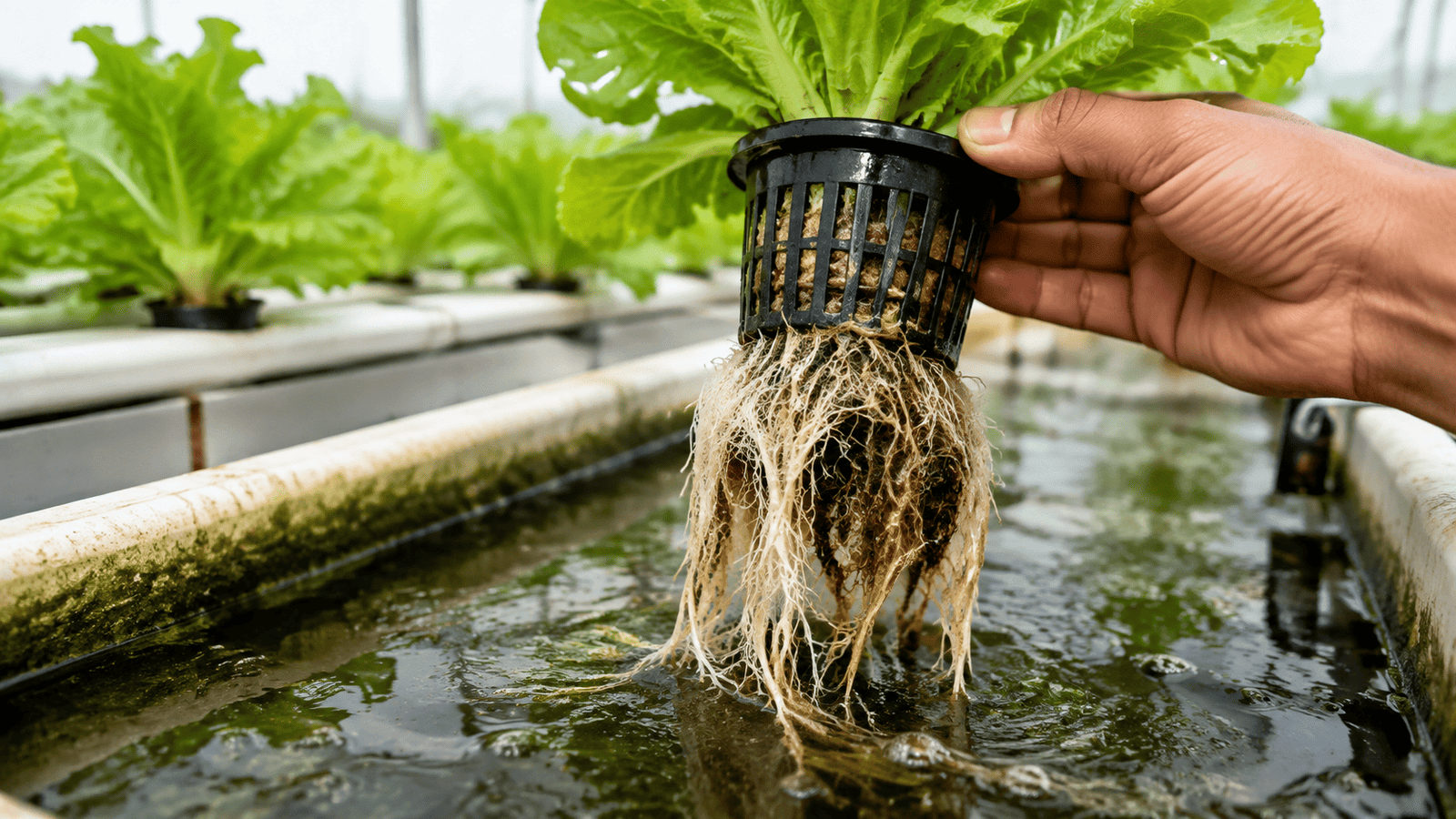
DWC suspends roots directly in still, oxygenated water; NFT keeps a thin film of nutrient solution constantly flowing past the roots — the difference shapes almost everything else about each system.
Deep Water Culture (DWC) and Nutrient Film Technique (NFT) are two of the most common
hydroponic systems, and beginners often ask which one is "better." The honest answer is neither —
they suit different situations. This guide compares DWC vs NFT hydroponic systems
across how each works, oxygenation, equipment, failure risk, crop suitability, and cost, so you can
match the system to your space, budget, and crop rather than guessing.
Key Takeaways
DWC suspends roots in a still, aerated nutrient reservoir; NFT continuously pumps a thin film of nutrient solution through a sloped channel past the roots.
DWC depends on a working air pump; NFT depends on a working water pump running near-continuously — a pump failure is a real risk in both, but NFT roots dry out faster once flow stops.
DWC is generally the more forgiving, lower-cost entry point; NFT scales more easily for growing many plants in a compact footprint.
Leafy greens with light root systems suit NFT well; larger or heavier-rooted plants generally do better in DWC or other systems entirely.
Neither system is universally superior — the right choice depends on your crop, budget, space, and tolerance for equipment failure risk.
How DWC Works
In Deep Water Culture, plant roots hang directly into a reservoir of nutrient solution, held in
place by a net pot sitting in a lid above the water line. An air pump connected to one or more air
stones continuously bubbles the reservoir, keeping the water oxygenated since the roots are
permanently submerged. There's no flow or pumping of the nutrient solution itself in a basic DWC
setup — the water sits still except for the aeration bubbles.
How NFT Works
In Nutrient Film Technique, plants sit in net pots along a slightly sloped channel or tube. A
water pump continuously moves nutrient solution from a reservoir to the top of the channel, where it
flows as a thin film past the roots before draining back into the reservoir. Roots aren't submerged;
they sit mostly in open air within the channel, picking up moisture and nutrients from the thin,
moving film as it passes.
Root Environment and Oxygenation
DWC: roots are fully submerged in still water, so oxygenation depends entirely on the air pump keeping dissolved oxygen levels up
NFT: roots are mostly exposed to air between water flow, which naturally provides oxygen — but only as long as the film keeps flowing
DWC roots are more vulnerable to low-oxygen stress if the air pump fails; NFT roots dry out and can wilt within hours if the water pump fails, since there's no standing reservoir around them
Equipment and Setup Complexity
Core Equipment by System
Component
DWC
NFT
Reservoir
Yes — doubles as the growing chamber
Yes — separate from the growing channel
Air pump and air stone
Required
Optional, but often used in the reservoir
Water pump
Not required
Required, running near-continuously
Sloped channel or tubing
Not needed
Required, with a consistent slope for drainage
Net pots
Yes
Yes
DWC setup is generally simpler — a bucket or tote, a lid, net pots, and an air pump can be
assembled in an afternoon. NFT requires getting the channel slope and pump flow rate right so the
film stays thin and consistent along the full length of the channel, which takes more setup care.
Maintenance and Failure Risk
⚠️ Important
NFT roots have very little water buffer — if the pump stops, roots can begin drying out within a
few hours, especially in warm conditions. DWC roots sitting in a full reservoir have more buffer
time if the air pump briefly fails, though extended outages still cause oxygen stress.
DWC maintenance centers on monitoring water level, topping up evaporated water, and keeping the air stone from clogging
NFT maintenance centers on checking the pump, watching for clogs in the channel (root mats can block flow over time), and confirming the film hasn't gone dry in any section
Both systems need regular pH and EC checks regardless of which one you choose
Electricity and Pump Dependence
DWC's air pump can often run on a small backup battery for a short outage, since air pumps typically draw very little power
NFT's water pump is a harder single point of failure — the system doesn't function at all without continuous flow, so power reliability matters more
Both benefit from a pump on a dedicated circuit and, ideally, some form of failure alert or backup for anyone growing at any meaningful scale
Crop Suitability
DWC: well suited to lettuce, herbs, and other plants that tolerate having roots constantly submerged; less ideal for crops sensitive to waterlogged roots
NFT: best suited to fast-growing, shallow-rooted crops like lettuce and leafy greens grown in tight succession; heavier or larger-rooted crops can outgrow the thin channel and clog flow
Neither system is typically the first choice for large fruiting crops like tomatoes, which are more commonly grown in drip or media-bed systems
Space, Beginner Fit, and Scalability
DWC scales by adding more buckets or a larger reservoir with more net pot sites — simple, but each unit is fairly space-inefficient per plant
NFT scales well horizontally or vertically in long channels, fitting more plants per square foot once the flow system is dialed in
For a first-ever hydroponic system, DWC's simplicity and lower failure consequences generally make it the easier starting point
NFT tends to suit growers who've already learned the basics and want a more space-efficient, higher-throughput setup
Cost Considerations
A small DWC setup is typically cheaper to build initially, since it skips the water pump and channel components
NFT's water pump, channel, and tubing add upfront cost, and a continuously running pump adds a bit more to ongoing electricity use than DWC's air pump alone
At larger scale, NFT's better use of space per plant can offset its higher per-unit setup cost — the comparison shifts with scale, not just per-unit price
💡 Quick Tip
If you're unsure which to choose, build a small DWC system first. The pH, EC, and monitoring
skills transfer directly to NFT later, and you'll have a much better sense of whether the added
complexity of a flowing system is worth it for your goals.
DWC vs NFT Comparison Table
DWC vs NFT — Side-by-Side Comparison
Factor
DWC
NFT
Water movement
Still, aerated reservoir
Continuous thin film flow
Oxygen source
Air pump and air stone
Air exposure of roots between flow
Pump dependence
Air pump only
Water pump, running near-continuously
Failure tolerance
Moderate — reservoir buffers short outages
Low — roots can dry within hours of a pump stop
Setup complexity
Low
Moderate to higher
Best crop fit
Lettuce, herbs, other tolerant shallow-rooted crops
Fast-growing, shallow-rooted leafy greens
Space efficiency
Lower per plant
Higher per plant at scale
Beginner suitability
High
Moderate
Commercial scalability
Moderate
High, once dialed in
Relative upfront cost
Lower for small setups
Higher for small setups, more efficient at scale
Which System Fits Your Situation
Choose DWC if: this is your first hydroponic system, you want the simplest possible setup, or you're growing a small number of plants and want to minimize failure risk
Choose NFT if: you've already run a simple system successfully, you're growing many fast-cycling leafy greens, and you can ensure reliable, continuous power to the water pump
Consider a different system if: you're growing large fruiting crops like tomatoes or peppers, where drip or media-bed systems are typically a better structural fit
Frequently Asked Questions
Is DWC or NFT better for beginners?
DWC is generally the better starting point — it has fewer components, a lower failure
consequence if the pump briefly stops, and is cheaper to build for a small first setup.
What happens if the pump fails in an NFT system?
Since NFT roots sit mostly in open air relying on the flowing film for moisture, a pump
failure can lead to roots drying out within a few hours, especially in warm conditions.
Can I grow tomatoes in DWC or NFT?
It's possible on a small scale, but neither system is the typical first choice for large
fruiting crops — drip or media-bed systems generally handle bigger root systems and plant weight better.
Does NFT use less water than DWC?
Both systems recirculate nutrient solution, so water use is broadly similar; the bigger
differences between them are in oxygenation method, equipment, and failure risk rather than water volume.
Which system is more space-efficient for growing lots of plants?
NFT channels typically pack more plants into a given footprint than individual DWC buckets or
totes, which is part of why NFT is common in larger-scale leafy green production.
Do I need an air pump in an NFT system?
It's not strictly required since roots get oxygen from air exposure between flow cycles, but
many growers still aerate the reservoir to keep dissolved oxygen levels higher, especially in warm conditions.
Conclusion
DWC and NFT solve the same basic problem — getting nutrients and oxygen to roots without soil —
in fundamentally different ways, and that difference cascades into everything from setup cost to
failure risk to which crops actually thrive in each. DWC rewards simplicity and forgives mistakes;
NFT rewards precision and space efficiency once you've got the flow dialed in. Match the system to
your crop, your space, and how much monitoring you're realistically willing to do, rather than
assuming one is objectively better than the other.
Want more hydroponic farming guides delivered to your inbox every week?
Data sources: Cornell University Controlled Environment Agriculture program guidance; University of
Arizona Controlled Environment Agriculture Center resources; Utah State University Extension
hydroponics fact sheets; Virginia Tech Extension hydroponic systems guidance. Figures and system
behaviors represent general guidance and vary by build quality, climate, and crop. Current as of
August 5, 2026.
 Farmers Advisory