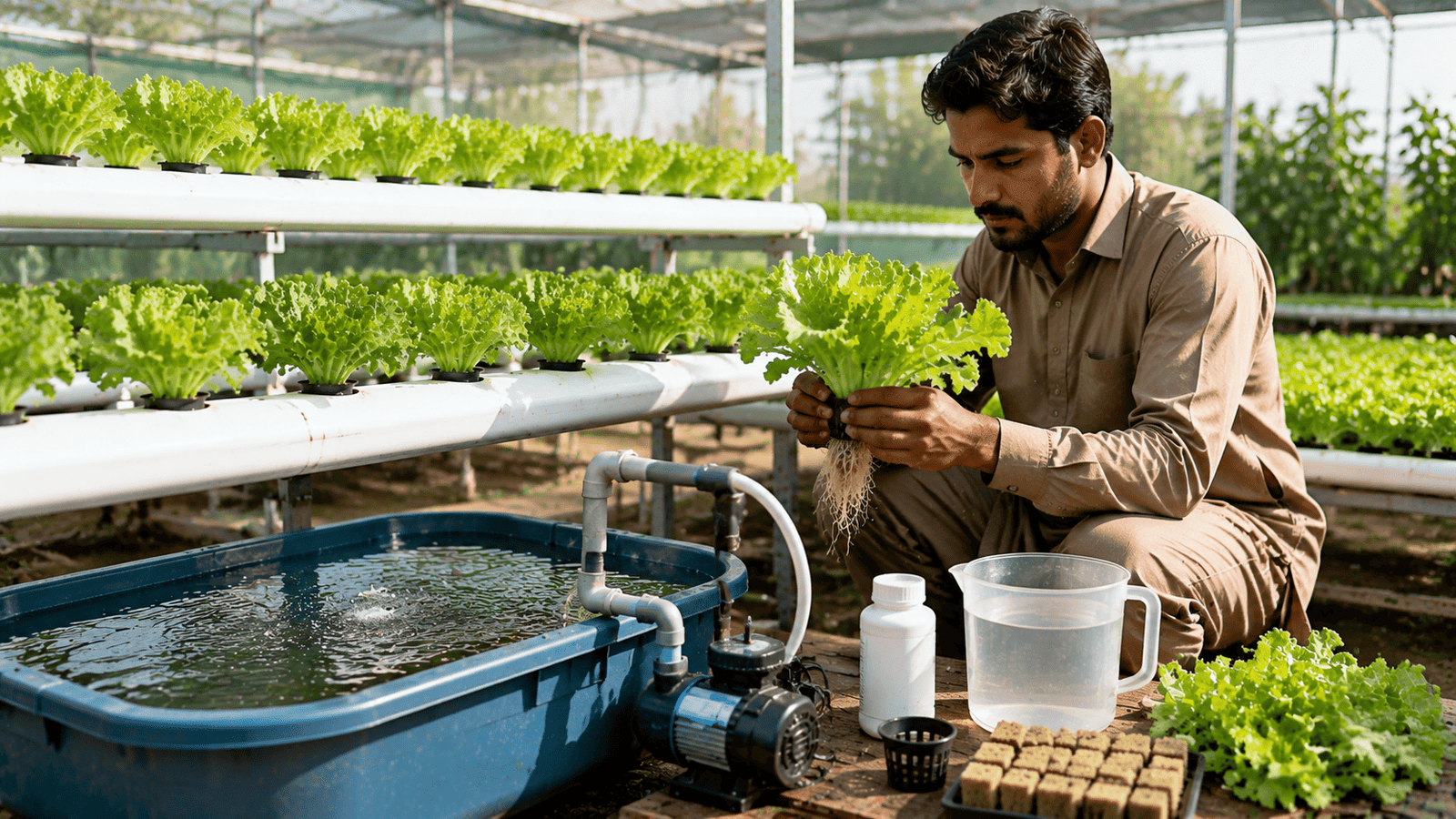
How to Start Hydroponic Farming at Home: A Beginner's Setup Guide (2026)
By Farmers Advisory Editorial Team ·
Published August 5, 2026 · Updated August 5, 2026 · 11 min read ·
Category: Hydroponic Farming
Most beginner hydroponic setups fail for the same three reasons: an unstable pH, poor oxygenation at the roots, and a system that's more complicated than the grower actually needs.
Hydroponic farming lets you grow vegetables and herbs indoors or on a balcony without soil, using a
nutrient solution to feed the roots directly. It's not exotic lab equipment — a working starter system
can fit on a kitchen counter and cost less than a nice bicycle. This guide covers how to start
hydroponic farming at home in 2026: picking a location and light source, choosing a system
type that matches your space and budget, the core equipment every setup needs, nutrient and pH basics,
and the mistakes that trip up most first-time growers.
Key Takeaways
A basic deep water culture (DWC) setup is the easiest and cheapest way for most beginners to start — it has the fewest moving parts and the lowest failure risk.
pH and nutrient concentration (EC/TDS) matter more than the system type itself; get these wrong and no system design will save the crop.
Leafy greens and herbs (lettuce, basil, spinach) are far more forgiving for a first attempt than fruiting crops like tomatoes or peppers.
Root-zone oxygen is just as important as nutrients — stagnant, low-oxygen water is the single most common cause of early crop failure.
Start with one small system and one or two crops before scaling up. Most abandoned home hydroponic projects were oversized on day one.
What Hydroponic Farming Actually Is
Hydroponic farming grows plants without soil, delivering water, dissolved nutrients, and oxygen
directly to the root zone. Roots are typically supported in an inert growing medium — such as rockwool,
clay pebbles, or coco coir — inside a net pot, while a reservoir below or beside the plant holds the
nutrient solution. Because the grower controls nutrient concentration and pH directly rather than relying
on soil chemistry, plants can grow faster and more predictably than in-ground crops, provided the water
and root-zone conditions are managed correctly.
The tradeoff is that hydroponic systems have no soil to buffer mistakes. A pH swing, a failed air pump,
or an unnoticed leak affects the crop far faster than it would in soil, which is why beginner systems
should stay simple and easy to monitor at a glance.
Beginner Setup Checklist
Core Items for a First Home Hydroponic System
Item
Purpose
Beginner Priority
Reservoir / container
Holds nutrient solution
Essential
Net pots + growing medium
Anchors roots, allows water contact
Essential
Air pump + air stone
Oxygenates the root zone
Essential for DWC
pH testing kit or meter
Keeps nutrients available to roots
Essential
EC or TDS meter
Prevents over- or under-feeding
Strongly recommended
Hydroponic nutrient concentrate
Feeds the plant directly
Essential
Grow light (if indoors)
Replaces or supplements sunlight
Essential indoors
Water pump (NFT/drip only)
Circulates solution past roots
System-dependent
💡 Quick Tip
Buy a pH meter and an EC/TDS meter before you buy anything else. Every other mistake in hydroponics is recoverable; a prolonged wrong pH is not.
1. Choosing a Location and Light Source
Indoors: gives full control over temperature and pests, but requires a grow light for anything beyond low-light leafy greens — natural windowsill light is rarely sufficient on its own for fruiting crops
Outdoors or on a balcony: uses free sunlight but exposes the system to temperature swings, rain dilution, and algae growth in clear reservoirs
Fruiting crops (tomatoes, peppers, cucumbers) generally need considerably more light than leafy greens or herbs — factor this in before choosing a first crop
Keep the reservoir out of direct, prolonged sun exposure where possible; warm reservoir water holds less dissolved oxygen and encourages algae
2. Choosing a Hydroponic System
System choice should follow your budget, space, and tolerance for troubleshooting — not the other way
around. The four most common beginner-accessible systems are:
Deep Water Culture (DWC): roots hang directly in an oxygenated nutrient reservoir. Simple, cheap, and forgiving, but relies entirely on the air pump staying on.
Nutrient Film Technique (NFT): a thin film of nutrient solution is pumped continuously past roots in a sloped channel. Efficient at scale, but a pump failure can dry out roots quickly since there's no standing reservoir at the roots.
Drip systems: nutrient solution is dripped onto the growing medium at intervals. Flexible and scalable, with more tubing and emitters to maintain and occasionally unclog.
Wick systems: passive, using a wick to draw solution up to the roots with no pump or electricity at all. Very low-maintenance, but generally limited to small, slow-growing plants.
For a first attempt, a small DWC bucket or tote is usually the most sensible starting point: it has
the fewest failure modes, the lowest cost of entry, and teaches the fundamentals — pH, EC, oxygenation —
that every other system depends on.
3. Core Equipment You'll Need
Growing medium and containers
Net pots hold an inert medium — rockwool cubes, expanded clay pebbles (LECA), or coco coir are all
common choices — that supports the stem while letting roots grow through into the solution below. None
of these mediums provide nutrients themselves; they exist purely for physical support and moisture
retention.
Reservoir, air pump, and air stones
The reservoir should be opaque or light-blocked to prevent algae growth, which competes with roots for
oxygen and nutrients. An aquarium-style air pump connected to one or more air stones keeps dissolved
oxygen levels high enough for root health — this single component is arguably the most failure-critical
part of a DWC system.
Water circulation (NFT and drip systems)
Systems that move water past the roots rather than submerging them need a small water pump, tubing,
and — for NFT — a slightly sloped channel so solution flows back to the reservoir by gravity.
4. Nutrient Solution, pH, and EC Basics
Hydroponic plants get 100% of their nutrition from the solution you mix, so getting the basics right
matters more here than in soil, where nutrients are buffered and slowly released.
pH: most hydroponic crops prefer a slightly acidic range, though the ideal target varies by crop — use a reliable meter or liquid test kit and adjust with pH-up or pH-down solutions in small increments
EC/TDS: measures nutrient concentration in the water; too low and plants are underfed, too high and roots can be damaged by nutrient burn — target concentration varies by crop and growth stage
Nutrient concentrate: use a complete hydroponic-specific formula (not general houseplant fertilizer) that supplies both macronutrients and micronutrients
Water temperature: keep reservoir water cool where possible — warm water holds less oxygen and encourages root disease
⚠️ Common Mistake
Mixing nutrient concentrate to "look about right" instead of measuring with an EC or TDS meter. Because there's no soil to buffer errors, over-concentrated solution can damage roots within days.
5. Starting Seeds and Transplanting
Germinate seeds in a small cube of rockwool or a similar starter medium kept moist (not soaked) until the first true leaves appear
Transplant seedlings into net pots once roots are visible extending from the starter medium
Space plants according to their mature size, not their seedling size — overcrowding restricts light and airflow as plants grow
Introduce seedlings to full-strength nutrient solution gradually rather than all at once, since young roots are more sensitive to concentration
6. Monitoring, Cleaning, and Maintenance
Check pH and EC every 1-3 days at minimum; both drift as plants take up water and nutrients unevenly
Top off or fully replace reservoir water on a regular schedule rather than waiting until levels run low
Inspect air stones periodically for clogging, since reduced airflow directly reduces oxygen at the roots
Clean the reservoir and lines between growing cycles to prevent algae and biofilm buildup
Watch temperature and humidity around the plants — both affect growth rate and disease risk independent of the nutrient solution itself
7. Common Beginner Mistakes
Starting with a fruiting crop (tomatoes, peppers) before mastering the basics on an easier leafy green
Letting the air pump run without a backup plan for power outages, which can suffocate roots within hours in DWC systems
Ignoring pH drift because "the plants still look fine" — nutrient lockout often shows up days after the pH problem started
Building an oversized system for a first attempt, which multiplies both cost and the number of things that can go wrong at once
Using a clear reservoir or tubing that lets in light, inviting algae growth that competes with roots
Pros and Cons of Starting Small
✅ Starting Small (One Bucket, One Crop)
Low cost of entry and low risk if something goes wrong
Easier to monitor pH, EC, and root health closely
Mistakes are cheap lessons rather than a lost season
❌ Starting Large (Multi-Plant System)
Higher upfront cost for pumps, lighting, and plumbing
A single equipment failure affects far more plants at once
More complex troubleshooting when problems appear
Frequently Asked Questions
Is hydroponic farming hard to learn as a beginner?
The core skills — checking pH, checking EC, and keeping roots oxygenated — are straightforward to
learn, but they need to be done consistently. Most beginner failures come from inconsistency, not
from the concepts being difficult.
What's the easiest hydroponic system to start with at home?
A small deep water culture (DWC) setup is generally considered the easiest starting point, since
it has fewer moving parts than NFT or drip systems and is more forgiving of minor mistakes.
Do I need grow lights for hydroponic farming indoors?
In most cases, yes. Natural window light is rarely strong or consistent enough for anything beyond
very low-light leafy greens, so an indoor setup typically needs a dedicated grow light matched to the crop.
How often do I need to check pH and nutrients?
Checking every 1-3 days is a reasonable starting routine for a small home system, since both pH
and nutrient concentration drift as plants take up water and nutrients unevenly.
Can hydroponic systems fail if the power goes out?
Yes, particularly DWC and NFT systems that depend on air or water pumps. An extended outage can
reduce root-zone oxygen significantly, which is why backup power or a manual air-supply plan is worth
considering.
What vegetables should a beginner grow first?
Leafy greens and herbs such as lettuce, basil, and spinach are typically recommended first, since
they grow quickly, tolerate minor mistakes better, and need less light than fruiting crops.
Conclusion
Starting hydroponic farming at home comes down to a handful of fundamentals done consistently: pick a
simple system, keep the roots oxygenated, and monitor pH and nutrient concentration rather than guessing.
A single DWC bucket growing lettuce or basil on a sunny counter or under a small grow light is enough to
learn every core skill that scales up to larger systems later. Most abandoned home hydroponic projects
weren't defeated by the technology — they were defeated by starting too big, too fast.
Want more hydroponic farming guides delivered to your inbox every week?
General guidance referenced from university extension and controlled-environment agriculture programs,
including Cornell University's Controlled Environment Agriculture program, University of Arizona's
Controlled Environment Agriculture Center, and Purdue University Extension horticulture publications.
Figures and ranges represent general guidance and vary by crop, system type, and environmental
conditions. Current as of August 5, 2026.
 Farmers Advisory