 Farmers Advisory
Farmers Advisory
Farmers Advisory
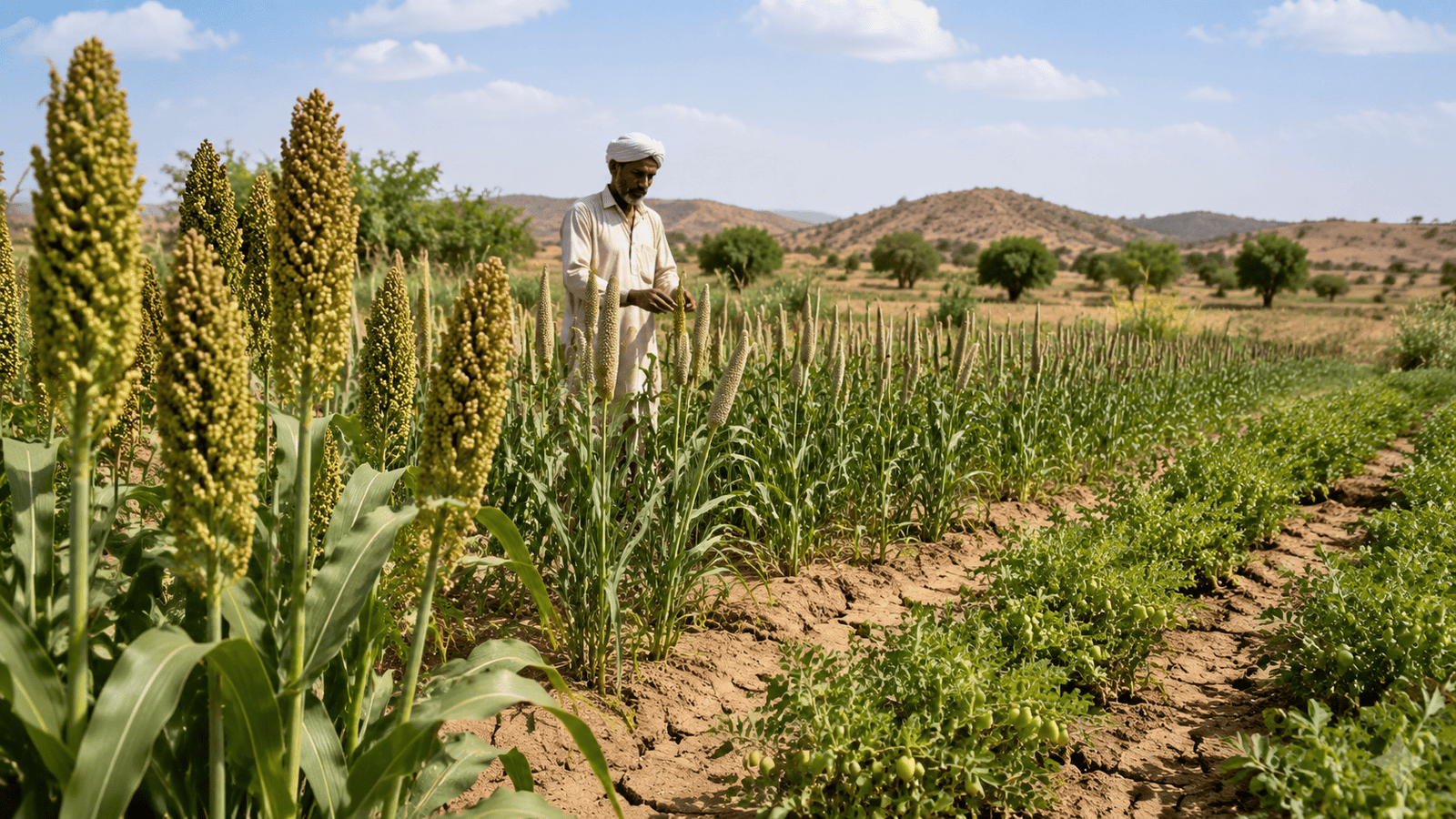
Dryland farming does not mean farming without water. It means farming on rainfall alone, without irrigation, in regions where rain is limited, seasonal, or unpredictable. The whole system is built around one problem: how to capture as much rainfall as possible, hold it in the soil, and match crop water demand to what's actually stored there. This guide explains what dryland farming is, how the system works from rainfall to harvest, and where it fits compared with rainfed and irrigated agriculture.
Dryland farming is a way of growing crops in regions where annual rainfall is low or unevenly distributed, using techniques that conserve soil moisture instead of relying on irrigation. It's practiced across semi-arid and dry sub-humid regions worldwide, wherever farmers need to make a fixed, often unpredictable, rainfall budget stretch across an entire growing season.
The core idea is straightforward even though the execution is not: every drop of rain that falls has to either soak into the soil where a crop's roots can reach it, or it's effectively lost to runoff or evaporation. Dryland farming practices — tillage choices, mulching, crop spacing, fallow periods, crop selection — all exist to tip that balance toward moisture the crop can actually use.
Dryland farming works as a chain of four linked stages. A weak link anywhere in the chain limits the whole system, regardless of how well the other stages are managed.
The terms overlap and are often used loosely, which causes confusion. Rainfed agriculture is the broader category — any farming that relies on natural rainfall rather than irrigation, including in regions with abundant, reliable rain. Dryland farming is a specific subset of rainfed agriculture practiced in dry or semi-arid regions, where rainfall is not just the water source but a genuine constraint that shapes every decision on the farm.
In other words, all dryland farming is rainfed, but not all rainfed farming is dryland. A rice farmer relying on monsoon rain in a high-rainfall region is practicing rainfed agriculture. A farmer growing sorghum on 400mm of unpredictable annual rainfall is practicing dryland farming specifically.
Two figures matter more than annual rainfall totals on their own: how that rainfall is distributed across the season, and how much of it actually reaches and stays in the crop's root zone.
This is why two farms receiving the same annual rainfall can see very different results — the difference usually comes down to how much of that rain was actually captured and stored rather than lost.
Because water is the limiting factor, crop choice in dryland farming is driven by drought tolerance, growing-season length, and how well a crop's water demand lines up with the local rainfall pattern — not simply by what's profitable or familiar. Short-duration, deep-rooted, and drought-tolerant crops such as sorghum, millet, chickpea, and certain legumes are widely used across dryland regions because their water needs are more forgiving of an unreliable rainfall pattern.
Planting timing is equally important. Sowing too early, before the soil profile has adequate stored moisture, risks poor germination. Sowing too late can push the crop's most water-sensitive growth stage — flowering, in most crops — into a period when rainfall reliably drops off. Farmers typically plant in response to the actual onset of rains and soil moisture conditions rather than a fixed calendar date.
Because so much of dryland farming's success depends on soil moisture, soil management practices are central to the system rather than optional extras.
| Practice | Main Purpose |
|---|---|
| Conservation or reduced tillage | Preserve soil structure and reduce moisture loss from disturbed soil |
| Mulching / residue retention | Shade the soil surface and slow evaporation |
| Contour farming | Slow runoff on sloped land so rain has time to infiltrate |
| Fallowing | Let a field rest a season to rebuild stored soil moisture |
| Adding organic matter | Improve the soil's water-holding capacity over time |
None of these practices work in isolation, and none is universally appropriate — a contour system suited to a gently sloped field may be unnecessary on flat land, and heavy residue retention that helps in a hot, dry climate can behave differently in a cooler one. Local soil type, slope, and rainfall pattern all shape which combination of practices makes sense for a given field.
Dryland farming is practiced across semi-arid and dry sub-humid regions worldwide — areas where annual rainfall is generally low, seasonal, or unevenly distributed, but still sufficient to support crops adapted to that constraint. Suitability depends on more than rainfall totals alone: soil depth and water-holding capacity, temperature and evaporation rates, and the length of the effective growing season all factor into whether a given crop can be grown reliably without irrigation in a particular location.
It's growing crops using only the rainfall a region naturally receives, with no irrigation, relying instead on soil and crop management to make the most of that limited water.
Not exactly. Rainfed farming is any farming without irrigation, including in wet regions. Dryland farming is rainfed farming specifically in dry or semi-arid areas where water is a real constraint.
This varies widely by crop, soil, and climate, so there's no single threshold that applies everywhere. What matters more than the total is how reliably that rainfall arrives during the crop's growing season.
Drought-tolerant, often short-duration crops such as sorghum, millet, chickpea, and various legumes are common, though the best choice always depends on the specific local climate and soil.
Yes. Good soil and crop management improves resilience and reduces risk, but a severe enough drought can still cause crop failure since there's no irrigation to fall back on.
Irrigation requires water sources, infrastructure, and ongoing costs that aren't available or economical everywhere. Dryland farming is often the realistic option where those conditions aren't met.
Dryland farming is a deliberate, water-budget-driven system, not simply the absence of irrigation. It succeeds or fails on how well rainfall is captured, how much of it is stored in the soil, and how closely crop choice and timing match that stored moisture. None of the individual techniques — tillage, mulching, crop selection, planting timing — matter in isolation; it's how they work together, tuned to local rainfall and soil conditions, that determines whether a dryland farm produces a reliable harvest or falls short in a difficult season.
Want more dryland and water-smart farming guides delivered to your inbox?
Subscribe to Farmers AdvisoryGeneral reference sources on dryland and rainfed agriculture principles include agricultural university extension services, the Food and Agriculture Organization (FAO), and national agricultural research institutions. Rainfall thresholds, crop water requirements, and yield outcomes vary by region, soil, and climate, and readers should consult local agricultural extension services for location-specific guidance. Current as of August 6, 2026.