 Farmers Advisory
Farmers Advisory
Farmers Advisory
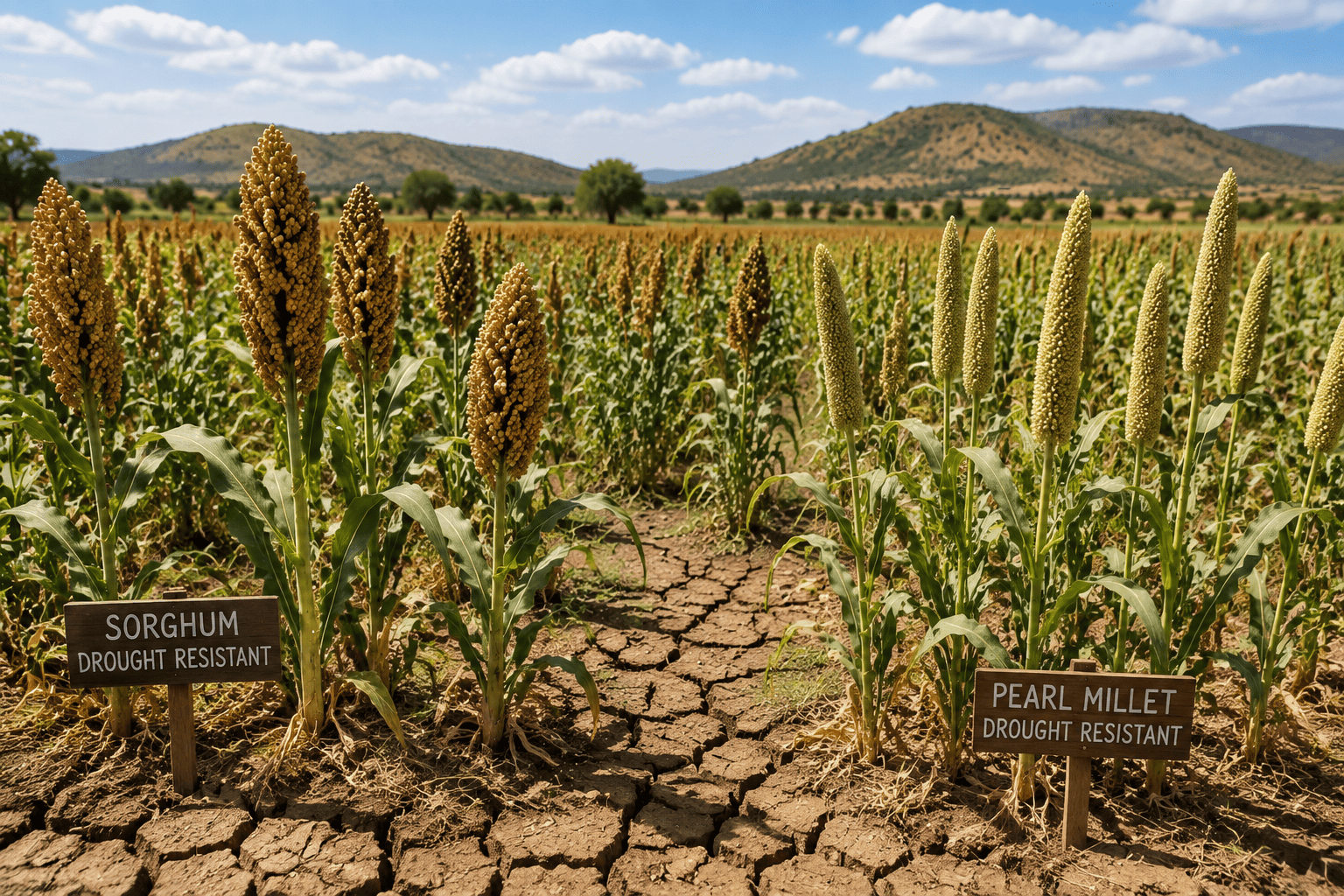
There is no single best crop for dryland farming, because dryland regions themselves vary enormously in rainfall amount, rainfall timing, temperature, and soil depth. What can be compared fairly is how a shortlist of proven dryland crops — sorghum, pearl millet, barley, wheat, chickpea, lentil, cowpea, and groundnut among them — perform against the factors that actually decide success in a moisture-limited system: drought tolerance, water requirement, growing season length, and yield stability. This guide walks through those factors and compares the crops most commonly grown across dryland and semi-arid regions.
| Crop | Drought Tolerance | Typical Growing Season | Relative Water Need | Soil Fit |
|---|---|---|---|---|
| Sorghum | High | 90-120 days | Low-moderate | Wide range, tolerates poorer soils |
| Pearl millet | Very high | 75-100 days | Low | Sandy, low-fertility soils |
| Barley | Moderate-high | 90-120 days | Moderate | Prefers well-drained loam |
| Wheat (dryland types) | Moderate | 110-150 days | Moderate-high | Fertile loam, needs the wetter end of dryland rainfall |
| Chickpea | Moderate-high | 90-110 days | Low-moderate | Well-drained loam, sensitive to waterlogging |
| Lentil | Moderate-high | 90-110 days | Low | Well-drained, lighter soils |
| Cowpea | High | 60-90 days | Low | Wide range, tolerates sandy soils |
| Groundnut | Moderate | 100-140 days | Moderate | Sandy loam, needs good drainage |
These are general characterizations, not fixed rules — actual drought tolerance, season length, and water need shift with variety, local temperature, and soil depth, so this table is a starting point for comparison rather than a substitute for local agronomic advice.
Before comparing individual crops, it helps to be clear on what actually determines whether a crop fits a given dryland farm:
Sorghum is widely grown across dryland regions because of its deep root system and ability to partially suspend growth during a dry spell and resume once moisture returns. It tolerates a wide range of soils, including those too poor or shallow for wheat, and generally holds yield more consistently through moderate drought than most other cereals grown in dry climates.
Pearl millet is generally considered among the most drought-tolerant cereal crops grown anywhere, with a short growing season and low water requirement that suit it to the driest end of the dryland spectrum, including sandy, low-fertility soils where few other cereals perform reliably.
Barley tends to tolerate drier and less fertile conditions than wheat and matures somewhat faster, making it a common choice toward the drier end of dryland wheat-growing regions. Wheat can still be grown under dryland conditions, particularly winter wheat types in regions with cooler, wetter winters and drier summers, but it generally performs best in the wetter portion of the dryland rainfall range rather than the driest.
Pulses are a common component of dryland cropping systems, both for their relatively low water requirement and because, as legumes, they can add nitrogen to the soil that benefits a following cereal crop.
Groundnut (peanut) is the most widely grown dryland oilseed in many regions, favoring sandy loam soils with good drainage. Its drought tolerance is moderate rather than exceptional — it performs best when rainfall is reasonably well distributed through pod development, and yield can be more sensitive to a poorly timed dry spell than sorghum or pearl millet.
As a general pattern, the driest dryland zones with the shortest or least reliable rainfall windows tend to favor pearl millet, sorghum, and cowpea, since these combine short seasons with genuinely high drought tolerance. The wetter end of the dryland range, or zones with cooler growing seasons, can generally support a wider range including wheat, barley, chickpea, and groundnut. This is a general pattern rather than a rule — local rainfall distribution, soil depth, and temperature can shift where a specific farm actually falls on that spectrum, which is why local agricultural extension recommendations, calibrated to the specific district or county, are the more reliable final word.
For a first attempt at dryland cropping, crops with a wide margin for error tend to work better than ones requiring precise timing. Sorghum and cowpea are commonly recommended starting points because they tolerate a range of soils, forgive some variation in planting date, and have relatively straightforward management requirements compared with crops like groundnut that are more sensitive to rainfall timing during a specific growth stage. Even so, checking with local extension services on variety choice and realistic yield expectations for the specific district is worth doing before committing significant acreage to any new crop.
Pearl millet is generally regarded as one of the most drought-tolerant cereal crops, with sorghum and cowpea also ranking highly, though the best choice still depends on local rainfall, soil, and season length.
Yes, particularly in the wetter portion of the dryland rainfall range or regions with cooler, wetter winters, but wheat generally needs more reliable moisture than sorghum, pearl millet, or cowpea.
Yes. Chickpea, lentil, and cowpea are commonly grown in dryland systems for their relatively low water requirement, short season, and soil nitrogen benefits for a following crop.
Match the crop's growing season and water requirement to local rainfall amount and distribution, confirm soil suitability, and check local market demand and seed availability before finalizing a choice.
No. Crop suitability depends on rainfall, temperature, soil, and season length, all of which vary significantly across dryland regions, so the right crop differs from one region to another.
Choosing a dryland crop comes down to matching its water need and season length to what the local climate and soil can actually provide, then checking that a market and seed supply exist to support it. Sorghum, pearl millet, and cowpea generally handle the driest and most unpredictable conditions best; chickpea, lentil, barley, and wheat can perform well toward the wetter end of the dryland spectrum. No crop on this list is universally superior — the fit depends on the specific field it's going into.
Want practical dryland farming guidance delivered to your inbox?
Subscribe to Farmers AdvisoryGeneral background: International Crops Research Institute for the Semi-Arid Tropics (ICRISAT), crop research on sorghum, pearl millet, chickpea, and cowpea; Food and Agriculture Organization (FAO) crop ecology guidance; USDA and university extension crop variety and growing-season publications. Figures represent general guidance and vary by region, variety, and season. Current as of August 6, 2026.