 Farmers Advisory
Farmers Advisory
Farmers Advisory
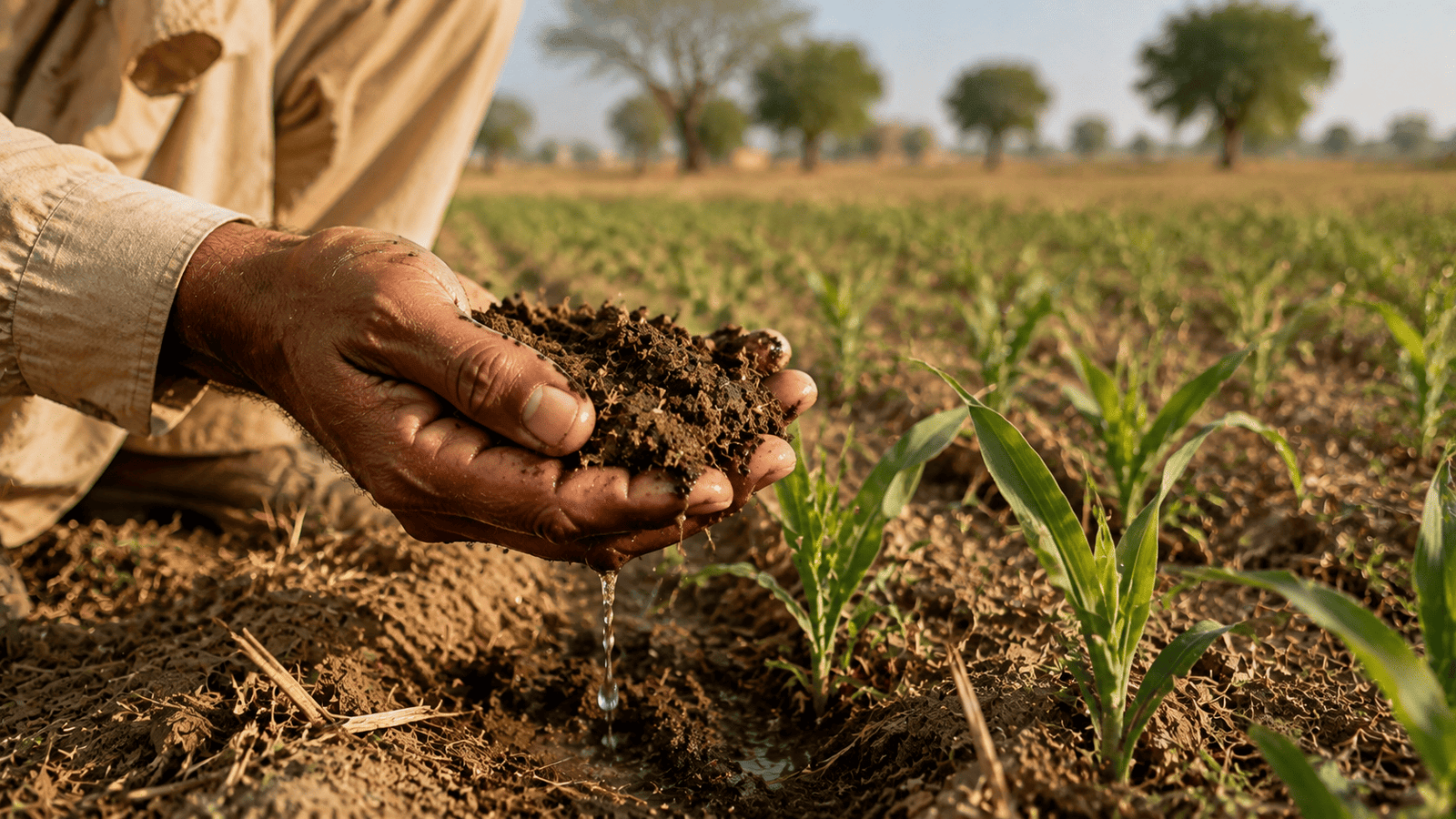
In dryland farming, the soil itself functions as the crop's water storage tank — there is no irrigation to correct a moisture shortfall mid-season, so how much water the soil can hold, and how efficiently the crop can draw on it, largely determines the outcome of the season. This guide covers what actually controls soil moisture behavior in dryland conditions, and the management practices that genuinely affect it, without treating any one practice as a universal fix.
In an irrigated system, a shortfall in stored soil moisture can be corrected with the next irrigation. In a dryland system, whatever moisture the soil is holding at any given point in the season is effectively the entire water budget available to the crop until the next meaningful rain. That makes soil moisture management — everything that affects how much water gets into the soil and how long it stays available — one of the most consequential areas of decision-making on a dryland farm, arguably more so than crop choice itself, since even a well-chosen crop will underperform on poorly managed soil.
Soil texture — the relative proportion of sand, silt, and clay particles — has a large effect on how much water a given depth of soil can hold and how easily a crop's roots can extract it.
Soil structure — how particles are aggregated together — affects how easily roots and water move through the profile independent of basic texture. Well-structured soil with good aggregation generally infiltrates and stores water better than a compacted or poorly structured soil of the same texture.
Soil organic matter improves water-holding capacity across virtually all soil textures, and it also improves infiltration by supporting better soil structure and biological activity. Because organic matter builds up gradually and breaks down slowly, its benefit to soil moisture is cumulative — soils that have been managed for years with residue retention, reduced tillage, and organic amendments generally hold water more effectively than soils of the same basic texture that have been depleted of organic matter through years of intensive tillage and residue removal.
Water that runs off the surface instead of infiltrating never becomes available to the crop at all, which makes infiltration the first checkpoint in soil moisture management. Compaction — from repeated heavy equipment traffic, or from soil structure degraded by intensive tillage — restricts infiltration and also physically blocks root growth, compounding the moisture problem by both reducing how much water gets in and how much of it a plant's roots can reach. Reduced tillage, avoiding field operations on wet soil, and controlling equipment traffic patterns are the main tools for limiting compaction on a dryland farm.
Once water is in the soil, two things drain it before a crop can use it: direct evaporation from the surface and uptake by weeds. Surface residue or mulch shades the soil and slows evaporation substantially compared with bare, exposed soil, particularly in hot, windy conditions. Weeds draw on exactly the same soil moisture reservoir as the crop, so timely weed control during early crop growth — when the crop's own canopy isn't yet shading the soil or outcompeting weeds for water — has an outsized effect on how much stored moisture remains available later in the season.
Planting timing determines whether a crop's peak water demand lines up with the period of highest soil moisture, which is generally the single biggest lever a dryland farmer has over how well a crop matches the available water. Plant density and row spacing also affect moisture management: closer spacing increases total water demand per unit area, while wider spacing gives individual plants access to more stored soil moisture at the cost of fewer plants overall — a trade-off that depends on how reliable local rainfall is expected to be that season. Healthy root development, supported by uncompacted soil and adequate but not excessive fertility, lets a crop access moisture from a larger soil volume, which matters more in a moisture-limited system than in an irrigated one.
Tracking rainfall and soil moisture, even informally, helps time field operations and flag drought stress earlier. Options range from a simple rain gauge and periodic hand-dug soil checks to more formal soil moisture sensors used in some commercial operations. The specific method matters less than having some consistent record to work from — knowing that soil moisture is trending down earlier in the season, rather than discovering it only when the crop shows visible stress, gives more time to adjust management where adjustment is still possible.
| Soil Type | Main Moisture Challenge | Priority Practices |
|---|---|---|
| Sandy | Low water-holding capacity, fast drainage | Organic matter building, mulching, higher planting density adjustments |
| Loam | Generally balanced, but still benefits from conservation | Reduced tillage, residue retention |
| Clay | Slow infiltration, runoff risk, compaction risk | Contour management where sloped, avoiding field work on wet soil, controlled traffic |
| Shallow soils over bedrock/hardpan | Limited total storage depth | Maximizing infiltration early, closely timed planting to rainfall |
These are general starting points rather than fixed prescriptions — local soil testing and extension guidance remain the more reliable basis for a specific field's management plan.
Clay soils generally hold the most total water, but loam is often considered more favorable overall because it combines solid water-holding capacity with better infiltration and easier root access to that stored water.
Yes. Organic matter improves both water-holding capacity and infiltration across most soil textures, though the benefit builds up gradually over multiple seasons rather than immediately.
Compaction restricts both water infiltration into the soil and root growth, which reduces the total volume of soil a crop's roots can draw moisture from.
A simple rain gauge combined with periodic hand-dug soil checks at root depth can give a useful general picture, though dedicated soil moisture sensors offer more precise, ongoing tracking.
Yes. Weeds draw on the same soil moisture reservoir as the crop, so timely weed control, particularly early in the season, preserves more stored water for the crop itself.
Soil moisture management in dryland farming comes down to three linked goals: getting as much rainfall into the soil as possible, holding it there through good structure and organic matter, and protecting it from evaporation and weed competition until the crop needs it. None of the individual practices — organic matter building, reduced tillage, mulching, weed control, monitoring — works in isolation, and none is universally the highest priority; which one matters most on a given farm depends on its specific soil texture, slope, and rainfall pattern.
Want practical dryland farming guidance delivered to your inbox?
Subscribe to Farmers AdvisoryGeneral background: USDA Natural Resources Conservation Service, soil health and water-holding capacity guidance; university agricultural extension publications on soil texture, organic matter, and moisture monitoring; Food and Agriculture Organization (FAO) soil and water resources. Figures represent general guidance and vary by soil type, climate, and management history. Current as of August 6, 2026.