 Farmers Advisory
Farmers Advisory
Farmers Advisory
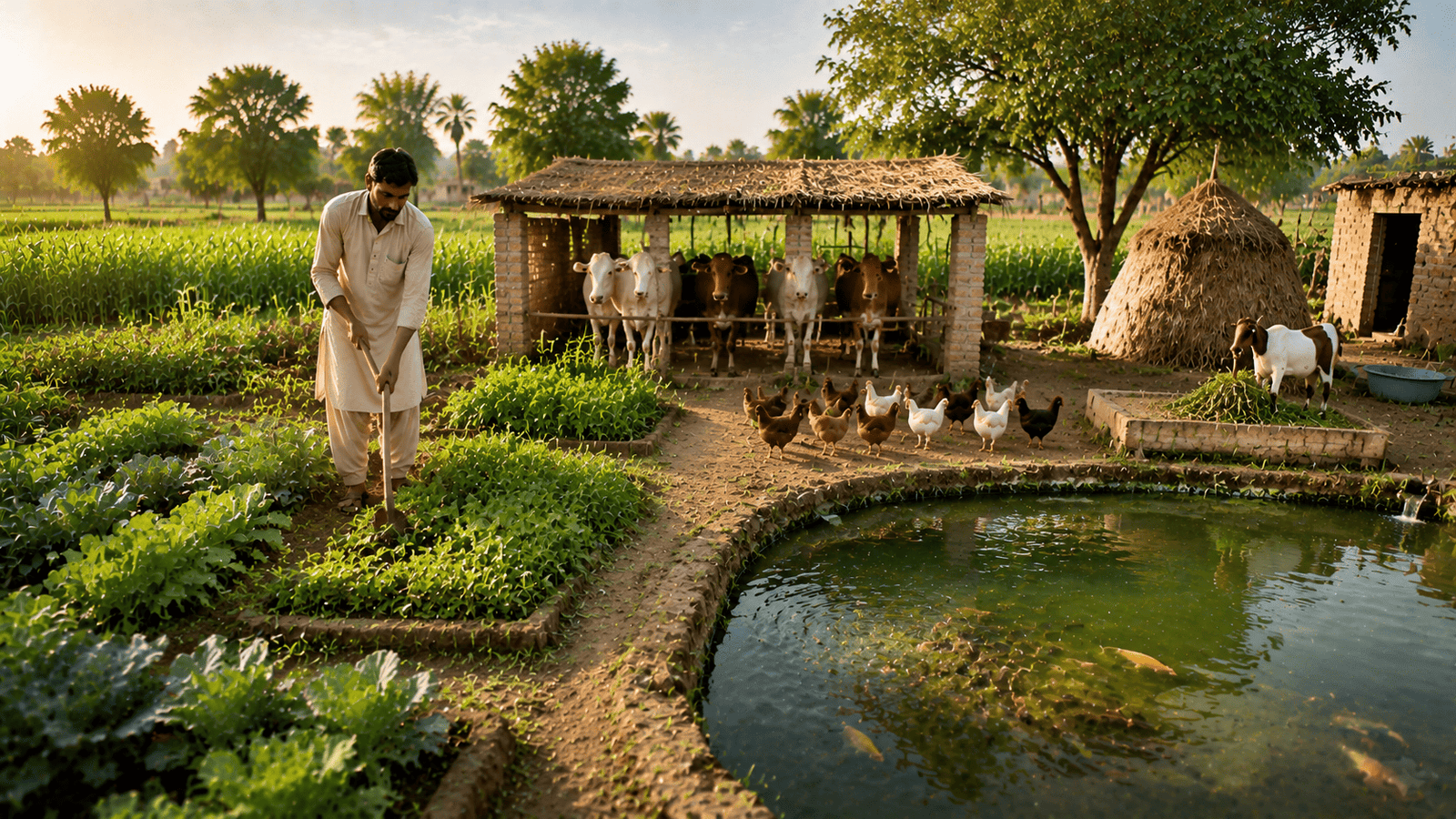
An integrated farming system combines two or more farm enterprises — crops, livestock, fish, or poultry — on the same holding so that the waste or by-product of one becomes an input for another. Crop residues feed animals, animal manure feeds soil or fish ponds, and pond sediment can return to the field as fertilizer. Rather than running each enterprise in isolation and buying in most of what it needs, the farm recycles a meaningful share of its own resources. This guide explains how integrated farming actually works, the main component combinations in use today, the nutrient cycle at the center of it, and the benefits and limitations a farmer should weigh honestly before adopting one.
An integrated farming system (IFS) is a farm design in which two or more production enterprises — such as field crops, vegetables, livestock, poultry, or fish — are deliberately connected so that materials, energy, or income flow between them. The defining feature is not simply raising several things on one property; a farm with a separate cornfield and a separate cattle operation that never interact is diversified but not integrated. What makes a system "integrated" is the resource link: crop residues become animal feed, manure becomes fertilizer or pond input, and pond water or sediment can return to irrigate or enrich the field.
Researchers describe this as closing the loop in nutrient and energy cycles rather than running each enterprise as a stand-alone, input-dependent operation. In a specialized system, a crop farm buys fertilizer and a livestock farm buys feed, with each generating waste that leaves the farm as a cost or a pollutant. In an integrated system, that same waste is redirected back into production.
The mechanics of integration follow a repeating pattern: a farm component produces something of value, a portion of it becomes waste or residue, and that residue is captured and routed to a second component instead of being discarded. The most common version of this loop looks like this:
Not every farm uses this exact five-step version. A poultry-fish system skips field crops entirely and cycles poultry droppings into pond fertility instead. A crop-fish system without livestock might route pond sediment directly onto vegetable beds. The underlying principle stays the same: a by-product that would otherwise be lost is captured and reused within the farm boundary.
Integrated farming isn't a single fixed model — it's a family of combinations, and the right one depends heavily on land, water, climate, and local markets. The table below summarizes the resource link in five common combinations; each is explored in more depth in its own guide within this series.
| Combination | Primary Resource Link | Typical Setting |
|---|---|---|
| Crop-livestock | Crop residue to feed; manure to soil | Mixed grain and dairy/small-ruminant farms |
| Crop-fish | Field runoff and organic matter to pond; pond sediment to soil | Rice-fish or vegetable-adjacent pond systems |
| Livestock-fish | Manure applied at controlled rates as pond nutrient input | Farms with cattle, pigs, or goats near a pond |
| Poultry-fish | Poultry droppings as a managed nutrient source for pond food organisms | Poultry houses built over or beside ponds |
| Crop-livestock-fish | Residue to livestock, manure split between soil and pond | Larger holdings with land and water both available |
See our full walkthrough of the integrated crop-livestock model and the fish-poultry system for species-level detail on each.
Nutrient cycling is the mechanism that actually produces most of the benefit in an integrated system. Instead of nutrients entering the farm once (as purchased fertilizer or feed) and leaving once (as harvested product and unmanaged waste), integration keeps a share of nitrogen, phosphorus, potassium, and organic matter circulating on-site for longer before it's lost to leaching, runoff, or volatilization.
These are genuine, well-documented advantages — but they depend on management quality, not on the mere fact of combining enterprises. See our dedicated article on the benefits of integrated farming for small farmers for a closer look at what this means at smallholder scale.
Integration multiplies the number of things that need attention, not just the number of income streams. Farmers considering an integrated system should weigh these limitations seriously:
None of this means integration is a bad choice — it means it's a management-intensive one. A detailed planning approach is covered in how to design an integrated farming system.
It's a farm that combines two or more enterprises — such as crops and livestock, or fish and poultry — so the waste or by-product of one becomes a useful input for another, instead of running each enterprise separately.
The most common components are field crops, vegetables, livestock (cattle, goats, sheep, pigs), poultry, and fish, combined in pairs or larger groups depending on land, water, and local conditions.
No. Profitability depends on management skill, scale, local markets, and input and labor costs. Integration diversifies risk and can improve resource efficiency, but it doesn't guarantee higher income than a well-run specialized farm.
Often yes, if water is available and pond conditions can be monitored, but manure and nutrient loading into the pond has to be carefully controlled to avoid oxygen depletion and fish kills — see our fish-poultry integration guide for the specifics.
Treating every crop residue or manure source as automatically safe to feed or apply without composting, testing, or considering the amount the receiving system can handle.
Not necessarily. Many integrated systems are designed specifically for smallholders with limited land, layering enterprises rather than expanding land area.
An integrated farming system is best understood as a design choice about where a farm's waste goes, not a fixed template every farm has to follow the same way. Crop residue, manure, and pond by-products either leave the farm as a cost or return to it as an input — integration is the deliberate choice to make the second option happen reliably. The combinations that work vary by land, water, climate, and market, and the benefits only materialize when composting, loading rates, and coordination between components are managed with real attention. Farmers weighing whether to integrate should start by mapping their own resource flows before choosing a model, a process covered step by step in our guide to designing an integrated farming system.
Want more integrated farming guides delivered to your inbox every week?
Subscribe to Farmers AdvisoryGeneral background: FAO Plant Production and Protection Division, guidance on integrated crop-livestock systems and nutrient/manure cycling; FAO Climate-Smart Agriculture Sourcebook, Module B5 on integrated production systems; FAO, "Mixed Crop-Livestock Farming: A Review of Traditional Technologies" (2001); FAO Fisheries Technical Paper 407, "Integrated Agriculture-Aquaculture." Figures and practices vary by farm scale, climate, species, and local regulation — treat all guidance here as a general framework rather than a fixed prescription. Current as of August 6, 2026.