 Farmers Advisory
Farmers Advisory
Farmers Advisory
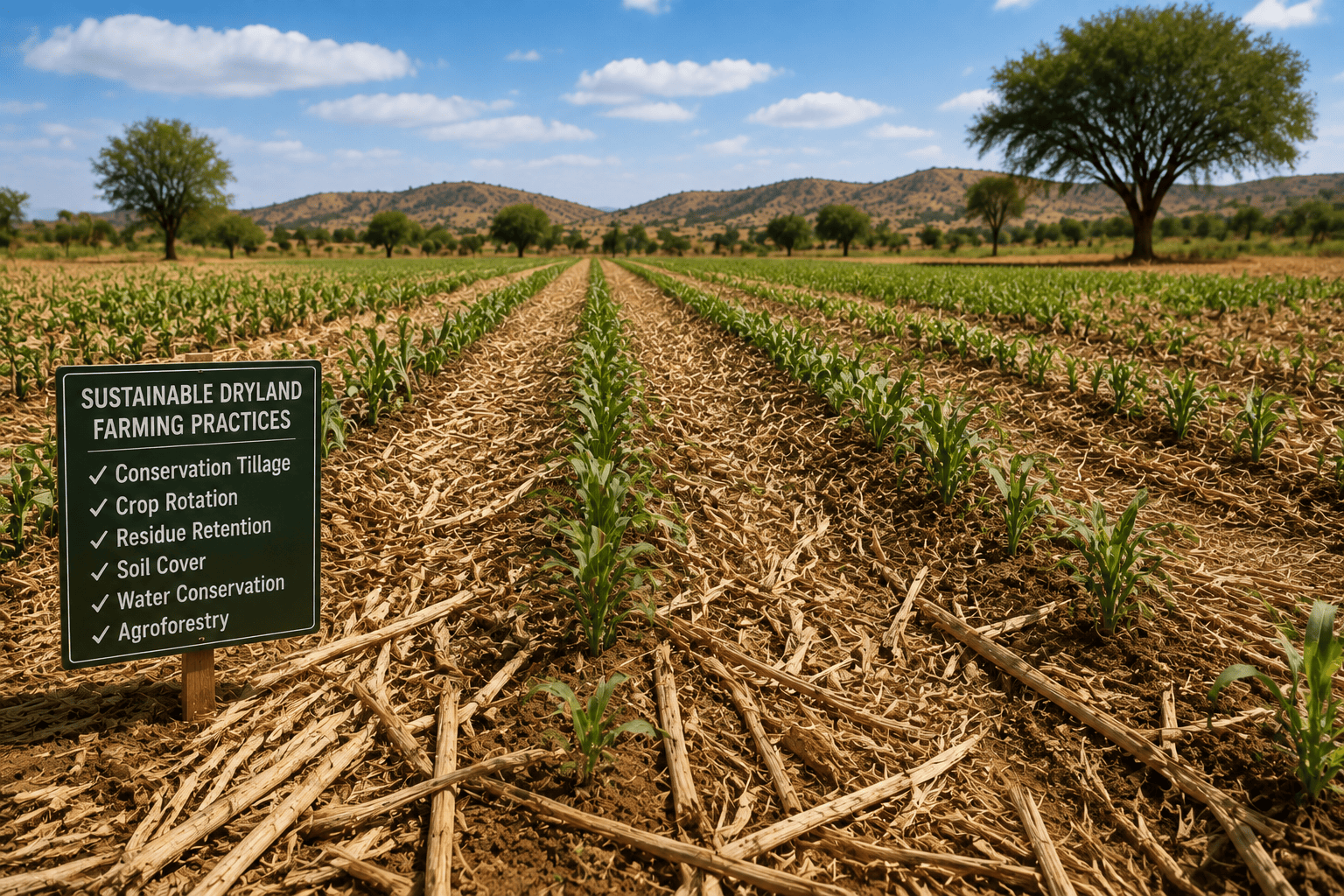
Sustainability in dryland farming is less about any single technique and more about how several practices reinforce each other over time. A farm that rotates crops, keeps residue on the surface, and limits tillage builds soil that holds more water, resists erosion better, and needs fewer purchased inputs — but only if those practices are combined and kept up over multiple seasons. This guide walks through the core techniques that make a dryland system genuinely more sustainable, and where each one does and doesn't apply.
A sustainable dryland farming system is one that maintains or improves its soil, water, and yield potential over the long term rather than drawing them down season after season. In water-limited environments, that mostly comes down to four connected goals: building soil that holds more of the rain that falls, minimizing water lost to evaporation and runoff, spreading risk across more than one crop, and managing pests and nutrients without depleting the resource base the farm depends on.
These goals reinforce each other. Soil with more organic matter holds more water. A field with better water retention supports more diverse cropping. A more diverse cropping system spreads financial and climate risk. None of the individual techniques below works in isolation as well as it works alongside the others.
Reducing how often and how deeply soil is disturbed helps preserve soil structure, protect organic matter, and keep more moisture in the profile. Conservation tillage systems leave a portion of crop residue on the surface after planting rather than burying it, which also reduces evaporation and erosion. The transition from conventional tillage can take a few seasons to show its full benefit, and equipment and weed-management adjustments are often needed along the way.
Leaving crop residue on the field after harvest, instead of removing or burning it, protects the soil surface from direct sun and wind, slows evaporation, and adds organic matter as it breaks down. In dryland systems where residue is also valued as livestock feed, farmers often need to balance how much residue to retain against how much to remove — a tradeoff worth planning deliberately rather than defaulting to full removal.
Compost, manure, and other organic amendments, where locally available and appropriate, add organic matter that improves water-holding capacity and soil structure over time. These inputs work gradually; a single application rarely produces a dramatic short-term change, but consistent use over several seasons measurably improves soil water storage in many systems.
Rotating between different crop types — for example alternating a cereal with a legume — breaks pest and disease cycles, diversifies root structures in the soil, and can improve nitrogen availability when a nitrogen-fixing legume is included. Rotation also spreads a farm's exposure across crops with different water demands and market conditions, which reduces the financial impact of a single crop's failure.
Growing two or more compatible crops in the same field at the same time, such as a cereal alongside a legume, can improve total land productivity and provide a partial harvest even if one crop underperforms in a dry season. Intercropping requires more planning around planting density, timing, and harvest logistics than a single-crop field, and its suitability depends heavily on the specific crop combination and local practice.
In dryland systems with a longer growing window or a fallow period, a cover crop can protect the soil surface and add organic matter. In tighter rainfall environments, however, a cover crop can compete with the following cash crop for the exact moisture that crop needs, so their use has to be weighed against local rainfall reliability rather than adopted by default.
Rows of trees or shrubs planted along field boundaries reduce wind speed at the soil surface, which lowers evaporation and protects young crops from wind damage. Agroforestry systems that integrate trees more directly into cropland can also provide additional income sources, fodder, or fuelwood, though they require longer-term planning since trees take years to establish.
Maintaining ground cover through residue or living plants, along with contour-based field layouts on sloped land, reduces the soil erosion that gradually strips away a field's most fertile topsoil. Erosion control measures on sloped ground should account for local slope, soil type, and drainage, since a structure suited to one field's slope can concentrate runoff harmfully on another.
Integrated pest management combines crop rotation, resistant varieties, timely scouting, and targeted intervention rather than routine broad-spectrum spraying, reducing input costs and preserving beneficial insects. Similarly, matching fertilizer or nutrient inputs to actual soil test results and crop need — rather than applying a fixed rate regardless of conditions — avoids both under-fertilizing yield potential and over-applying nutrients that a water-stressed crop cannot use efficiently anyway.
The techniques above deliver the most benefit when combined rather than adopted individually. A common and well-documented combination in dryland systems pairs reduced tillage with residue retention and a rotation that includes a legume — the reduced disturbance and surface cover conserve moisture and reduce erosion, while the rotation supports soil nitrogen and interrupts pest cycles. Adding windbreaks or field-boundary trees where feasible further reduces evaporative loss at the field edge.
Because every farm's slope, soil, and rainfall differ, there's no single fixed sequence for adopting these techniques. Many farmers start with the lowest-risk, most reversible changes — such as residue retention — before moving to changes that require more investment or a longer commitment, like agroforestry or a full shift to conservation tillage.
| Technique | Primary Benefit | Adoption Consideration |
|---|---|---|
| Conservation/reduced tillage | Soil structure, moisture retention | Weed control and equipment need adjustment |
| Residue retention | Reduced evaporation and erosion | Balance against livestock feed needs |
| Crop rotation | Pest cycle disruption, soil nitrogen | Requires planning across multiple seasons |
| Intercropping | Land productivity, partial-failure buffer | Needs careful crop-pairing and spacing |
| Cover crops | Soil protection, organic matter | Can compete for moisture in tight rainfall areas |
| Windbreaks/agroforestry | Reduced wind evaporation, added income | Long-term investment, slow establishment |
Sustainable practices are not a guaranteed fix for every dry-season problem. In a severe drought, no amount of residue retention or conservation tillage fully offsets a genuine shortage of rainfall — these practices reduce loss and improve resilience over time, but they do not replace water that simply isn't there. Some techniques also carry upfront tradeoffs: reduced tillage can initially increase certain weed pressures until a farmer adjusts their weed-management approach, and residue retention competes with other uses for that same crop residue on mixed crop-livestock farms. Treating these techniques as a long-term system rather than a one-season fix produces more realistic expectations.
There isn't a single most important technique — conservation tillage, residue retention, and crop rotation are foundational because they support soil health and moisture retention, which in turn make other techniques like intercropping and cover cropping more effective.
They can, but with caution. In tight rainfall environments a cover crop can compete with the following cash crop for scarce soil moisture, so their use depends on local rainfall reliability and the length of the growing window available.
Soil structure and organic matter improvements from reduced or conservation tillage typically build up over multiple seasons rather than appearing immediately, though reduced erosion and evaporation losses can be noticeable sooner.
Not necessarily. Soil-health-focused practices generally support more stable yields over time and reduce the severity of losses in dry years, though a transition period with adjusted management is often needed before benefits fully show.
It depends on the crop combination and the farm's goals. Intercropping can improve total land productivity and provide a partial harvest if one crop underperforms, but it requires more careful planning around spacing, timing, and harvest logistics than a single crop.
Copying a specific practice or structure from another farm without adjusting for local slope, soil type, and rainfall pattern — a technique well-suited to one field can perform poorly, or even cause harm, on a field with different conditions.
Sustainable dryland farming is built from a set of complementary practices — conservation tillage, residue retention, crop rotation, and thoughtful water and landscape management — rather than any single technique. The strongest systems combine several of these deliberately, adjust them to local slope, soil, and rainfall, and expect the full benefit to build over several seasons rather than one. Treated this way, sustainability and yield stability work together rather than against each other.
Want more dryland farming guidance delivered to your inbox every week?
Subscribe to Farmers AdvisoryGeneral guidance drawn from publicly available agricultural extension and research sources, including university extension services, national agricultural research institutions, FAO conservation agriculture guidance, and CGIAR dryland systems research summaries. Practices and their outcomes vary by region, soil, rainfall pattern, and farm management, and figures here represent general patterns rather than guaranteed results. Current as of August 6, 2026.