 Farmers Advisory
Farmers Advisory
Farmers Advisory
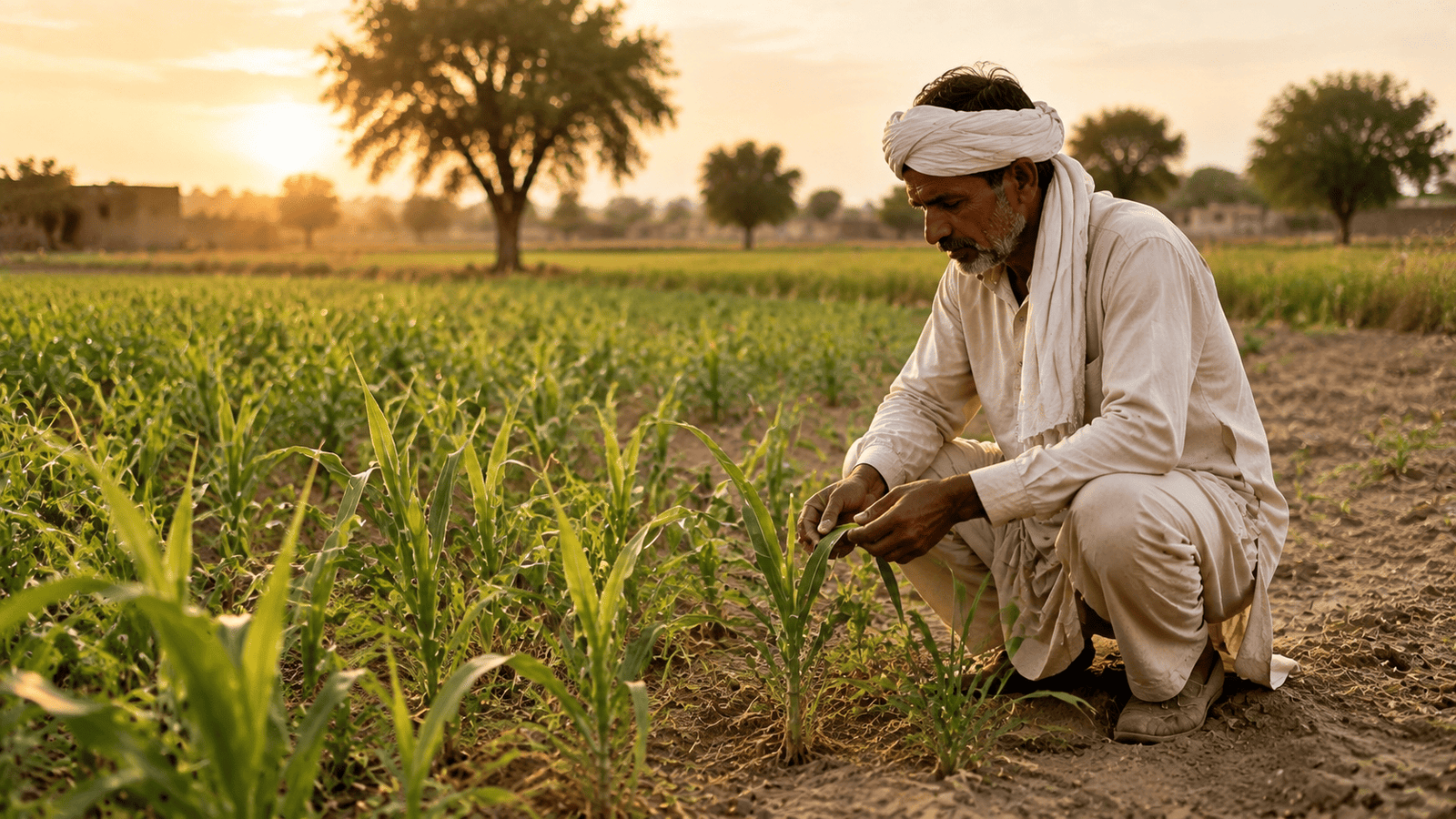
Improving yield in dryland farming is less about maximizing inputs and more about improving how efficiently a crop converts the rainfall it actually receives into grain, forage, or fiber. Because there's no irrigation to fall back on, the biggest yield gains typically come from variety choice, timing, and moisture-conserving management rather than from simply adding more fertilizer or seed. This guide covers the practices with the most consistent record of improving dryland yield, along with a clear-eyed look at their limits.
The most useful mental model for dryland yield improvement is water-use efficiency: how much yield is produced per unit of water the crop actually had access to. In an irrigated system, additional inputs like fertilizer usually have room to translate into more growth because water can be supplied to match. In a dryland system, that relationship breaks down once inputs push a crop toward needing more water than the season can supply — additional fertility, for instance, can drive lush early growth that then runs out of moisture before grain fill, reducing yield rather than raising it. This is why dryland yield improvement generally starts with getting more value out of the existing water budget rather than assuming more inputs are automatically better.
Choosing a variety suited to the local rainfall pattern, season length, and typical drought timing is generally one of the highest-leverage decisions available, because it affects every other input's effectiveness downstream. Certified, high-quality seed with strong germination and known disease resistance also reduces the risk of a poor stand that no amount of later management can fully correct. Where seed treatment against soil-borne disease or early pests is locally recommended for a given crop, it can protect the stand during the vulnerable early growth stage without requiring additional water.
Planting date remains one of the most consequential single decisions in dryland farming, since it sets whether the crop's peak water demand — typically flowering and grain fill — coincides with the period of highest soil moisture. Plant population and row spacing should generally be adjusted to match expected moisture availability: denser stands can outyield sparse ones in a good rainfall year but can also deplete soil moisture faster and underperform in a drier one, so local recommendations calibrated to typical rainfall for the area are a more reliable guide than a fixed, one-size density.
Nutrient management in dryland farming works best when fertility is matched to realistic yield potential given expected rainfall, rather than to a maximum-yield target that assumes unlimited water. Building soil organic matter over time through residue retention and reduced tillage improves both nutrient availability and water-holding capacity together, making it one of the more efficient long-term fertility investments in a dryland system. Excess nitrogen applied ahead of a dry season, in particular, can push vegetative growth that the available moisture then can't support through to grain fill.
Weeds compete directly with the crop for the same limited soil moisture, so timely weed control — particularly in the early growth stages before the crop canopy closes — is one of the more reliably effective yield-protecting steps in dryland farming. Pest and disease management matters for the usual reasons, but it carries added weight in a dryland system because a pest or disease outbreak that weakens the crop's root system or canopy also reduces its ability to use available soil moisture efficiently, compounding the yield loss beyond the direct damage itself.
Rotating cereals with pulses is a common dryland practice, since legume crops can add nitrogen to the soil that benefits a following cereal, while also breaking pest and disease cycles that build up under continuous single-crop planting. Intercropping — growing two compatible crops together, such as a cereal and a pulse — can improve overall yield stability and land-use efficiency in some systems, but it also means the two crops share the same limited water, so the practice needs to be matched to local rainfall reliability rather than assumed to be a net gain everywhere it's tried.
Because yield in dryland farming tracks available soil moisture so closely, the conservation practices covered elsewhere in this cluster — conservation tillage, mulching, residue retention, contour management where slope requires it — function as yield-improvement practices in their own right, not just as risk-reduction measures. Improving how much rainfall the soil captures and retains effectively raises the water budget the crop has to work with, which is often a more durable yield gain than any single input adjustment.
Yield gains built up over a season can still be lost at harvest through delayed timing, shattering losses, or poor post-harvest drying and storage that leads to spoilage. Harvesting at the correct maturity and moisture content for the crop, and drying and storing grain properly afterward, protects the yield the crop already produced rather than adding new yield — but it's a step that's sometimes overlooked in a focus on growing-season practices.
There is no single most effective step for every situation, but variety selection and planting timing, matched to local rainfall pattern, generally have the most consistent effect across dryland systems.
No. Fertilizer applied beyond what available soil moisture can support can push vegetative growth that the crop then can't sustain through grain fill, reducing rather than increasing yield.
Yes, often substantially, because weeds compete directly with the crop for the same limited soil moisture, and timely control during early growth protects that moisture for the crop.
Generally yes over time, particularly rotating cereals with nitrogen-fixing pulses, though the specific benefit depends on the crops chosen and local rainfall reliability.
No. Good management improves the odds and the average outcome over time, but a severe drought can still reduce yield regardless of how well the farm is managed, since there is no irrigation backup.
Improving dryland farming yield is largely a matter of getting more crop out of the same water budget: choosing a well-matched variety, timing planting to the local rainfall pattern, protecting stored moisture from weeds and evaporation, and calibrating fertility to what the season can realistically support rather than to a maximum-yield target. None of this guarantees a higher yield every season — rainfall variability still sets the outer limit — but it consistently improves the odds of a good outcome and reduces the downside in a poor one.
Want practical dryland farming guidance delivered to your inbox?
Subscribe to Farmers AdvisoryGeneral background: International Crops Research Institute for the Semi-Arid Tropics (ICRISAT), dryland cropping and water-use efficiency research; USDA and university extension publications on dryland variety selection, fertility, and weed management. Figures represent general guidance and vary by crop, variety, region, and season. Current as of August 6, 2026.