 Farmers Advisory
Farmers Advisory
Farmers Advisory
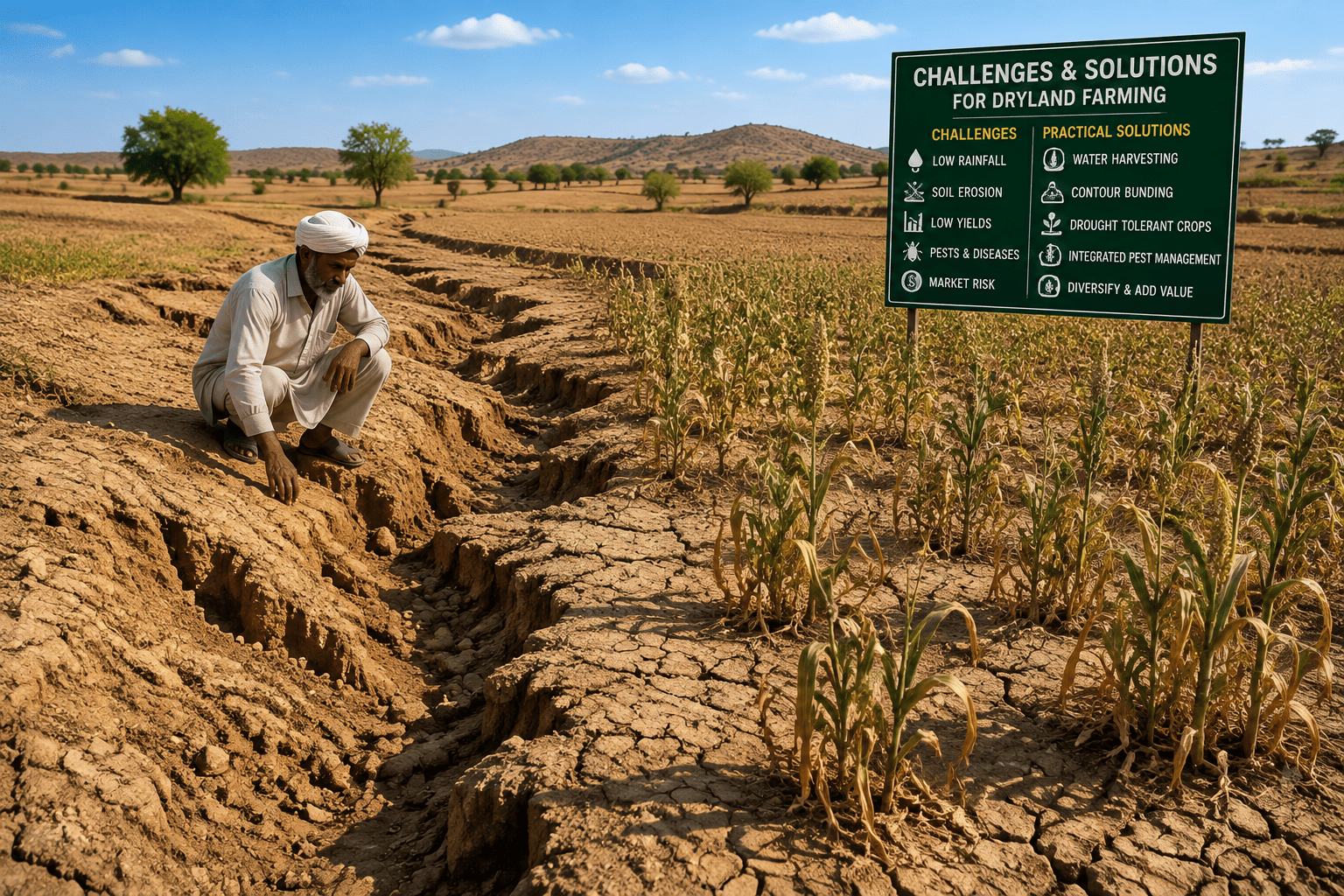
"Drought-resistant" is one of the most overused phrases in seed marketing, and one of the least understood on the farm. No crop or variety simply stops needing water. What separates a genuinely drought-adapted variety from an ordinary one is how it manages a water shortfall — by dodging the dry spell, slowing down its water use, tolerating internal water stress, or bouncing back after it. Understanding which of these mechanisms a variety actually relies on is what allows a farmer to match seed to a specific dry region instead of buying on the promise of a label.
In practical terms, a drought-resistant variety is one that produces a usable yield under a water deficit that would cause a bigger yield loss, or outright crop failure, in a less-adapted variety of the same crop. It does not mean the crop needs no water, and it does not mean it will yield the same in a dry year as it would in a good one. Even the most drought-hardy sorghum variety still loses yield potential when rainfall drops far enough below what the crop needs during its most sensitive growth stages.
Drought itself is not a single, fixed condition either. A dry spell that hits during germination behaves very differently from one that hits during flowering or grain fill, and a variety bred to handle one timing of stress will not necessarily handle another equally well. This is one reason a variety that performs well in one dry region can underperform in another with a different rainfall pattern, even if the two regions receive similar total annual rainfall.
Plant breeders and agronomists generally group drought adaptation into four overlapping strategies. Most drought-adapted varieties lean on a combination of these rather than relying on just one.
Sorghum is frequently cited as combining more than one of these strategies, which is part of why it performs relatively consistently across a range of dry environments, while other crops may rely almost entirely on early maturity to escape drought.
Public agricultural research institutions and university breeding programs develop drought-adapted varieties by selecting parent lines with useful traits — such as deep rooting, early maturity, or reduced water loss through the leaf — and crossing them over multiple generations, then testing the offspring under real dry-season field conditions across several sites and years. A line only earns a formal release and variety name after it has shown consistent performance across those trial locations and seasons, not after a single good result.
National and regional agricultural research institutions, along with international centers focused on dryland and semi-arid crops, run much of this work for staple dryland crops. Their trial data, not marketing copy, is the most reliable source for how a variety actually performs under water stress in a given region.
Several physical and physiological traits show up repeatedly in crops and varieties known for handling dry conditions reasonably well. None of these traits works in isolation, and their relative importance shifts with the crop and the region.
| Trait | What It Does | Typical Benefit |
|---|---|---|
| Early maturity | Shortens the time between planting and harvest | Crop finishes before a late-season dry spell arrives |
| Deep or extensive root system | Reaches moisture stored deeper in the soil profile | Sustains water uptake after the surface layer dries |
| Reduced leaf water loss | Leaf pores close or leaf area shrinks under stress | Conserves internal moisture during peak heat |
| Osmotic adjustment | Cells retain water uptake ability at lower moisture levels | Keeps tissue functioning under mild-to-moderate stress |
| Heat tolerance | Reproductive stages continue under high temperature | Reduces flowering or grain-fill failure during heat spikes |
| Seedling vigor | Rapid early establishment and ground cover | Reduces evaporation loss and early-season competition |
Several crop groups are widely grown across semi-arid and dry regions because they generally perform more reliably under limited and variable rainfall than many alternatives. This is a description of relative crop-group tendencies, not a ranking, since actual variety performance still depends on local conditions and management.
Within each of these crop groups, individual varieties still differ substantially in maturity length, heat tolerance, and disease resistance. A locally released, certified variety from a national or provincial seed program will almost always outperform an unverified "drought-resistant" seed lot of unknown origin, regardless of crop group.
Selecting a drought-adapted variety is less about finding the single "best" option and more about matching a variety's specific strategy to your region's rainfall pattern and your farm's soil.
A drought-adapted variety still needs supportive field management to express its genetic potential. Planting time matters — even an early-maturing, drought-escaping variety loses its advantage if planted late and pushed into the dry period regardless. Adequate plant spacing reduces competition for limited soil moisture, and controlling weeds early prevents them from drawing down soil water that the crop needs later. Where feasible, practices that improve infiltration and reduce evaporation — residue retention, reduced tillage, and timely planting on stored moisture — work alongside variety selection rather than replacing it.
It also helps to treat drought-adapted varieties as one part of a broader risk-management approach rather than a single fix. Diversifying crops or varieties across a farm, staggering planting dates where practical, and maintaining soil organic matter all reduce the chance that one dry spell wipes out an entire season's income.
| Mistake | Why It's a Problem | Better Approach |
|---|---|---|
| Buying on the word "drought-resistant" alone | The label has no formal, standardized meaning across sellers | Ask for the variety name and check its official release documentation |
| Assuming one variety fits every dry field on the farm | Soil depth and microclimate vary within a single farm | Match maturity length and rooting depth to each field's soil profile |
| Ignoring disease resistance | A drought-tolerant variety can still fail to disease in a wet start | Review the full trait package, not drought tolerance alone |
| Using uncertified, unverified seed | Seed identity and drought performance cannot be confirmed | Source certified seed through a recognized supplier or program |
| Expecting the same yield as a good rainfall year | Drought tolerance reduces loss, it does not remove it | Plan for a realistic, reduced yield target in dry years |
It means the variety can produce a usable yield under a water deficit that would cause greater yield loss in a less-adapted variety of the same crop, through mechanisms like early maturity, deeper rooting, or reduced water loss — not that it needs no water at all.
Pearl millet, sorghum, cowpea, chickpea, groundnut, and barley are widely grown across dry and semi-arid regions and are generally regarded as relatively drought-hardy crop groups, though actual variety performance still depends on local conditions.
No. Drought escape means the crop finishes its life cycle before a dry period arrives, usually through early maturity. Drought tolerance means the plant keeps functioning even while under active water stress. Many varieties combine elements of both.
No. Drought-adapted varieties reduce yield loss compared to non-adapted varieties under the same dry conditions, but they do not eliminate the yield gap caused by insufficient water.
Check whether the variety has been officially released or trial-tested for your specific agro-climatic zone through a university extension office, provincial or national agriculture department, or certified seed supplier before planting significant acreage.
Yes. Deep-rooting varieties depend on adequate soil depth to reach subsoil moisture. On shallow soils over rock or hardpan, that rooting advantage is limited regardless of the variety's genetics.
No. Seed selection works best alongside field practices such as timely planting, weed control, residue retention, and moisture-conserving tillage, plus broader risk management like crop and variety diversification.
Choosing a drought-resistant variety starts with understanding which survival strategy it actually relies on — escaping the dry season through early maturity, avoiding stress through deep roots, tolerating it through internal adjustment, or recovering from it once rain returns — and then matching that strategy to your region's rainfall pattern, your soil depth, and your season length. No variety removes drought risk entirely, but a well-matched, locally verified variety, backed by sound field management, meaningfully narrows the gap between a dry year and a normal one.
Want more dryland farming guidance delivered to your inbox every week?
Subscribe to Farmers AdvisoryGeneral guidance drawn from publicly available agricultural extension and research sources, including university extension services, national and regional agricultural research institutions, FAO technical guidance on dryland crop production, and CGIAR/ICRISAT dryland and semi-arid crop research summaries. Variety names, release status, and performance data are not specified here and should be verified directly with a local university extension office, provincial or national seed authority, or certified seed supplier before purchase. Figures and traits represent general patterns and vary by crop, region, season, and management. Current as of August 6, 2026.