 Farmers Advisory
Farmers Advisory
Farmers Advisory
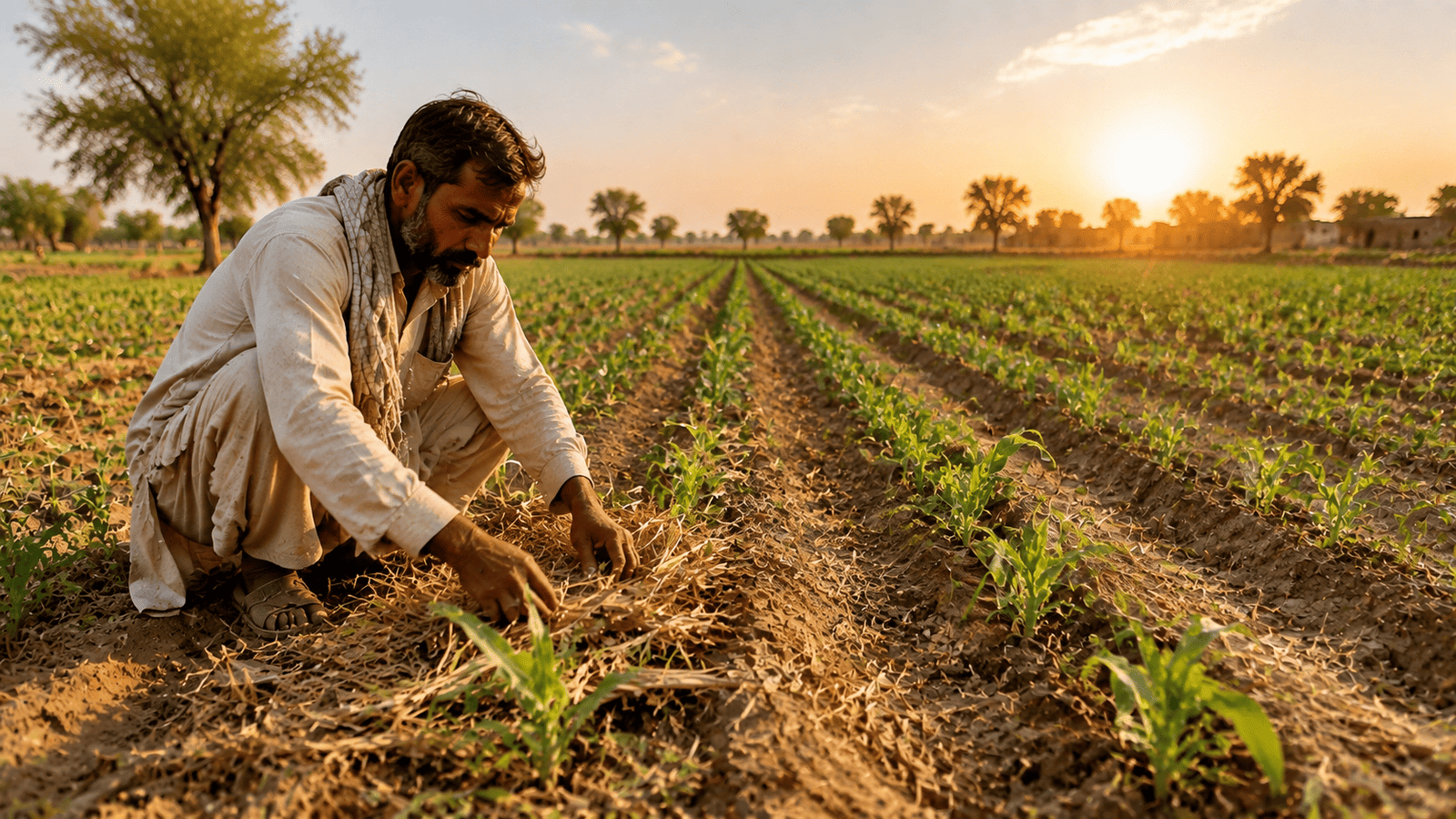
In dryland farming, water conservation is not one technique but a set of complementary practices that work at different points in the rainfall cycle: capturing runoff before it leaves the field, helping rain infiltrate rather than pool or run off, storing that moisture in the soil profile, and then reducing how fast it evaporates or gets used by weeds before the crop needs it. This guide covers the main techniques dryland farmers use at each of those stages, and where each one does or doesn't make sense.
Every water conservation technique in dryland farming targets one or more links in the same chain: capture rainfall at the surface, help it infiltrate into the soil rather than run off, store it in the root zone, and then protect that stored moisture from evaporation and weed competition until the crop can use it. Techniques cluster naturally around these stages — rainwater harvesting and contour structures address capture and infiltration, mulching and reduced tillage address storage and loss, and weed control and windbreaks address protecting what's already stored.
Rainwater harvesting in a dryland farming context usually means shaping the land and field boundaries so that rain is slowed down and directed into the soil or into a collection structure, rather than allowed to run off the field entirely.
None of these structures should be built without accounting for where the diverted water will ultimately go — poorly planned diversion can simply move an erosion or flooding problem onto a neighboring field.
On sloped land, farming along the natural contour of the land — rather than straight up and down the slope — is one of the most effective ways to reduce runoff, because each row acts as a small barrier that slows water moving downhill.
Reducing how much the soil is disturbed, and covering its surface, are two of the most broadly useful water conservation techniques because they apply on nearly any dryland farm, regardless of slope.
Leaving crop residue on the field after harvest, rather than removing or burning it, keeps the soil surface shaded and slows both evaporation and wind erosion. Where local rainfall and season length allow, cover crops planted between main crop cycles can extend that surface protection and add further organic matter, though in the driest dryland zones a cover crop can compete with the following main crop for the same limited moisture — a trade-off that needs weighing against local rainfall reliability rather than assumed to be a net positive everywhere.
Small farm ponds, check dams, and other modest water-storage structures are used in many dryland regions to capture and hold runoff for later use — commonly for livestock watering, sometimes for limited supplemental irrigation during a critical crop stage where local rules and water rights permit it. These structures require attention to local soil type (some soils don't hold standing water well without lining), evaporation losses from open water surfaces in hot climates, and any local regulations governing water capture and storage.
Wind increases evaporation from both soil and plant surfaces, so windbreaks — rows of trees, shrubs, or even temporary barriers — can meaningfully reduce moisture loss on exposed dryland farms, alongside their more familiar role in reducing soil erosion. Weed control conserves water in a more direct way: every weed in a field is drawing on the same limited soil moisture as the crop, so keeping fields weed-free during the critical early growth period preserves stored water for the crop itself rather than for competing vegetation.
No single combination of techniques suits every dryland farm. As a general guide:
Local soil surveys and extension recommendations remain the most reliable way to match technique to a specific piece of land, since slope, soil depth, and rainfall pattern can vary meaningfully even within a single district.
There isn't a single most effective technique for every situation — mulching and residue retention are broadly useful across most dryland farms, while contour farming and bunds are more specifically valuable on sloped land.
Yes. Mulching shades the soil surface and can substantially reduce direct evaporation compared with bare soil, while also adding organic matter as it breaks down.
Generally not — contour farming addresses runoff on sloped land. On flat land, infiltration and evaporation control through mulching and conservation tillage are usually more relevant.
They can improve soil structure and surface cover, but in very dry regions a cover crop can also compete with the next main crop for limited moisture, so the trade-off depends on local rainfall reliability.
Yes, indirectly — reducing wind speed across a field lowers evaporation from both soil and plant surfaces, in addition to the more commonly known erosion-control benefit.
They can be useful for capturing and storing runoff, particularly for livestock watering, but soil suitability, evaporation losses, and local water regulations should be checked before building one.
Water conservation in dryland farming works best as a combination of techniques matched to the specific farm — mulching and conservation tillage to cut evaporation, contour structures where slope demands it, residue retention to build long-term soil water-holding capacity, and weed and wind management to protect whatever moisture is already stored. No single technique substitutes for the others; the farms that get the most out of limited rainfall are generally the ones combining several of these practices at once, scaled to their own slope, soil, and rainfall pattern.
Want practical dryland farming guidance delivered to your inbox?
Subscribe to Farmers AdvisoryGeneral background: USDA Natural Resources Conservation Service, conservation tillage and water management guidance; Food and Agriculture Organization (FAO), water harvesting and soil-water conservation resources; university extension publications on contour farming, mulching, and residue management. Figures and practices represent general guidance and vary by slope, soil, and regional rainfall pattern. Current as of August 6, 2026.